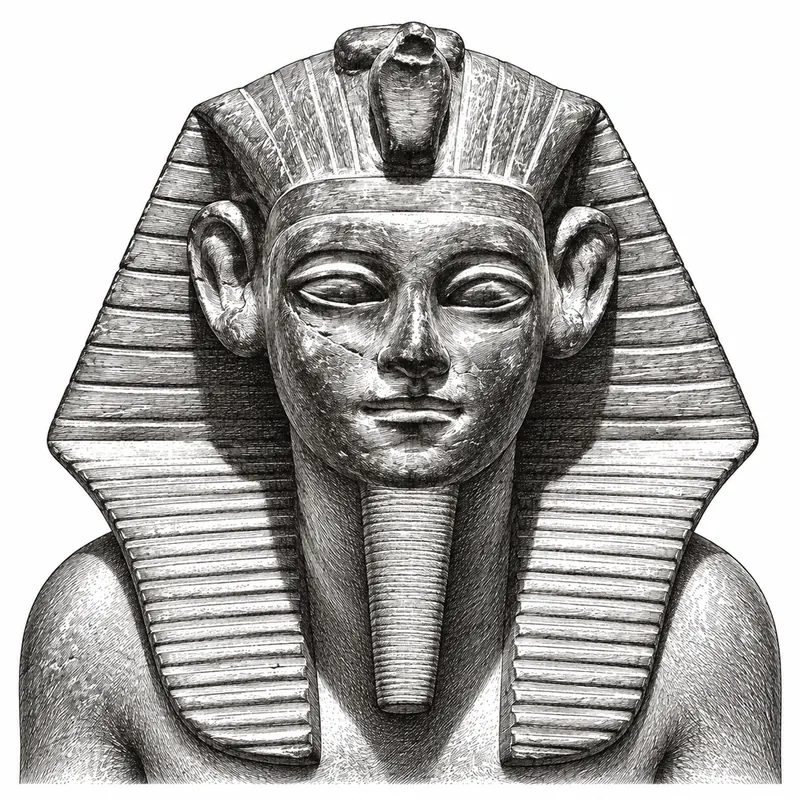
A ruler in the middle of a long dynasty
Neferhotep I, Khasekhemre in his throne titulary, belongs to the 13th Dynasty. His position in the king lists falls after Khendjer and before Sobekhotep IV, even though the details of the sequence vary between reconstructions. He is among the best-attested kings of this period, thanks to seals, stelae and other monuments. These documents give more purchase on his family and on practices of legitimation than those of many of his immediate predecessors. They do not, however, allow the reign to be turned into a continuous year-by-year narrative. Absolute dates remain approximate and should be presented as landmarks rather than as an established calendar. In the chronology of Ian Shaw (Oxford, 2000), his reign falls in the 13th Dynasty, between about 1773 and 1650 BC (Shaw does not date its kings one by one).
A family named on the seals
Scarabs bear the royal name of Neferhotep and mention his father Haankhef and his mother Kemi. Such a family reference is remarkable in a context where the later lists generally give only the names of kings. It allows the origin of power to be studied without assuming that every ruler of the 13th Dynasty descended directly from the previous one. These names prove neither the exact social rank of the parents nor all the details of the succession. Seals linked titulary, administration and the circulation of objects. Their spread helps to measure the king’s presence in official networks, but each example must be placed in its find context and dated with caution.
Abydos and the memory of Osiris
Neferhotep I is attested at Abydos, the great centre of the cult of Osiris (in French). A royal stela there sheds light on his relationship to the ceremonies and to the staging of power. In this town, displaying the ruler’s presence carried strong religious weight: the king presented himself as the guarantor of the rites and as heir to an already ancient tradition. Official inscriptions speak in a language of prestige; they are not neutral reports. Their interest is to show what the court wished to make visible and which places it considered important. The Abydos record points to a capacity for action beyond the royal residence, without allowing the full extent of the territory actually administered to be traced.
The representation of power
The titulary Khasekhemre and the name Neferhotep place the ruler within the classical language of kingship. Cartouches, statues and stelae created an official presence in sanctuaries and places of passage. This formal continuity does not mean that the political system was identical to that of the 12th Dynasty. The faster successions and the multiplication of rulers oblige us to consider a different balance between the court, senior officials and local elites. The material evidence shows that the pharaonic institution still functioned with its codes. It does not directly reveal the negotiations, resistance or financial means that sustained it day to day.
Attested contacts without an account of campaigns
The monuments of Neferhotep I found outside a single centre show a royal authority that could make itself felt in several regions. We must nevertheless avoid drawing too neat a political map from them. An object moves through trade, gift, reuse or collecting; its find-spot does not always correspond to a place where the king exercised direct control. No great military chronicle comparable to those of the New Kingdom recounts his external action. The right method is to list the attestations, distinguish the media, then formulate hypotheses in proportion to their solidity. This restraint does not weaken the subject: it shows how the history of a poorly documented period is built.
With Sihathor and Sobekhotep IV
The lists place Sihathor between Neferhotep I and Sobekhotep IV. The proximity of these names and the family data have led Egyptologists to study their links as a whole. The passage from one king to the next nevertheless remains difficult to reconstruct in its concrete circumstances. A king list records a succession, not the discussions or conflicts that accompanied it. Contemporary inscriptions sometimes allow us to go further, but they are scattered. Presenting Neferhotep as the anchor of a short dynastic sequence is therefore useful, provided that he is not credited without proof with all the decisions of his successor. His reign illustrates both the continuity of the state and the fragility of its documentation.
A key figure for understanding the period
The interest of Neferhotep I lies in the variety of his evidence. His seals give the names of his parents; the monumental inscriptions show the official practice of kingship; the lists insert him into a relative chronology. None of these groups tells the whole story on its own. Cross-checking them nevertheless allows a more precise portrait than for many kings of the 13th Dynasty. It becomes possible to describe a power concerned with family and religious legitimacy, active in the great cult centres, while leaving open the questions of the length of the reign and territorial control. It is this evidence, and not a legend of decline or greatness, that gives his reign its interest.
Main sources
- UCL Digital Egypt, kings of the Second Intermediate Period
- UCL Digital Egypt, scarabs bearing royal names
- UCL Digital Egypt, the Loyalist Teaching and the Abydos attestation
- Model for the line portrait: statue of Neferhotep I, Museo Civico Archeologico di Bologna, KS 1799.
- Reference photograph: Khruner, CC BY-SA 3.0.
Reference works
- Ian Shaw (ed.), The Oxford History of Ancient Egypt, Oxford, Oxford University Press, 2000, chronology pp. 479–483
- Aidan Dodson and Dyan Hilton, The Complete Royal Families of Ancient Egypt, London, Thames & Hudson, 2004