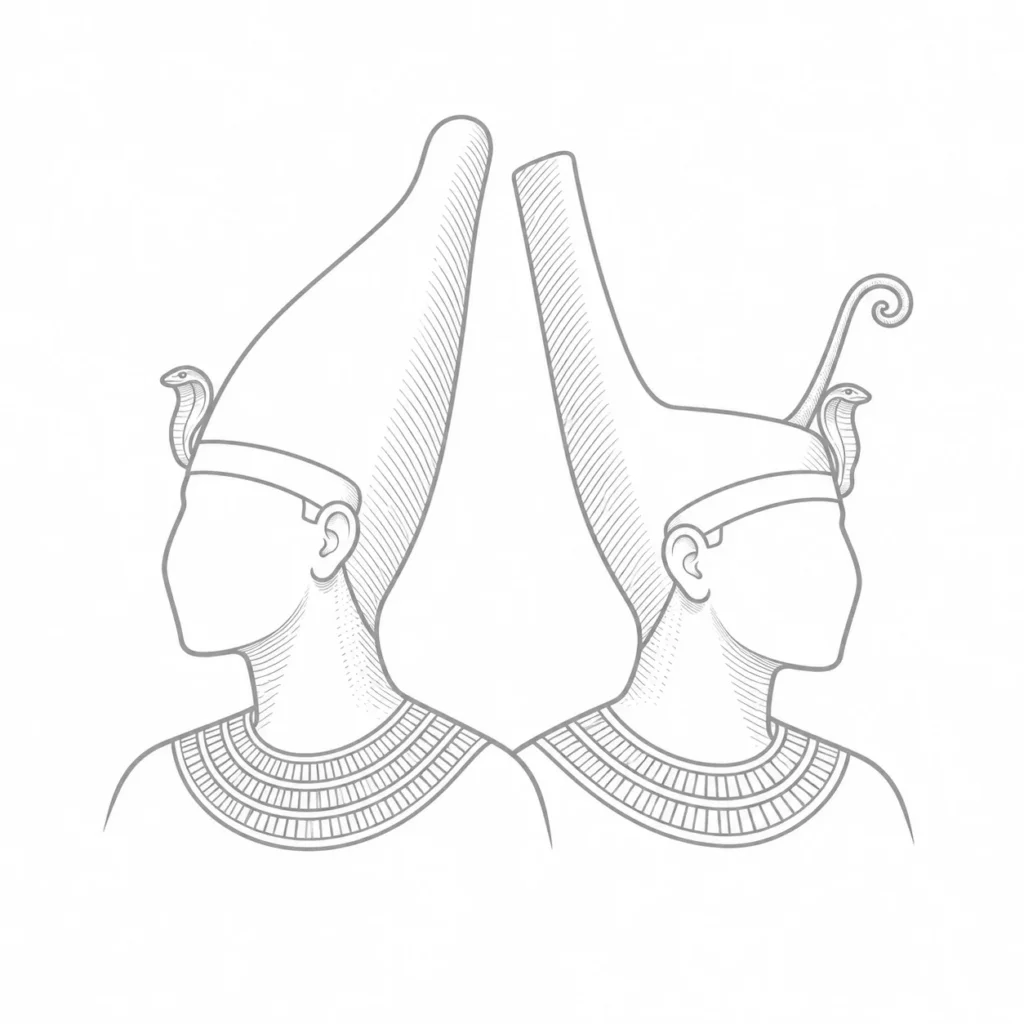
A king better documented than many of his neighbours
Sobekhotep IV, named Khaneferre in his throne cartouche, belongs to the 13th Dynasty. The lists place him after Neferhotep I and the short-lived Sihathor. The numbers added to the names of the Sobekhoteps are modern and vary in older publications; his double designation avoids confusion. His reign stands out for a body of statues, stelae and inscriptions richer than that of many rulers of the same period. This relative abundance makes it possible to describe the places where he was active and the way he represented kingship. It does not, however, provide a complete political diary. Absolute dates and some details of his family must remain subject to chronological discussion. In the chronology of Ian Shaw (Oxford, 2000), his reign falls in the 13th Dynasty, between about 1773 and 1650 BC (Shaw does not date its kings one by one).
A succession linked to Neferhotep I
The connections between the documents of Neferhotep I and those of Sobekhotep IV make their succession an important point for understanding the 13th Dynasty. The sources suggest a shared family milieu and a continuity of the royal circle, but they do not tell how the new ruler was chosen or what opposition he may have met. Between them, the lists record Sihathor, whose reign is very poorly known. Presenting Sobekhotep as a mere automatic heir would erase this uncertainty. Comparing the names of relatives, senior dignitaries and inscribed objects is more instructive. It shows how Egyptology reconstructs a political sequence from scattered clues, often published in different collections.
The monuments and the geography of the reign
Attestations of Sobekhotep IV are known in several parts of the Nile Valley. They indicate that the court could commission images and inscriptions beyond a single sanctuary. A royal name inscribed in a place proves an official presence, however, not necessarily a uniform day-to-day administration of the whole region. Statues may have been moved, sometimes much later. Places of production, deposition and discovery must therefore be distinguished. This work on provenance gives the monuments their value: they are not only portraits, but traces of relations between the court and the great religious centres. Their distribution allows the extent of power to be questioned concretely.
Legitimacy through titles and images
The titulary Khaneferre places Sobekhotep IV within the conventions of the pharaonic monarchy. His statues and reliefs present a ruler able to take on the ritual functions attached to the throne. The recurrence of these forms under the 13th Dynasty contradicts the idea that kingship simply disappeared after the 12th. Nor does it prove that political resources and stability were the same. Official images are a programme of representation; they express what the king wished to have recognised. Examining them with their inscriptions and find contexts makes it possible to understand their message. Using them as snapshots of a power without limits would, on the other hand, overstate the certainties.
The officials and the state
The seals and stelae of the period make known figures who spanned several reigns, notably between Neferhotep I and Sobekhotep IV. This administrative continuity counts as much as the change of name at the top of the state. It suggests that offices, titles and networks of service could survive despite rapid successions. But the presence of the same dignitary tells us neither the full range of his duties nor how decisions were made. Private documents, such as the stela of Rehuankh at Abydos, shed light on careers and affiliations in a different way from royal monuments. Together, they outline an active state, but one known in fragments.
A chronology to be handled with care
The 13th Dynasty has prompted several reconstructions, notably those of Jürgen von Beckerath and Kim Ryholt. They do not always give all the rulers the same order. In the case of Sobekhotep IV, his identity is secure, while the details of his placement and the precise length of his reign are less certain. Dates must therefore be accompanied by a margin of uncertainty. Comparisons with the discoveries at Tell el-Dab’a help to follow the transformations of the Delta, but they do not allow the history of Egypt to be reduced to a linear and uniform succession. A relative chronology based on names, styles and contexts is sometimes more reliable than a year presented without reservation.
A window on the 13th Dynasty
The monuments of Sobekhotep IV shed light on the continuity of institutions at a time when the king lists become particularly complex. His record links the succession, possible family ties, networks of officials and the ritual display of the monarchy. It shows that the term ‘intermediate period’ does not describe an absence of culture or power: for historians it designates a political configuration that was less stable and less well documented. The interest of this ruler is that he allows a precise examination of the evidence. The objects can be named, their places located and what they show explained, while the questions of length of reign and territorial control remain open.
Main sources
- UCL Digital Egypt, list of the kings of the Second Intermediate Period
- UCL Digital Egypt, comparisons of von Beckerath and Ryholt
- UCL Digital Egypt, the stela of Rehuankh and the Loyalist Teaching
- Crowns drawn from the statue of Senusret I and the relief of Ahmose, Metropolitan Museum of Art.
Reference works
- Ian Shaw (ed.), The Oxford History of Ancient Egypt, Oxford, Oxford University Press, 2000, chronology pp. 479–483
- Aidan Dodson and Dyan Hilton, The Complete Royal Families of Ancient Egypt, London, Thames & Hudson, 2004