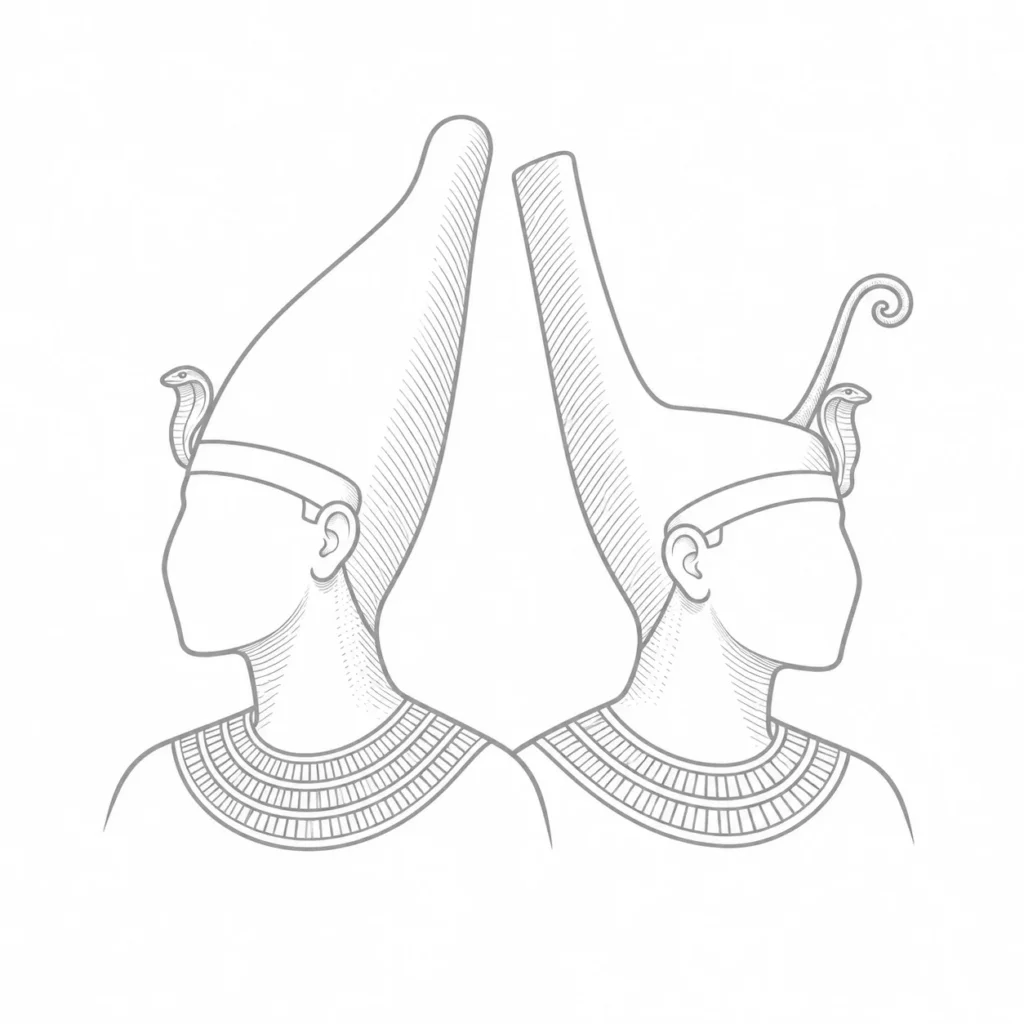
A king of the eastern Delta
Nehesy belongs to the 14th Dynasty, a line of kings who ruled the north-eastern Delta during the Second Intermediate Period, in parallel with the last kings of the 13th Dynasty. His birth name, Nehesy, means ‘the Nubian’. His throne name, Aasehre, means ‘Great is the counsel of Ra’. His reign was very short: the Turin royal papyrus gives him only a few months. He is nevertheless one of the few kings of this dynasty known both from the king lists and from inscribed objects of his own time, which makes him a valuable witness to a poorly documented region and period. In the chronology of Ian Shaw (Oxford, 2000), his reign falls in the 14th Dynasty, c. 1773–1650 BC (Shaw does not date its kings one by one).
Avaris, capital of a northern kingdom
The centre of power of the 14th Dynasty was Avaris, present-day Tell el-Dab’a, in the eastern Delta. Since the Middle Kingdom the town had housed a large population from the Levant, and its material culture mixes Egyptian and Near Eastern traditions. The Austrian excavations directed by Manfred Bietak uncovered, in a sacred area, two door blocks bearing the name of Nehesy. They come from a group of temples, some of which follow Near Eastern plans. These discoveries show that the king built in his capital, in a religious setting where several traditions met.
A Nubian name, a Levantine image
The name Nehesy is intriguing. In Egyptian it designates an inhabitant of Nubia, but it was also borne by Egyptians with no connection to the south. According to Manfred Bietak, the king had himself depicted with a tall pointed crown characteristic of the kings and gods of the Levant, and his mother bore a West Semitic name. Kim Ryholt has proposed other parentages, including a Nubian mother. These hypotheses do not agree with one another and rest on few documents. Above all, they are a reminder that the population of the eastern Delta was very mixed at this time.
The monuments of Tell el-Hebua
Most of Nehesy’s monuments come not from Avaris but from Tell el-Hebua, ancient Tjaru, a fortress guarding the road to Palestine on the eastern frontier. Stelae there bear his names. A fragment of an obelisk and other blocks found in the Delta link him with the god Seth (in French), a major deity of the region whom the Hyksos would honour in their turn. Scarab seals bearing his name have been found as far away as Nubia. Some specialists nevertheless wonder whether all these objects refer to the same person, since a prince of the same name is also known.
A fragile kingdom
The 14th Dynasty counts many kings, often short-lived. The Turin papyrus preserves a long list of them, but most are known only by name. This rapid succession suggests an unstable power. Manfred Bietak has proposed that these kings financed part of their trade with the Levantine city of Byblos by plundering tombs of the Memphite elite. The hypothesis is still debated. The excavations at Avaris show, at any rate, that a palace of this period ended in a fire, which suggests that the transition to the following dynasty was not peaceful.
Before the Hyksos
At Avaris, the 14th Dynasty preceded the 15th Dynasty, that of the Hyksos, which would extend its authority over a large part of Egypt. The two lines shared the same capital and the same cultural environment, but they are not to be confused. The exact chronology of their transition remains debated, as does the starting date of the 14th Dynasty itself. Depending on the reconstruction, Nehesy is placed in the 17th century or at the end of the 18th century BC. His reign thus sheds light on the period before foreign kings came to power in the Delta.
What this reign reveals
Nehesy reigned for only a few months, but he is one of the best-attested kings of an almost unknown dynasty. His monuments at Avaris and Tjaru show a kingship that kept Egyptian forms while belonging to a world turned towards the Levant. His name, his image and his family raise questions that the documents do not yet allow us to settle. His record illustrates the diversity of northern Egypt in the Second Intermediate Period, well before the Hyksos became its masters.
Main sources
- Manfred Bietak, King Nehesy at Avaris and the Looting of the Memphite Elite Necropoleis, Austrian Academy of Sciences
- Alexander Ilin-Tomich, ‘Second Intermediate Period’, UCLA Encyclopedia of Egyptology, 2016
- Crowns drawn from the statue of Senusret I and the relief of Ahmose, Metropolitan Museum of Art.
Reference works
- Ian Shaw (ed.), The Oxford History of Ancient Egypt, Oxford, Oxford University Press, 2000, chronology pp. 479–483
- Aidan Dodson and Dyan Hilton, The Complete Royal Families of Ancient Egypt, London, Thames & Hudson, 2004