A king in a succession difficult to establish
Khendjer, whose throne name is Userkare, belongs to the 13th Dynasty. He reigned after the great rulers of the 12th Dynasty, in a period when the king lists become long and reigns often short. The exact order of the rulers is debated, notably because the Turin royal papyrus is fragmentary. The lists compared by University College London nevertheless place Khendjer in a recognisable sequence, before the better-documented reigns of Neferhotep I and Sobekhotep IV. His personal biography remains almost unknown. His historical interest comes above all from his pyramid and from the inscriptions that firmly establish his existence, while showing the continuity of the royal forms of the Middle Kingdom. In the chronology of Ian Shaw (Oxford, 2000), his reign falls in the 13th Dynasty, between about 1773 and 1650 BC (Shaw does not date its kings one by one).
The pyramid at South Saqqara
Khendjer’s funerary complex lies at South Saqqara, in an area already occupied by several royal monuments. Its core was built of mud brick, with a stone casing that has now disappeared. This technique reveals a way of building different from the great stone pyramids of the Old Kingdom, but it does not justify speaking simply of a decline in architecture. The monument had the expected elements of a royal complex, including an enclosure, a chapel and underground structures. Their present state is the result of collapse, the removal of materials and excavation. The attribution to Khendjer rests on inscribed elements, which makes it a solid landmark among the tombs of the 13th Dynasty.
A named pyramidion
The pyramidion, the stone that crowned the pyramid, bears the titulary of Khendjer. This piece is essential: it links the king’s name to the architectural form and religious programme of the burial. The pyramidion tells us nothing directly about the events of the reign, but it confirms that the complex was conceived as a ruler’s monument. The mention of royal names in a funerary setting is also an assertion of continuity with the preceding dynasties. Epigraphic studies must check the reading of the signs and the history of their discovery. A displaced inscription might have been reused; here, the convergence of the pyramidion and the other remains makes the identification of the owner far more convincing.
The burial and the limits of the documentation
The excavations uncovered the internal arrangements of the complex, including the area of the burial chamber. Yet the presence of a pyramid does not in itself prove that the king’s body was placed and preserved there. Ancient intrusions and destruction have erased a large part of the evidence. Archaeologists therefore distinguish the funerary project, attested by the architecture, from the actual history of the burial, which is harder to establish. Khendjer’s tomb also shows the continuing place of Saqqara in royal geography at the beginning of the second millennium. It helps to compare the practices of the rulers of the 13th Dynasty with those of their predecessors without assuming perfect continuity.
Small objects and the spread of the name
A tile fragment bearing the name of Khendjer is kept in the Metropolitan Museum of Art. This type of object complements the monumental record by showing the circulation of a titulary on small media. The discovery or acquisition of an isolated piece is not, however, enough to reconstruct a building, a route or a building policy. The certain information, the inscribed name, must be separated from its geographical interpretation. Seals, architectural fragments and king lists are valuable precisely because they check one another. In a reign poor in narratives, each of these witnesses carries disproportionate weight. Reading them cautiously avoids inventing an administration or a military campaign of which no contemporary source speaks.
The political context of the 13th Dynasty
The 13th Dynasty succeeded the powerful state of the 12th, but its many rulers do not necessarily form a series of identical crises. Certain institutions, writing practices and religious forms continued. The case of Khendjer, able to launch a royal pyramid complex, is a reminder that a short reign or an uncertain list does not automatically mean an absence of resources. We do not know, however, what revenues were mobilised, how many workers were employed or the exact extent of his authority. The available documentation describes the funerary project better than the workings of the state. This imbalance explains why the king’s political history must remain sober and his archaeological history more developed.
What Khendjer helps us understand
The pyramid of Khendjer offers a concrete point of reference for a dynasty often reduced to a succession of names. His record combines an approximate position in the lists, a titulary and an identifiable monument. It also shows the difference between a reconstructed regnal date, always open to revision, and the material existence of a funerary complex. The visitor can thus follow a historical question: how do we write the reign of a ruler whose buildings survive better than his decisions? The answer lies in comparing inscriptions, architecture and chronologies, with explicit room given to the gaps. This is an educational value as important as the pyramid itself.
Main sources
- UCL Digital Egypt, kings of the Second Intermediate Period
- UCL Digital Egypt, owners of the pyramids
- Metropolitan Museum of Art, fragment bearing the name of Khendjer
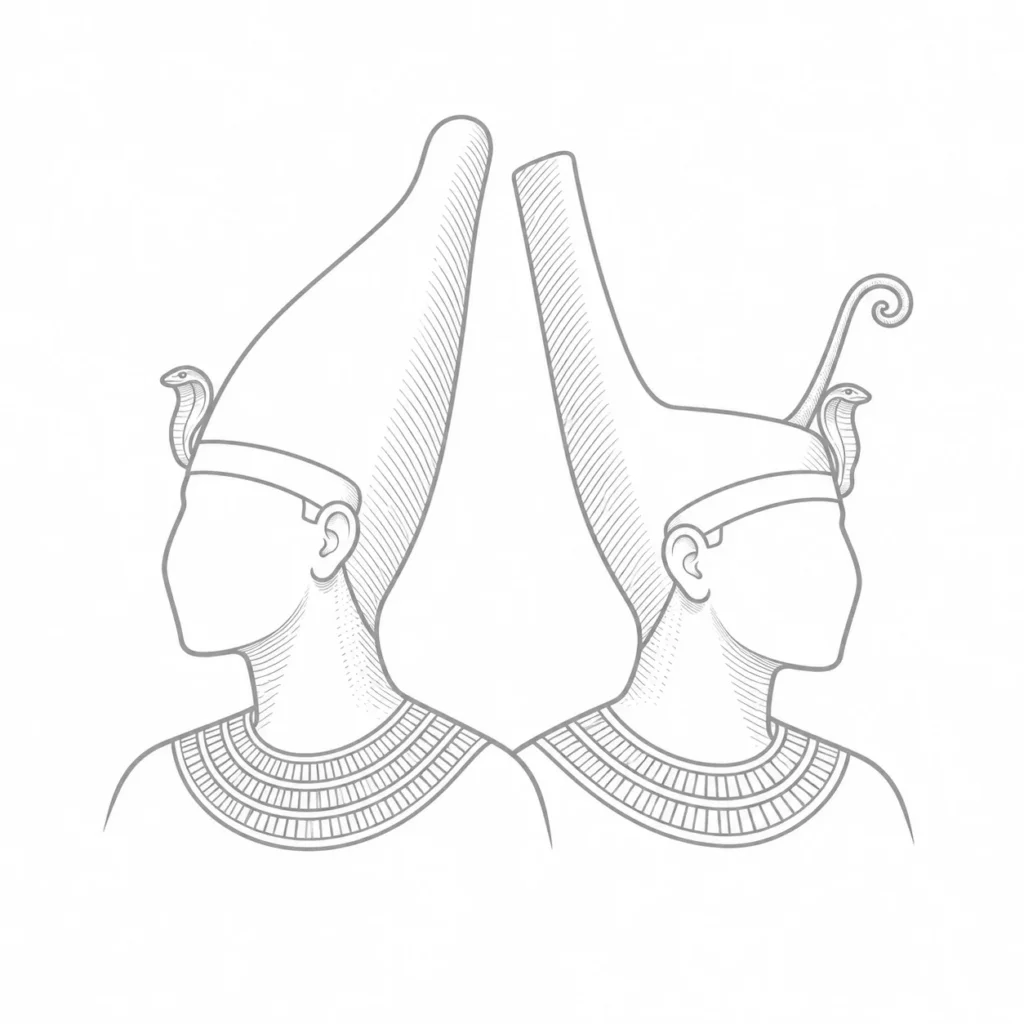
- Crowns drawn from the statue of Senusret I and the relief of Ahmose, Metropolitan Museum of Art.
Reference works
- Ian Shaw (ed.), The Oxford History of Ancient Egypt, Oxford, Oxford University Press, 2000, chronology pp. 479–483
- Aidan Dodson and Dyan Hilton, The Complete Royal Families of Ancient Egypt, London, Thames & Hudson, 2004