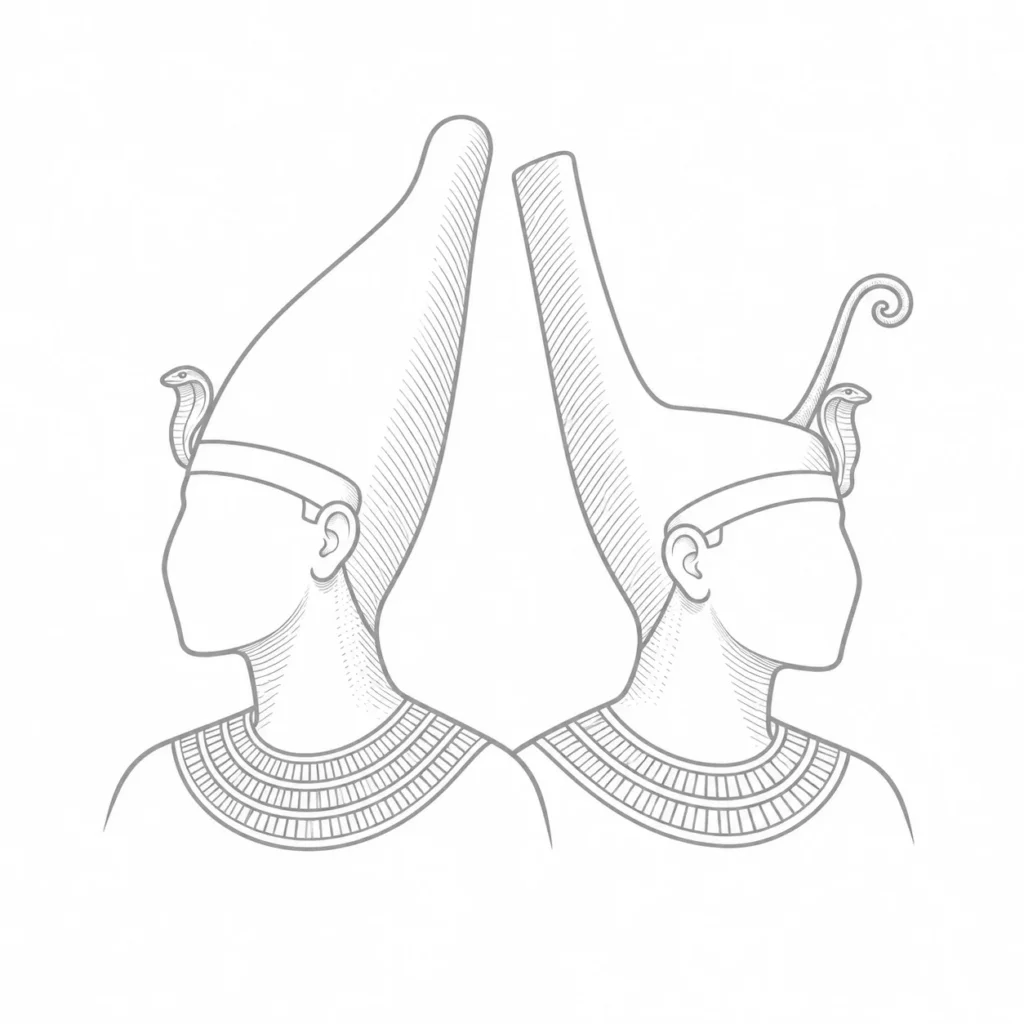
A king between Seqenenre and Ahmose
Kamose is generally presented as the last king of the Theban 17th Dynasty. He reigned before Ahmose I, who would complete the conquest of the Delta and inaugurate the 18th Dynasty. His rule seems to have been short, but the exact dates vary between chronologies. The inscriptions of Kamose make his reign particularly visible: they set out the campaigns undertaken against the Hyksos power of Avaris and build the image of a ruler determined to restore unity. These texts are valuable contemporary documents, but also victory discourses. They therefore tell us both about the operations described and about the way the Theban court wished to present them to its subjects and to the gods. In the chronology of Ian Shaw (Oxford, 2000), his reign falls c. 1555–1550 BC.
The first stela and the decision to fight
In the tradition preserved by the texts of Kamose, the king opposes a situation in which several powers share the Nile Valley. His counsellors are portrayed as more cautious than he is. This composition gives a central role to royal initiative and prepares the account of a necessary war. The stela allows us to grasp the political arguments of Thebes, namely that the presence of Avaris to the north and of a Nubian power to the south made Theban authority incomplete. We should not believe that the reported speeches are words recorded verbatim. Their literary form serves to make the decision legitimate and memorable. It nevertheless remains direct evidence of the reign’s propaganda.
The campaign to the north
The inscriptions describe the advance of the Theban troops towards positions controlled by or linked to the Hyksos. They mention captures, destruction and booty. The account shows that the war was also a logistical operation: men, boats, provisions and messages had to be moved along the Nile. The place names help to follow the progress, but the destruction announced may be amplified by the conventions of royal victory. Archaeologists therefore compare the text with the sites and the material traces, without assuming that each formula corresponds to a complete siege. Kamose nevertheless changed the balance of power and carried the war close to the enemy capital.
The second stela and the message of Apophis
The second stela of Kamose, found at Karnak and now in the Luxor Museum, mentions a message from Apophis to the king of Kush. According to the Theban account, this letter was intercepted. The episode reveals the strategic importance of a possible coordination between Avaris and the Nubian south, which would have encircled Thebes. It also bears witness to Kamose’s skill in staging his success: the king claims to understand and thwart his adversaries’ plans. The existence of a message in the stela is a textual fact; the precise conditions in which it was sent and the full intentions of the correspondents are harder to verify. This distinction makes the episode fascinating without turning it into an absolute certainty.
Karnak, a place of memory
Setting up a stela in the temple of Amun (in French) at Karnak placed the campaign within the major religious space of Thebes. The victory was not only presented to contemporaries; it was meant to survive in the memory of the sanctuary. The discovery, reuse and preservation of the fragments show the long material history of the text. Digital Karnak makes it possible to follow the monument and its present location. The choice of Karnak associated military action with divine protection and the legitimacy of the dynasty. It explains why these inscriptions have carried considerable weight in modern accounts. Their value does not, however, cancel out that of the archaeological data from Avaris, which document the society that Kamose fought.
An unfinished victory
Kamose did not single-handedly achieve the lasting reunification of Egypt. The campaigns of Ahmose I, known notably from the biographies of soldiers, continued the struggle and led to the capture of Avaris. The death of Kamose and the passing of power to his successor remain poorly documented. We should therefore speak of a decisive offensive stage, not of an immediate end of the Hyksos. The distinction matters for understanding the long time-scale of the political transformation: a proclamation of victory does not mean that all the territories had changed hands. The stelae show Theban strategy and ambition; the following events show that a war once begun still had to be carried through.
The reign and its legacy
Kamose holds a strong place in Egyptian history because his own inscriptions recount a war plan with a precision unusual for the Second Intermediate Period. They allow us to study frontiers, royal discourse, diplomatic communication and the place of Karnak. They also call for a critical reading of the figures and triumphal formulas. Kamose thus emerges as a king who took verifiable initiatives, beyond his rhetoric. His legacy lies both in the military change he set in motion and in the model of political narrative handed down to the following dynasty. The reunification would be that of Ahmose, but the stela of Kamose is an indispensable source for it.
Main sources
- Digital Karnak, victory stela of Kamose
- University of Chicago, presentation of the sources of Kamose and Apophis
- UCL Digital Egypt, sites of the end of the 17th Dynasty
- Crowns drawn from the statue of Senusret I and the relief of Ahmose, Metropolitan Museum of Art.
Reference works
- Ian Shaw (ed.), The Oxford History of Ancient Egypt, Oxford, Oxford University Press, 2000, chronology pp. 479–483
- Aidan Dodson and Dyan Hilton, The Complete Royal Families of Ancient Egypt, London, Thames & Hudson, 2004