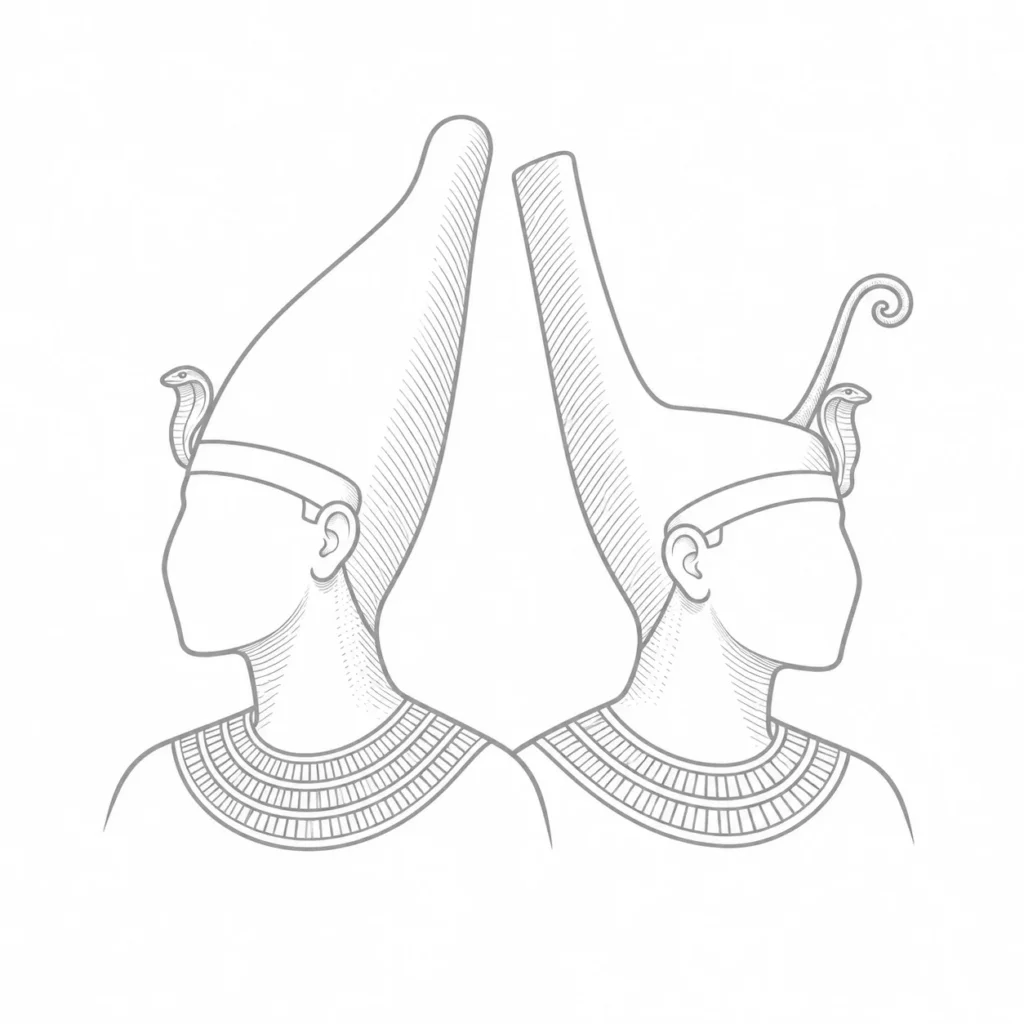
A king of Thebes in a divided Egypt
Seqenenre Tao belongs to the Theban 17th Dynasty, at the end of the Second Intermediate Period. The north of the country was then dominated by the Hyksos kings of Avaris, while the south had its own rulers and maintained complex relations with Nubia. The details of Tao’s reign remain patchy. His name is associated above all with the intensification of the conflict that preceded the campaigns of Kamose and the reunification under Ahmose I. It would be unwarranted to credit him, on the basis of this dynastic sequence alone, with all the first military operations against the Delta. His interest lies in the rare convergence of a historical tradition, family ties and the direct study of his mummy. In the chronology of Ian Shaw (Oxford, 2000), his reign falls c. 1560 BC (Tao II).
The family that carried the reunification
The Theban court of this period was marked by important female figures, notably Ahhotep and Ahmose-Nefertari, and by the generation that led the struggle against Avaris. The exact genealogical relationships are not always as simple as modern family trees suggest. Seqenenre’s reign nevertheless lies at the heart of this Theban continuity. The titles of the queens, the names of their children and later commemorations show that this was not merely a succession of war leaders. A dynasty was seeking recognition of its religious and political legitimacy. Ahhotep’s place in the accounts of the transition is a reminder that the stability of the court also depended on actors other than the king.
A mummy with violent wounds
The mummy attributed to Seqenenre has severe head injuries. A CT study published in 2021 analysed the fractures and proposed a scenario of violent death, possibly in captivity or in battle. The researchers link some of the wounds with weapons known from the period. This medical investigation provides information that the texts do not give: the nature of the trauma and the state of the body before embalming. It cannot, however, identify with certainty the attackers, the place of the event or the political motives. Moving from anatomical observation to a precise battle scene would be a reconstruction. The mummy sheds light on the physical risk run by the ruler, while leaving the final circumstances open.
Later accounts and the caution they require
Literary traditions refer to tensions between a king of Avaris and the Theban ruler. They are useful for understanding how the Egyptians later pictured the conflict, but their date and genre rule out reading them as an official record of Seqenenre. The famous story of the hippopotamuses, for example, is a narrative device. The stelae of Kamose, closer to the events that followed, clearly show the Theban offensive project, without recounting Tao’s reign in detail. These sources must be combined according to their nature: dynastic memory, royal propaganda and bodily remains. This distinction makes it possible to write a solid history without reducing a real king to a repeated anecdote.
Thebes, the residences and power
Excavations at Deir el-Ballas and in the Theban region reveal installations from the end of the 17th and the beginning of the 18th Dynasty. They may be linked to the political milieu in which Seqenenre, Kamose and Ahmose moved. Attributing a particular building to a specific reign nevertheless requires stratigraphic or inscribed evidence. The landscape shows a court able to organise works, house groups and maintain military and economic networks. These data complement the dramatic picture given by the mummy. Even when faced with war, Theban kingship had to administer, build and produce the signs of its legitimacy.
A transition without a single date
There is no known day on which Egypt passed from division to unity. The reign of Seqenenre precedes a series of actions led by Kamose and then Ahmose. Territories, alliances and balances of power changed in stages. The king’s violent death has sometimes served as a simple starting point for a patriotic story of liberation. This reading gives his figure a strong meaning, but it goes beyond what the sources demonstrate. The relative chronology is more secure: Tao belongs to the Theban generation preceding the decisive offensives. Understanding his place means following the continuities of the court and the limits of what is known of his personal activity.
A reign at the crossroads of methods
The record of Seqenenre Tao brings together forms of evidence rarely so different: royal names, a dynastic position, written traditions and a body studied by medical imaging. Each category answers distinct questions. CT scanning establishes injuries, not the name of an enemy; the narratives give a memory of the conflict, not the date of death; regional archaeology locates a court, not all its decisions. Comparing them allows a rigorous portrait of a ruler engaged in a time of rivalry. It shows how a historical enquiry can recognise a violent event without fabricating a definitive scene.
Main sources
- Frontiers in Medicine, CT study of the mummy of Seqenenre
- UCL Digital Egypt, index of archaeological sites and Deir el-Ballas
- UCL Digital Egypt, Ahmose-Nefertari and the Theban family
- Digital Karnak, victory stela of Kamose
- Crowns drawn from the statue of Senusret I and the relief of Ahmose, Metropolitan Museum of Art.
Reference works
- Ian Shaw (ed.), The Oxford History of Ancient Egypt, Oxford, Oxford University Press, 2000, chronology pp. 479–483
- Aidan Dodson and Dyan Hilton, The Complete Royal Families of Ancient Egypt, London, Thames & Hudson, 2004