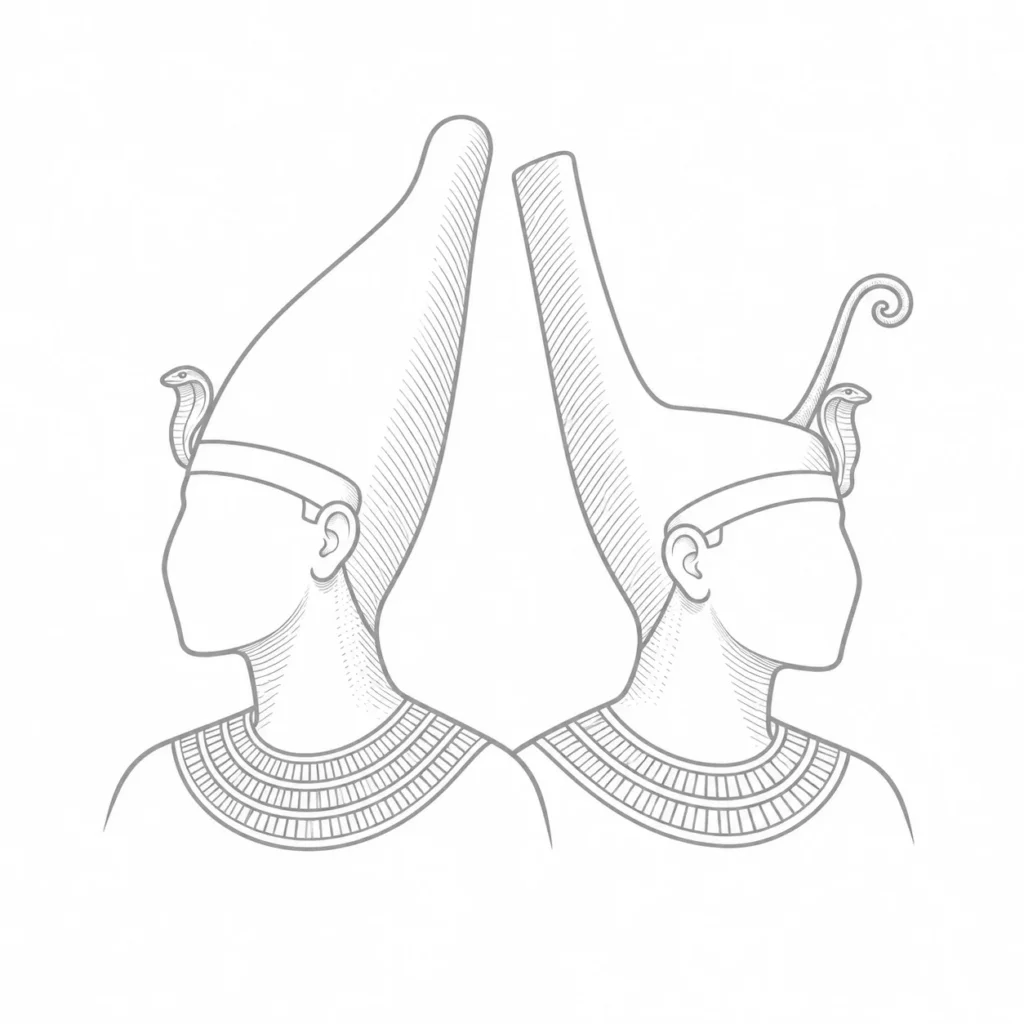
A king of the 15th Dynasty
Khayan is one of the Hyksos rulers of the 15th Dynasty, established in the eastern Delta during the Second Intermediate Period. His name appears on seals and objects found in Egypt and beyond, but the exact length of his reign and his place in some reconstructions remain debated. The term ‘Hyksos’ comes from an Egyptian title meaning rulers of foreign lands; on its own, it does not designate a homogeneous ethnic group. Khayan ruled within a society where Egyptian and Near Eastern traditions existed side by side. The excavations at Tell el-Dab’a, identified with ancient Avaris, give his record an archaeological depth that is exceptional for this period. In the chronology of Ian Shaw (Oxford, 2000), his reign falls c. 1600 BC.
Avaris, a capital in the Delta
Tell el-Dab’a reveals districts, tombs, official buildings and places of worship over a long period. The town was a crossroads between the Nile Valley and the eastern Mediterranean. The history of Khayan belongs there, but not all the levels of the site date from his reign. The excavators use stratigraphy, pottery and seal impressions to link certain groups with the king. This method avoids attributing the whole life of the capital to a single ruler. It also shows that Hyksos rule cannot be described solely from the texts of their Theban adversaries. Archaeology restores institutions, food practices and ritual spaces.
The palace associated with Khayan
The Austrian Academy of Sciences is studying, in area F/II at Tell el-Dab’a, a large palatial complex associated with Khayan by seal impressions. A vast deposit of pottery and remains linked to ritual meals was discovered there. These materials give access to court activities that the king lists ignore. A distinction must nevertheless be drawn between the existence of impressions bearing the ruler’s name and the date of construction of the palace: the building may have functioned before and after him. The study of the pits, the vessels and the internal circulation seeks to clarify how gatherings were organised. The royal name thus becomes a reference point for a social enquiry, not a mere label for a monument.
Seals and administration
A scarab in the British Museum bears the throne name of Khayan. The impressions found at Avaris also indicate the use of seals in the management of goods and spaces. These small objects had a practical function: to mark, close or authenticate. Their historical value depends on the precise context and on the people who handled them. An impression in a palace shows a relationship with the royal administration; a scarab kept without secure archaeological provenance does not define a political frontier. The multiplication of media nevertheless attests that Khayan mastered the language of Egyptian kingship, notably the cartouche, and that he had channels able to spread his name.
A society of mixed traditions
Research at Avaris emphasises the composite character of the population and of religious practices. Temples and objects show links with several traditions, without any need to divide the inhabitants mechanically into ‘Egyptians’ and ‘foreigners’. Khayan adopted pharaonic signs, while the capital retained customs peculiar to the eastern Delta. This situation is not an anomaly: Egypt had long traded with the Levant. The excavations allow these contacts to be followed in houses, burials and pottery. They invite us to understand the reign as a political experiment rooted in a particular town, rather than as a mere interlude before the Theban reconquest.
The question of the extent of power
We do not know how far Khayan’s authority was exercised directly. The spread of objects bearing his name is often cited to suggest distant contacts, but a portable object travels more easily than an administration. The kings of the 15th Dynasty controlled the Delta and maintained complex relations with other powers in the valley, including those of Thebes. The map changed over time; that of Khayan’s reign cannot be fixed by a few isolated finds. Analysis of the deposits at Avaris provides a more solid anchor. It allows a court, rites and activities of redistribution to be described, without crediting them with an unverifiable continental domination.
Why this reign matters
Khayan allows us to look at the Hyksos other than through the story of their expulsion. His name is linked to an excavated palatial complex, to seal impressions and to museum objects. This evidence shows a kingship that presented itself in Egyptian forms while governing a society open to the eastern Mediterranean. The uncertainties about the succession and dates must be pointed out, but they do not diminish the contribution of fieldwork. Pottery, buildings and inscriptions complement one another. Together they give a more precise picture of the Delta in the 16th century BC than the old formulas simply opposing invaders and liberators.
Main sources
- Austrian Academy of Sciences, the palace of Khayan and deposit L81 at Tell el-Dab’a
- Austrian Academy of Sciences, temples and practices at Tell el-Dab’a
- British Museum, scarab bearing the name of Khayan
- Crowns drawn from the statue of Senusret I and the relief of Ahmose, Metropolitan Museum of Art.
Reference works
- Ian Shaw (ed.), The Oxford History of Ancient Egypt, Oxford, Oxford University Press, 2000, chronology pp. 479–483
- Aidan Dodson and Dyan Hilton, The Complete Royal Families of Ancient Egypt, London, Thames & Hudson, 2004