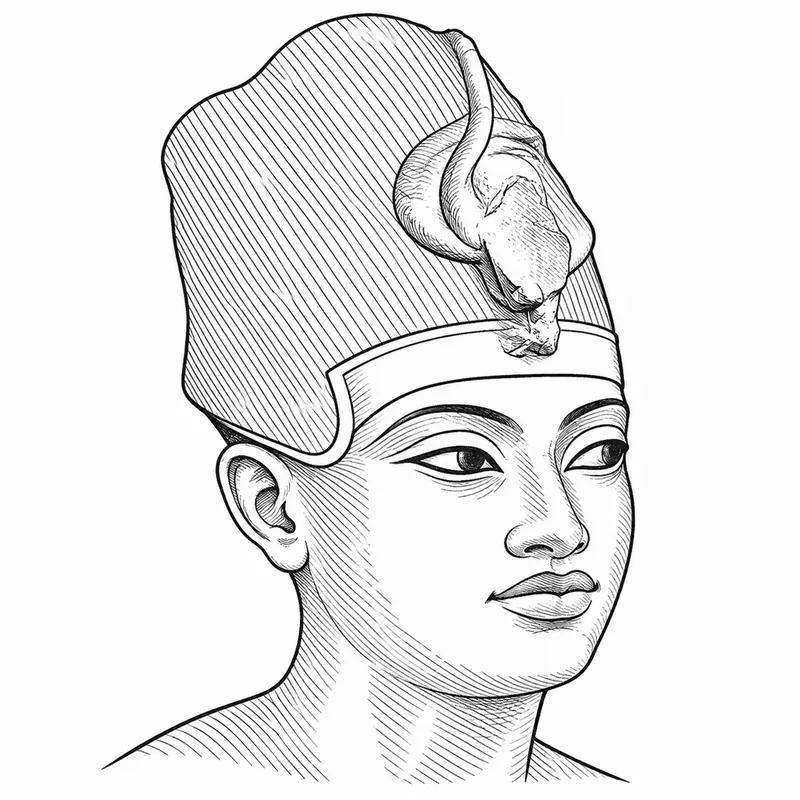
A long reign at the height of the 18th Dynasty
Amenhotep III, Nebmaatre, reigned for nearly forty years in the 14th century BC. UCL Digital Egypt places his rule c. 1388–1351 or 1350 BC, depending on the chronology adopted. Egypt then had a vast network of relations in Nubia and the Near East. The reign is exceptionally well documented by temples, statues, inscribed scarabs, the tombs of dignitaries and diplomatic letters. This richness makes it possible to go beyond the vague image of a golden age. It reveals the choices of a court that invested in the representation of the king, festivals, religion and diplomacy. The precise dates remain debated, but the relative length of the reign is far more secure than for several earlier dynasties.
Tiye and the royal court
The great royal wife Tiye holds a particularly visible place on the monuments of Amenhotep III. Commemorative scarabs name the queen and relate events linked to the court. This visibility does not give access to all her personal decisions, but it shows that the royal couple was part of the official message. Marriage alliances, descent and representations of the queen served to stabilise a powerful dynasty. The Amarna letters reveal a diplomacy between sovereign courts in which the women of the royal family are also mentioned. Tiye should not therefore be reduced to a portrait beside the king. Her presence helps us understand the relationships between power, family and international representation.
Luxor and the Colossi of Memnon
Amenhotep III built or transformed several sanctuaries, including the temple of Luxor. On the west bank of Thebes, his vast mortuary temple was fronted by two colossal statues now called the Colossi of Memnon. These figures are the most visible elements of a complex that is largely ruined and was reused. Excavation of the blocks and foundations is gradually allowing its scale to be reconstructed. The temple combined the cult of the living and deceased ruler with that of the gods. The colossi are therefore not isolated monuments set in the desert: they marked the entrance to a major religious and political programme. Their present state also reflects two millennia of destruction and interpretation.
Malqata, a town of festivals
At Malqata, near Thebes, the court laid out a palace complex and a town linked to the celebrations of the reign. The excavations of the Metropolitan Museum of Art are studying the mud-brick buildings, the workshops and thousands of potsherds there. Jar labels help to date the activities and to follow the supply of the court. Malqata shows another face of power, less visible than the stone statues: feeding the participants, organising festivals and managing temporary or permanent spaces. The king’s jubilee festivals required considerable mobilisation. The remains of the site allow the ideology of royal regeneration to be set within material acts, from construction to meals.
Scarabs and the messages of the reign
Amenhotep III had scarabs bearing long commemorative inscriptions distributed. Some mention Queen Tiye, others hunts or court events. These objects were small enough to circulate, but their text turned a chosen piece of information into a repeatable official message. They are not neutral news bulletins. The king appears in them according to themes of prestige, strength and prosperity. Comparing them with the reliefs and the letters makes it possible to distinguish internal propaganda, diplomatic relations and daily practice. The distribution of these scarabs is in itself a political fact: the royal name and its claimed successes entered networks far wider than the walls of the temples.
The Amarna diplomacy
The correspondence found at Amarna, the capital of his successor Akhenaten, includes letters that bear witness to relations between Amenhotep III and other rulers. The exchanges concern gifts, marriages, reciprocal obligations and the status of kings. They show a foreign policy that cannot be reduced to military campaigns. The letters are written according to the diplomatic conventions of the Near East and must be placed in their context. They do not reveal all the decisions of the Egyptian palace, but they let us hear the expectations of its partners. The reign of Amenhotep III thus emerges as a moment of active regional balance, maintained through negotiation and prestige goods.
A legacy to be examined without shortcuts
Amenhotep III was the father of Akhenaten, but his whole reign should not be read as a mere prelude to the Amarna reform. His temples, his palace, his festivals and his diplomacy have their own logic. The question of a possible co-regency with his son remains debated and must be presented as such. His record reveals a ruler who took the staging of kingship very far and invested massively in the sacred landscapes of Thebes. These choices are linked to the resources of the state and to international exchanges, while the surviving monuments must be distinguished from the vanished buildings. It is this diversity, more than an image of luxury, that makes the reign a major landmark.
Main sources
- UCL Digital Egypt, Amenhotep III and his monuments
- Metropolitan Museum of Art, excavations at Malqata
- UCL Digital Egypt, cuneiform tablets from Amarna
- Model for the line portrait: head of Amenhotep III wearing the blue crown, Metropolitan Museum of Art, 56.138.
Reference works
- Ian Shaw (ed.), The Oxford History of Ancient Egypt, Oxford, Oxford University Press, 2000, chronology pp. 479–483
- Aidan Dodson and Dyan Hilton, The Complete Royal Families of Ancient Egypt, London, Thames & Hudson, 2004