A reign at the beginning of the 6th Dynasty
Userkare takes his place between Teti and Pepi I in the royal succession. This position is secured by the Abydos List, drawn up much later under the 19th Dynasty, and supported by the annals of the 6th Dynasty discovered at South Saqqara. The documentation does not allow his reign to be described in the detail available for Pepi I. It is enough, however, to establish that he was recognised as king. Reconstructions that make him a usurper or the protagonist of a dynastic crisis remain hypotheses.
Why a funerary complex is expected
The rulers of the Old Kingdom had a complex built combining a pyramid, a mortuary temple, a causeway and cult installations. Even a short reign could leave a building site, a modified project or a monument taken over by a successor. Finding Userkare’s would fix a major point in the topography of Saqqara and help us better understand the transition between Teti and Pepi I. But the present absence of an identified monument proves neither its total destruction nor its location at Tabbet al-Guesh.
Vassil Dobrev’s reasoning
The research carried out at Tabbet al-Guesh starts from the funerary landscape. The tombs of priests and cult officials may cluster around a royal centre to which their offices were linked. If a coherent funerary community is found without a visible central monument, it becomes legitimate to look for this centre beneath the layers of sand and the later buildings. This method has a strength: it starts from human networks. It also has a limit: priests could serve several cults, and necropolises could evolve over generations.
The first geophysical campaign
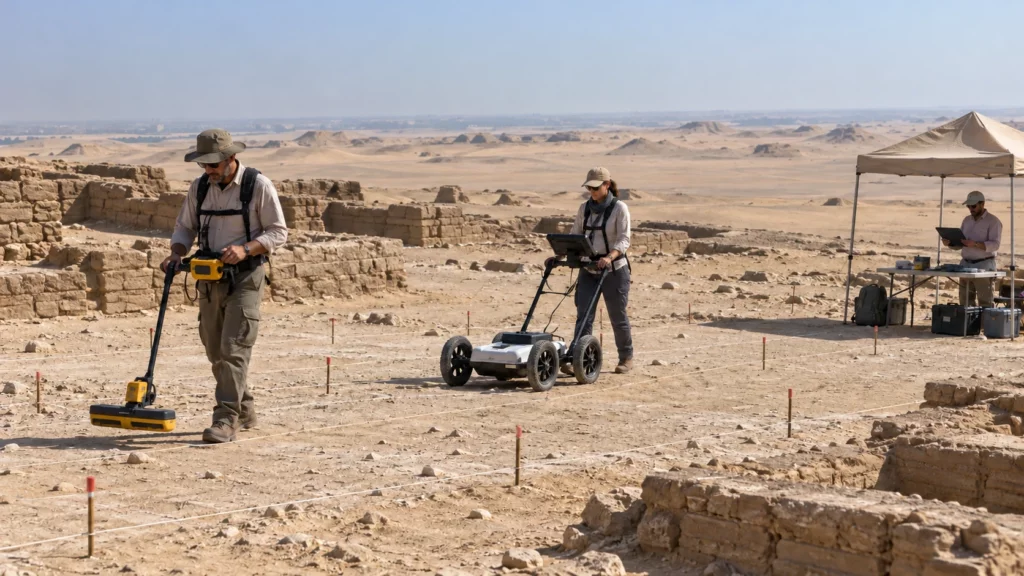
In 2013, the team combined electromagnetic induction, ground-penetrating radar and magnetic measurements with the explicit aim of detecting possible pyramid foundations. The study published in 2021 is unambiguous about this result: no solid material evidence of such foundations was found. The conductivity contrasts observed nevertheless showed that the method could distinguish certain materials and that a finer survey was worth attempting.
The anomalies of 2015
The new campaign used a tighter spatial resolution and a depth of investigation of less than two metres. The maps revealed several structured rectangular forms, one of about 80 square metres and another with an orthogonal organisation in small squares. The authors consider that these are probably man-made structures comparable to the neighbouring tombs. These anomalies are good candidates for guiding excavation; they have no inscriptions, no demonstrated royal plan and no attribution to Userkare.
What would constitute proof
To identify a complex of Userkare, the evidence would have to converge on diagnostic elements: royal architecture, fragments inscribed with the king’s name, seals, foundation vessels, titles of priests explicitly linked to his cult or a compatible monumental layout. A geophysical form, however spectacular, remains a physical signal. Excavation must then establish its nature, date and function. This chain of proof protects history against announcement effects.
An investigation still open
The aim presented by the IFAO for the Tabbet al-Guesh operation was to provide archaeological proof of the existence of the complex of at least one of the missing kings of the 6th Dynasty. The wording matters: it does not presuppose which one, or even that the complex lies within the area already excavated. Userkare remains the most evocative candidate, because his reign occupies a real but brief place in the sources. The site offers reasons to search; it does not yet allow a discovery to be announced.