The discovery of 2015
The two complexes were uncovered a few days apart: the tomb of Sabi on 19 February 2015, that of Ankhti on 1 March. They belong to the Tb NW sector of Tabbet al-Guesh. The publication by Vassil Dobrev, Diane Laville and Olivier Onézime describes mudbrick structures associated with several shafts, then burial chambers fitted out in limestone. This proximity does not erase the differences of plan and deposit; rather, it reveals a coherent funerary quarter of the second half of the 6th Dynasty.
Mudbrick superstructures
The visible part organised the cult and marked the tomb in the landscape. Mudbrick made it possible to raise walls and masses quickly, but it withstands erosion poorly once exposed. The archaeologists must therefore record the courses, repairs and circulation before the monument deteriorates. The burial shafts descended to protected chambers underground; several were later reused for other burials, which transformed the tomb without entirely erasing its original state.
Painted chambers
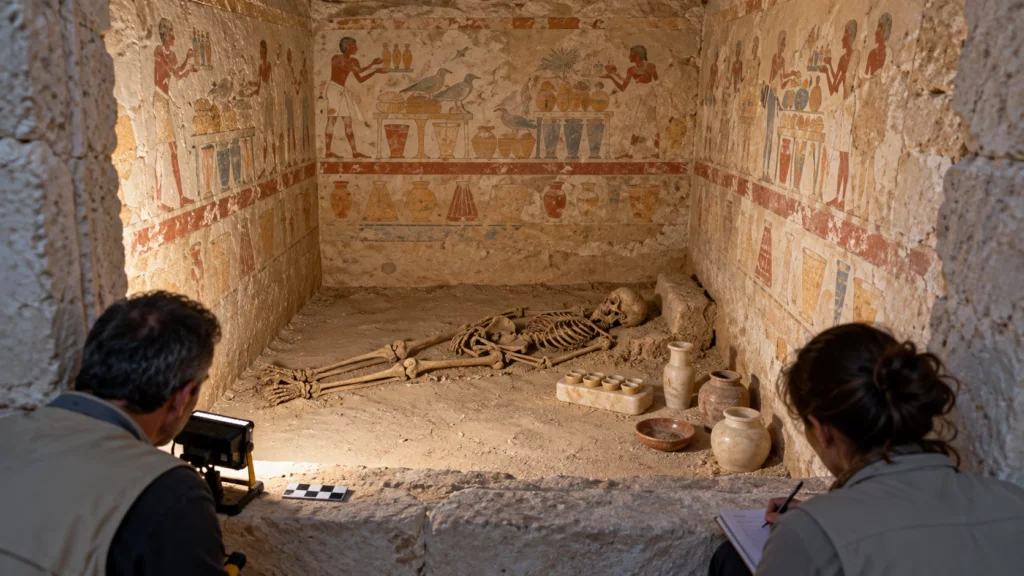
The limestone walls bear offering scenes whose preservation struck the excavators. They use the visual language of the Old Kingdom: food, vessels and objects are ordered to guarantee an ideal provision for the deceased. The images do not simply describe a real meal. They act as a lasting programme, supported by the inscriptions and by the gestures performed in the chapel. Their study tells us about beliefs, workshops and the owner’s choices.
The seven oils and the Opening of the Mouth
The alabaster tablet of the seven oils is one of the most telling objects. Its cavities symbolically received the unguents essential for purification and rebirth. The equipment also included pieces associated with the Opening of the Mouth ritual, a ceremony intended to restore the use of the senses to the deceased. These miniature objects are not mere scale models: they condense a set of ritual actions and make them available for ever in the chamber.
Bodies, objects and context
The skeletons, vessels and objects must be studied as an organised deposit. Their position may indicate what belongs to the original burial and what comes from an intrusion or a reuse. Ancient robbery disturbed some parts, while other spaces remained better protected. This combination explains why a tomb can be called ‘intact’ for a particular chamber or deposit without the whole monument having escaped every opening.
Two ritual professionals
Sabi and Ankhti bore the title of lector priest under Pepi II. In ceremonies, the lector pronounced the texts that accompanied the gestures. This skill established a link between writing, voice and ritual efficacy. Their own funerary equipment shows the same logic: the painted words, the depicted offerings and the instruments of ritual were to go on acting after the tomb was closed. The office held in their lifetime thus becomes a key to reading their burial.
A major piece of the Dobrev file
With Sabi and Ankhti, the series has a solid foundation: names, titles, date, architecture, decoration and equipment are brought together in an accessible publication. These tombs show concretely why the presence of priests is of interest to the search for a larger cult centre. They do not on their own prove the existence of the pyramid of Userkare, but they attest an active religious landscape at the end of the Old Kingdom. Their strength lies precisely in providing facts before hypotheses.