The portrait and the façade
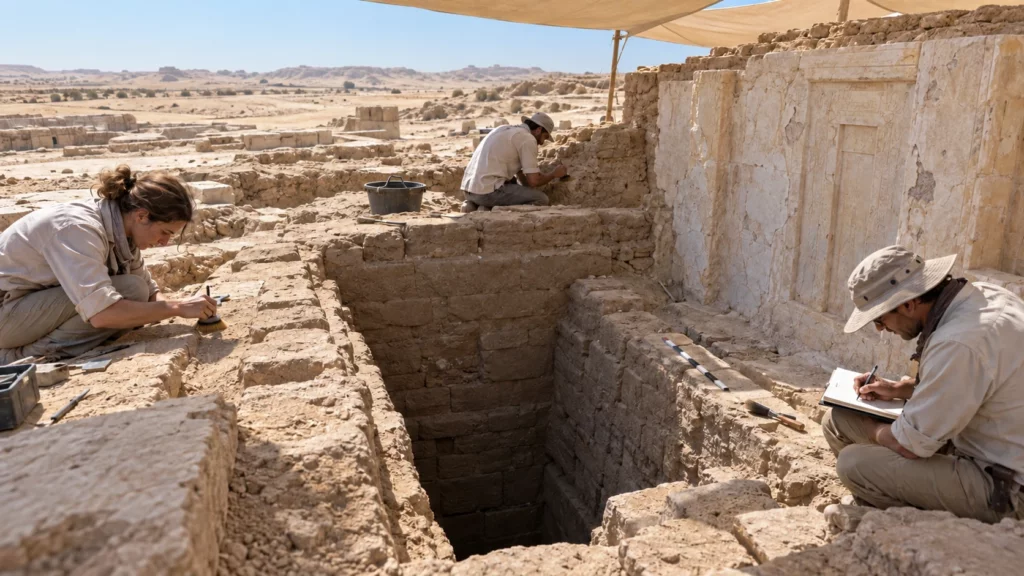
Pepior’s profile is carved at the entrance to his funerary chapel. In the extract posted online by the programme Des Racines et des Ailes – France Télévisions, the commentary names the priest, then Vassil Dobrev presents the inscriptions and the figures around him. The façade had been found partly collapsed; reassembling it makes it possible to bring the fragments together and restore an almost complete composition. Clearing the shaft may yet yield elements that fell from this part of the monument.
A name associated with the pharaoh
Dobrev draws attention to the hieroglyphs repeated on the façade and suggests understanding the name of the deceased as ‘the two eyes of the pharaoh Pepi I’ (translated from the French). This explanation should be reported as his reading of the name in the documentary, rather than turned into a separate honorific title. It places Pepior in a symbolic relationship with the sovereign; on its own, it is not enough to reconstruct his whole career.
The service of the royal statues
The archaeologist presents Pepior as the head of the priests of the great palace. He describes their task through precise gestures: undressing the statues of the pharaoh kept in the temple, removing their ornaments, cleaning them, then putting on clean clothes and the ornaments again. According to his explanation, this service was renewed twice a month, every fifteen days. The phrase places Pepior among the supervisors of staff responsible for the royal cult. The specialised term of the title is imperfectly rendered by the available subtitles; the office is described here without imposing a transliteration that would not be secured by an epigraphic publication.
The office of lector priest
Dobrev also stresses his title of lector priest, which he describes as the principal office in the formula he comments on. The lector pronounced the texts accompanying the ceremonies: speech contributed to the efficacy of the gestures. In the film, the archaeologist places Pepior at an important rank, but below that of the vizier, and uses a comparison with a secretary of state. This analogy helps to understand the hierarchy; it is not an exact equivalent of a modern administrative office.
The wife, the children and the offerings
The decoration preserves part of the family circle. The eldest son is shown bringing offerings to his father after his death. This image brings the continuity of the cult into the representation of the family: symbolically feeding the deceased is also a way of keeping his place among his own. Two daughters appear on the façade. The elder holds a staff, which Dobrev interprets as the sign of an authority conferred on her by her father. The wife also appears, but another woman is placed between her and Pepior.
Henib and the limits of a reading
This woman, smaller in size, is called Henib in the documentary. Dobrev explains that no tie of parentage is indicated and translates her name as ‘she who brings my heart to life’. He suggests an intimate relationship with the owner of the tomb. When his interlocutor mentions a mistress, however, he replies that this description is not inscribed. The scene therefore allows us to speak of a woman close to Pepior and to report the archaeologist’s interpretation; it does not allow us to state as fact a liaison whose nature the text does not give.
From the shaft to the work of conservation
The film shows the preparations for the opening: a wooden platform is installed around the shaft, which Dobrev expects to be eight to ten metres deep. The excavator checks the soundness of the rock and recovers a fragment that may come from the façade. This attention to positions and materials links the underground exploration to the study of the chapel. The sequence does not on its own provide a complete inventory of the chamber or proof that the tomb was never reopened.
What the documentary now makes it possible to clarify
The name, several offices and part of Pepior’s circle are well presented in the sequence. They can complete his portrait, provided the readings are attributed to Vassil Dobrev and the images are not confused with a full edition of the inscriptions. The metal roof placed over the chapel, the closed entrances and the seal affixed each evening by the antiquities inspector show the other side of the discovery: making a monument readable while ensuring its conservation.
Sources and references
- Des Racines et des Ailes – France Télévisions: ‘Les archéologues ouvrent une maison d’éternité oubliée depuis des millénaires !’ (in French), the audiovisual source of Vassil Dobrev’s readings.
- Name, carved profile and preparations for the shaft (from 5 min 20, in French)
- Reading of the façade, name and offices (from 7 min 50, in French)
- The two daughters, the wife and Henib (from 9 min 10, in French)
- IFAO, presentation and bibliography of Tabbet al-Guesh (in French)
- IFAO, the Tabbet al-Guesh operation (in French)