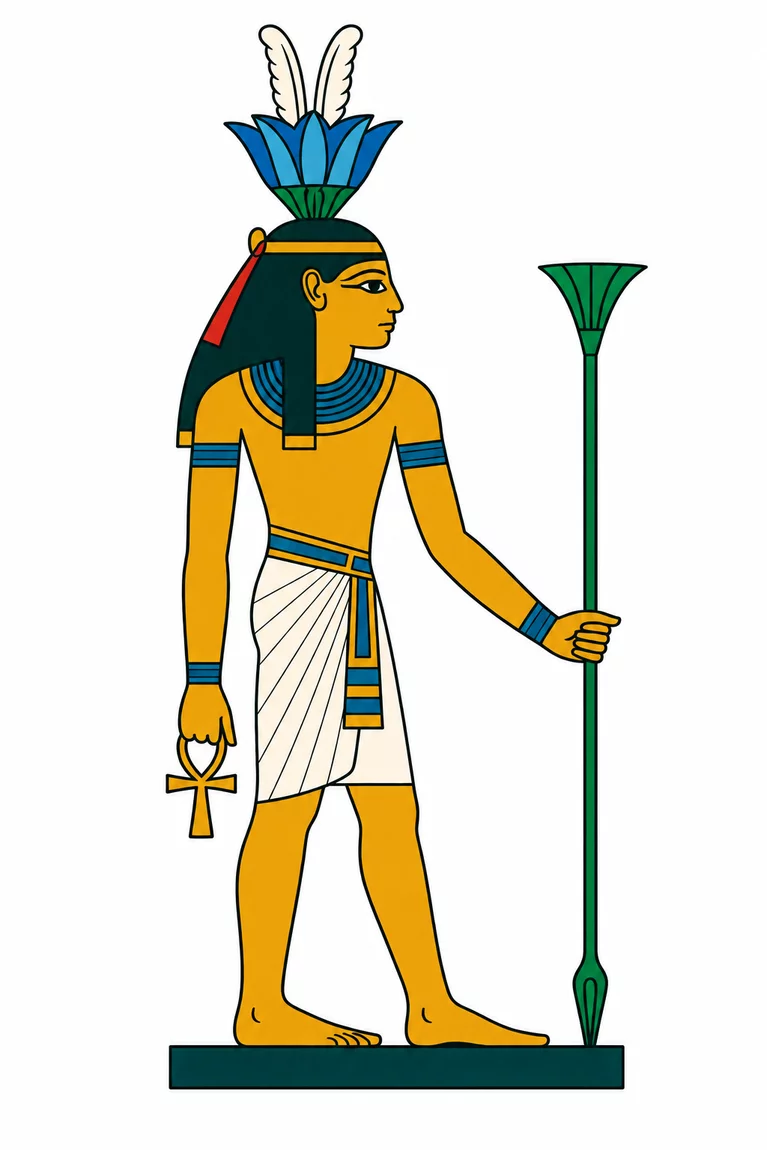
The lotus and the first morning
Nefertem, also written Nefertum, is closely associated with the lotus. The Metropolitan Museum recalls the story in which he springs from a flower on the mound of creation. The lotus opening to the light makes it possible to evoke the rising sun and the renewal of the world. This image is not a marvellous botany to be taken literally. It brings together an observation of nature, the rhythm of the day and a religious way of thinking about life beginning again.
The scent of the flower also helps to define the god. The museum’s entry links him to pleasant, fragrant things. This sensory dimension sometimes disappears when Egyptian art is reduced to crowns and animals. A flower has a shape, a colour and a smell; it appeals to several senses. In the case of Nefertem, creation is thus expressed through a perceptible experience rather than an abstract discourse. The lotus lets us feel the freshness of a new start.
A young god of Memphis
In a tradition associated with Memphis, Nefertem is the son of Ptah and Sekhmet. The Metropolitan Museum also notes variants in which Bastet or other feline goddesses take the place of mother. These versions should not be treated as errors in a single family tree. They show how sanctuaries brought powers together according to their own traditions. Divine descent links the functions of the figures and gives a framework to their cooperation.
The god’s youth does not mean a lesser power. A museum entry mentions his protective aspects and his vigour. His kinship with a lioness goddess places him within a network of images in which energy can defend as well as threaten. The morning lotus adds the promise of a new beginning. This mixture explains why the image of Nefertem lent itself to small statuettes and amulets. Theology could go with a person on an object worn close to the body.
The signs on a statuette
The collections preserve many figures of Nefertem. The museum describes a headdress made up of a lotus, two tall plumes and counterpoises of the menat necklace. These details help to distinguish him from a young man simply holding a flower. The size of a statuette does not measure a god’s importance: a small figure could be offered, carried or kept for protection. It tells us less about the full ritual, however, than an explicit inscription would.
The lotus, sometimes accompanied by plumes, is a major attribute of Nefertem. The youth of the god and the open flower evoke the appearance of light and the renewal of life. On an ancient statuette, the inscription, the provenance and the state of preservation complete these clues: a missing flower or plume can make identification harder.
The museum specifies that some statuettes may have been offered within the precinct of a temple. Their discovery away from their original position calls for caution: we can recognise the image of the god without always reconstructing the object’s history. This distinction between what we see and what we infer allows ancient beliefs to be presented without turning a hypothesis into a certainty.
Sources and references
Reference works
- Richard H. Wilkinson, The Complete Gods and Goddesses of Ancient Egypt, London, Thames & Hudson, 2003, entry Nefertem
- Christian Leitz (ed.), Lexikon der ägyptischen Götter und Götterbezeichnungen, 8 vols, Leuven, Peeters, 2002–2003 (Orientalia Lovaniensia Analecta 110–116 and 129)