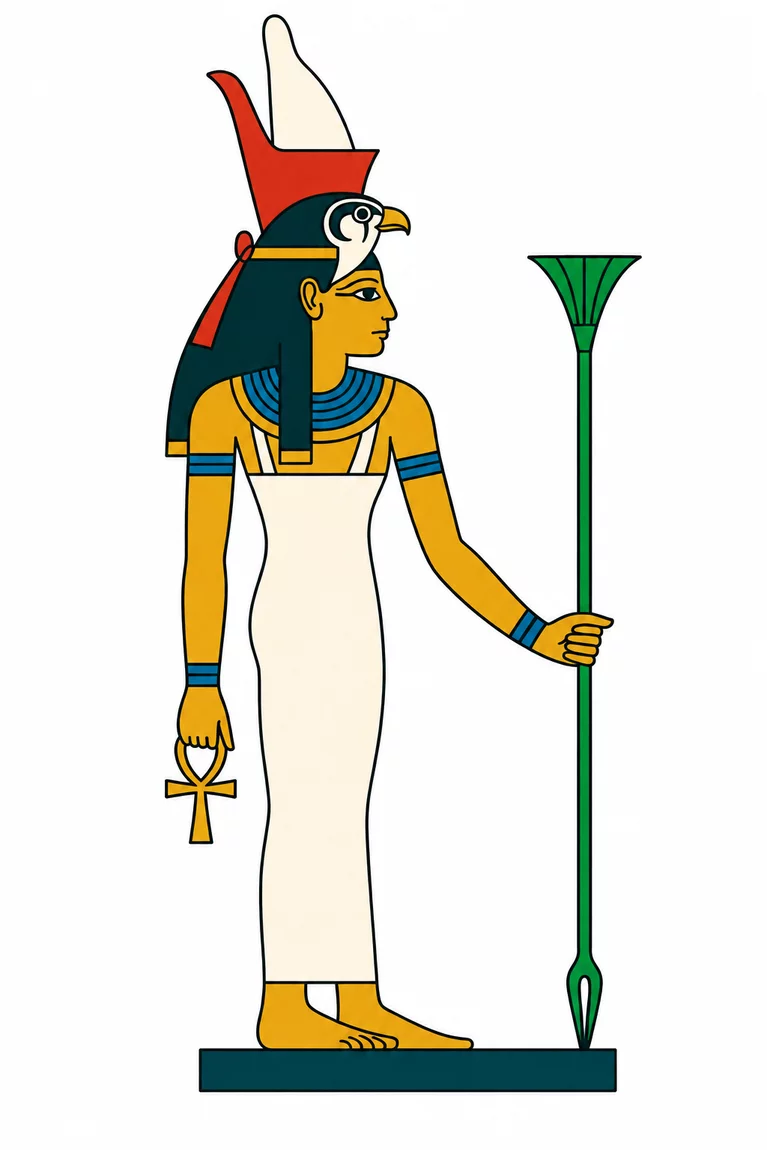
The mother of the Theban triad
Mut, written Mout in French, bears a name that means ‘mother’. In the religion of Thebes she is the consort of Amun and belongs, with Khonsu, to a divine triad. This grouping should not be understood as a human family whose every detail was fixed. It orders great powers honoured within the same sacred landscape. Mut can express motherhood, majesty and protection without being reduced to a domestic role. Her importance grew with that of the Theban region.
The Metropolitan Museum holds a stela whose inscription names ‘Mut the great, mistress of Isheru’. There the goddess is brought together with Taweret in a context of pregnancy and birth. The museum’s commentary interprets the object as a request for intercession on behalf of a woman. The stela documents a concrete devotion: a family could turn to Mut with a personal concern. Her place within a vast temple complex therefore did not erase the closeness that worshippers sought.
A crown of majesty
A head of a goddess in the Metropolitan Museum once wore the Double Crown associated with Mut, the consort of Amun. The museum also stresses the double uraeus, characteristic of female figures shown with royal dignity. The crown visually unites Upper and Lower Egypt. It does not claim that the goddess reigned like a historical person; it gives shape to a divine authority that the Egyptians could link to the power of the king.
Mut can take on other aspects on the monuments. Goddesses with a lioness’s head, a disc or horns are not automatically the same. An inscription, the provenance and the composition guide identification. Our drawing favours the Double Crown because it makes an important form of Mut legible. Its colour and posture follow the graphic language of this series, without claiming to be an ancient code valid for every period.
Kinship and practice
The relationships of Mut with Amun and Khonsu appear within a network of temples, processions and offerings. Khonsu keeps his identity as a lunar god, while the goddess remains a power in her own right. Local texts can nuance the titles and lines of descent. It is better to name a source or a place than to turn the triad into a uniform genealogy. Egyptian gods often work through association, comparison and complementarity, depending on the scene.
The name ‘mother’ finally expresses more than a family tie. It can evoke the capacity to give life, to welcome and to defend. The stela linked to birth gives this idea a human dimension, while the Double Crown places Mut on a royal scale. At Thebes, the same goddess could thus be honoured as the majesty of the temple and called upon as a protector in the worries of a household. This coexistence explains the richness of her images.
The name Isheru designates a feature of the sacred landscape of her Theban precinct. A temple epithet can thus tie the goddess to a very precise place. These geographical details help us move beyond the general image of a ‘mother goddess’. They show how a divine presence was built up in a city, in its rites and in its monuments.
Sources and references
Reference works
- Richard H. Wilkinson, The Complete Gods and Goddesses of Ancient Egypt, London, Thames & Hudson, 2003, entry Mut
- Christian Leitz (ed.), Lexikon der ägyptischen Götter und Götterbezeichnungen, 8 vols, Leuven, Peeters, 2002–2003 (Orientalia Lovaniensia Analecta 110–116 and 129)