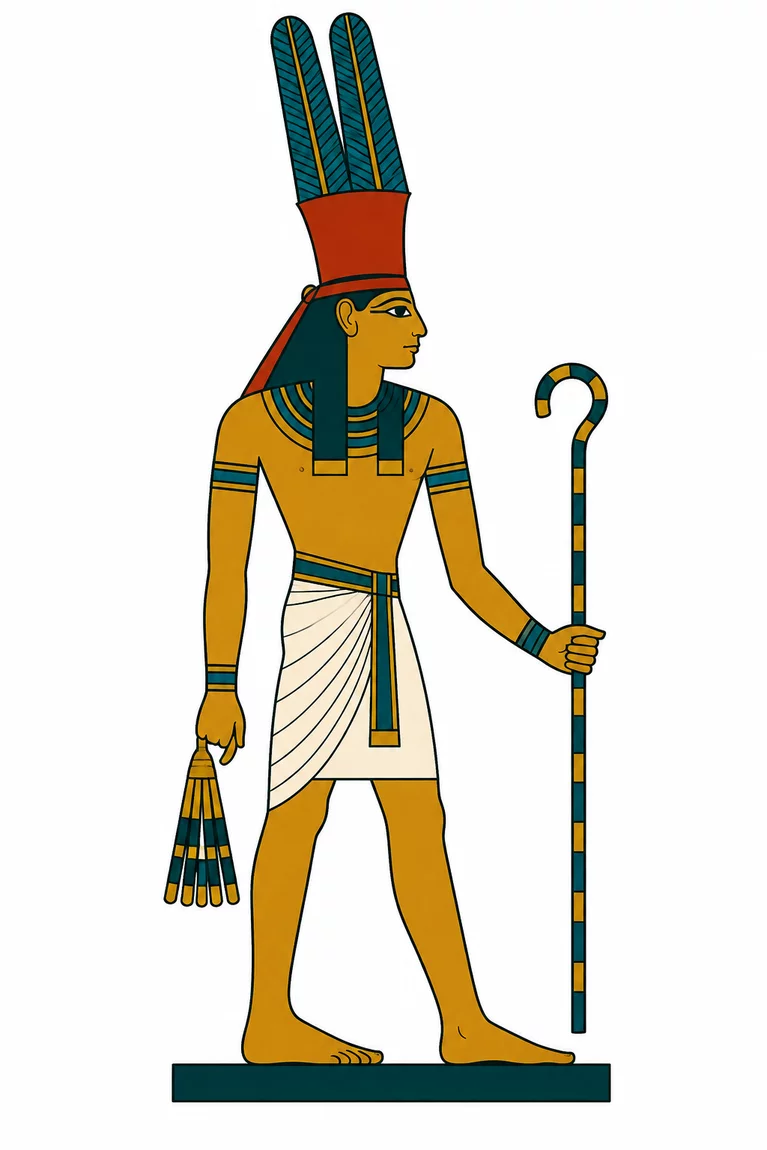
Andjety is an ancient deity of the Egyptian Delta, associated with the region of Djedu, which the Greeks called Busiris. His name is less familiar than that of Osiris, yet the histories of the two gods cross in this city. Images and texts link Andjety with signs of sovereignty that would also become famous in the iconography of Osiris. This closeness does not tell a story of simple replacement: it shows how a religious centre could preserve and transform its traditions over the centuries.
A god linked to Djedu
Djedu lay in the Delta, within a territory that the Greek sources would name Busiris. The link between Andjety and this place gives his figure a precise local scope. Egyptian gods did not receive the same titles or the same importance everywhere; a city could honour an ancient power while later welcoming other divine forms. Studying Andjety therefore means beginning with a geography of the cult before looking for a single story of his deeds.
The surviving documents are fragmentary. His antiquity and his relationship with Osiris attract particular attention. A scholarly article from the Metropolitan Museum devoted to early monuments from Busiris confirms the historical interest of this relationship, but also recalls the debates it raises. Researchers discuss how the cults of Busiris and Abydos contributed to forming the Osiris known from later periods. Caution is needed when turning these clues into a secure chronology.
The attributes of power
Andjety can be shown as a man crowned with two plumes and holding insignia such as the crook and the flail. These objects belong to the visual vocabulary of authority. They are later recognised in many images of Osiris, but their history is not entirely resolved. Symbols circulated between gods, rulers and cult places. Saying that Osiris ‘borrowed’ them from Andjety may sum up an iconographic kinship; it does not by itself prove the exact path of each object or each rite.
The illustration on this page highlights these attributes. It is not a copy of an ancient monument and should not serve as evidence for dating a tradition. To identify an ancient figure, the crown and the objects held must be compared with the inscribed name, the medium and the other figures present. The same signs can take on distinct meanings depending on the scene.
Andjety and Osiris: continuities and questions
Osiris became a major figure of dead kingship and of rebirth after death. At Busiris his cult developed in a religious landscape where Andjety already had his place. The two gods were brought together; some of the titles and visual signs of Andjety came to be associated with Osiris. This is a common phenomenon in Egyptian religion: a local deity does not need to disappear entirely for its qualities to be absorbed into another.
It would nevertheless be going too far to say that all the features of Osiris come from Andjety. The archaeological record remains incomplete and scholars still debate the regional origins of the god Osiris. A relief, an inscription or a tomb door can bear witness to a cult at a given moment, but cannot by themselves explain a whole theology. The value of Andjety is precisely to remind us that the great stories we know have a history made of layers and places.
Reading a discreet god
Andjety does not appear in museums and popular books as often as Osiris. His relative obscurity today does not mean that he was unimportant to the people of his region. It partly reflects the accidents of survival and the later success of other figures. A history attentive to local deities gives the pantheon depth: beliefs did not form a closed list, identical throughout the country.
Remembering Andjety thus means keeping three landmarks: Djedu in the Delta, the attributes of authority and the complex relationship with Osiris. These landmarks invite us to observe the objects rather than repeat an over-neat legend. They make it possible to follow, over time, how the Egyptians attached different traditions to one idea of sovereignty and continuity.
Sources and references
Reference works
- Richard H. Wilkinson, The Complete Gods and Goddesses of Ancient Egypt, London, Thames & Hudson, 2003, entry Andjety
- Christian Leitz (ed.), Lexikon der ägyptischen Götter und Götterbezeichnungen, 8 vols, Leuven, Peeters, 2002–2003 (Orientalia Lovaniensia Analecta 110–116 and 129)