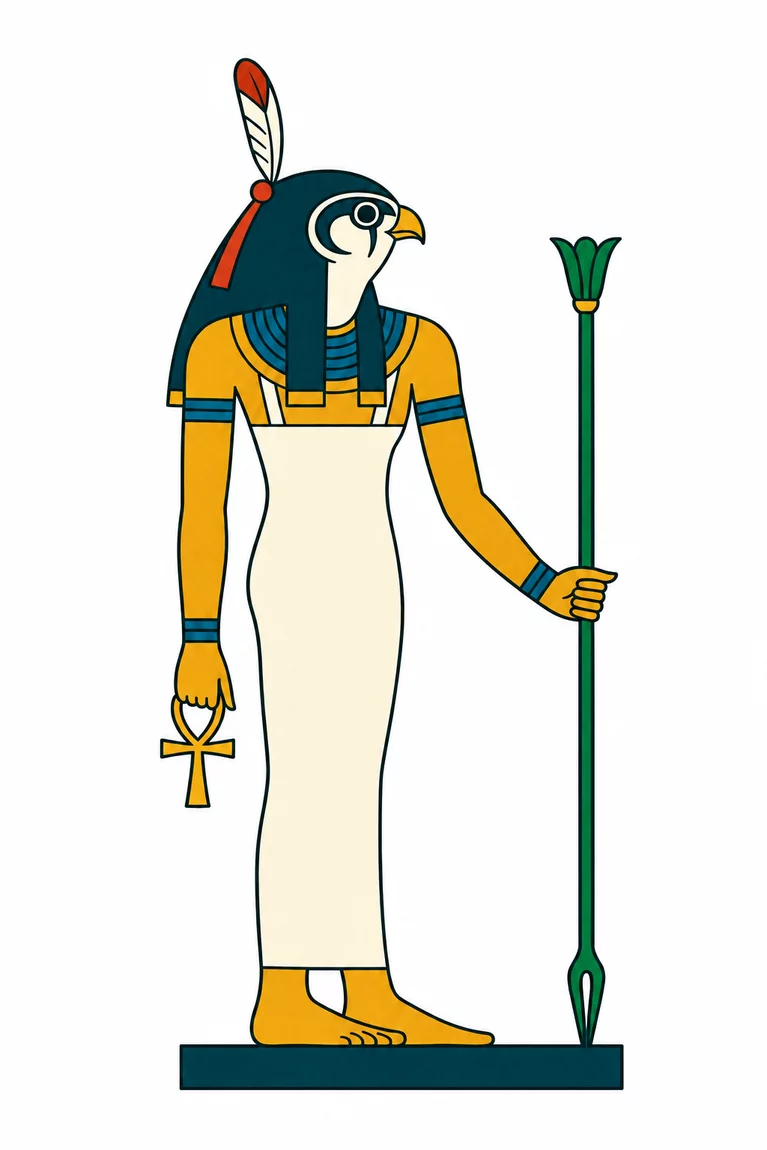
One of the four sons of Horus
Qebehsenuef belongs to the group of the four sons of Horus, often present among funerary equipment. The Metropolitan Museum shows him with a falcon’s head and specifies that he protects the intestines. His companions are Imsety, Duamutef and Hapi, son of Horus, each with a particular form and association. The group does not correspond to four gods entirely separate in their uses. They act together to preserve the deceased and support their transformation in the tomb.
The word ‘son’ is a mythological and ritual tie. It should not be imagined as a human birth register. The four figures appear on canopic jars, in coffins and on small objects placed with the dead. Their presence is a reminder that the survival hoped for in the afterlife also depended on the integrity and protection of the body. Funerary religion thus linked material acts of preparation to images and divine names.
The falcon on the canopic jar
A canopic jar of the early 18th Dynasty in the Metropolitan Museum has a falcon-headed lid identified as Qebehsenuef. The museum presents the other lids of the same set and notes that these animal forms were not used in the same way in every period. Older jars could receive plain or human lids. This development matters: the falcon’s head is a very useful sign, but it belongs to a history of objects.
The falcon can recall Horus himself and other deities. On an isolated work, it would be unwise to decide on the beak alone. The place within a set of four, the type of jar and the inscription guide identification. The figures could also take a mummiform shape. Our standing portrait with a falcon’s head is a contemporary choice of presentation that makes the figure legible beside the other members of the pantheon.
A network of protection
The protection of the organs was not limited to the four sons of Horus. Tutelary goddesses are associated with each of them; Serqet often accompanies Qebehsenuef in this arrangement. The relationships can vary with sources and periods. They nevertheless show that funerary equipment was conceived as a whole, in which jars, figures, words and acts answer one another. The little god was not a mere decoration placed on a container.
The Metropolitan Museum stresses a more general protective function of these four gods. They could be linked to mummification and to the nourishment of the deceased, beyond guarding a single organ. This nuance avoids reducing Qebehsenuef to an anatomical label. He takes part in a broader vision of the preserved body and of life continued. The falcon image thus keeps its full meaning in a funerary scene, even when no canopic jar is visible.
The jar of Tetinakht finally allows a stage in this history to be dated thanks to its archaeological context. It is not just an example illustrating a general rule: it shows at what moment a visual solution was in use. Comparing several dated objects avoids turning a long tradition into a motionless image. Qebehsenuef thus gains a history, instead of remaining the name of a falcon-headed lid.
Sources and references
Reference works
- Richard H. Wilkinson, The Complete Gods and Goddesses of Ancient Egypt, London, Thames & Hudson, 2003, entry Four Sons of Horus
- Christian Leitz (ed.), Lexikon der ägyptischen Götter und Götterbezeichnungen, 8 vols, Leuven, Peeters, 2002–2003 (Orientalia Lovaniensia Analecta 110–116 and 129)