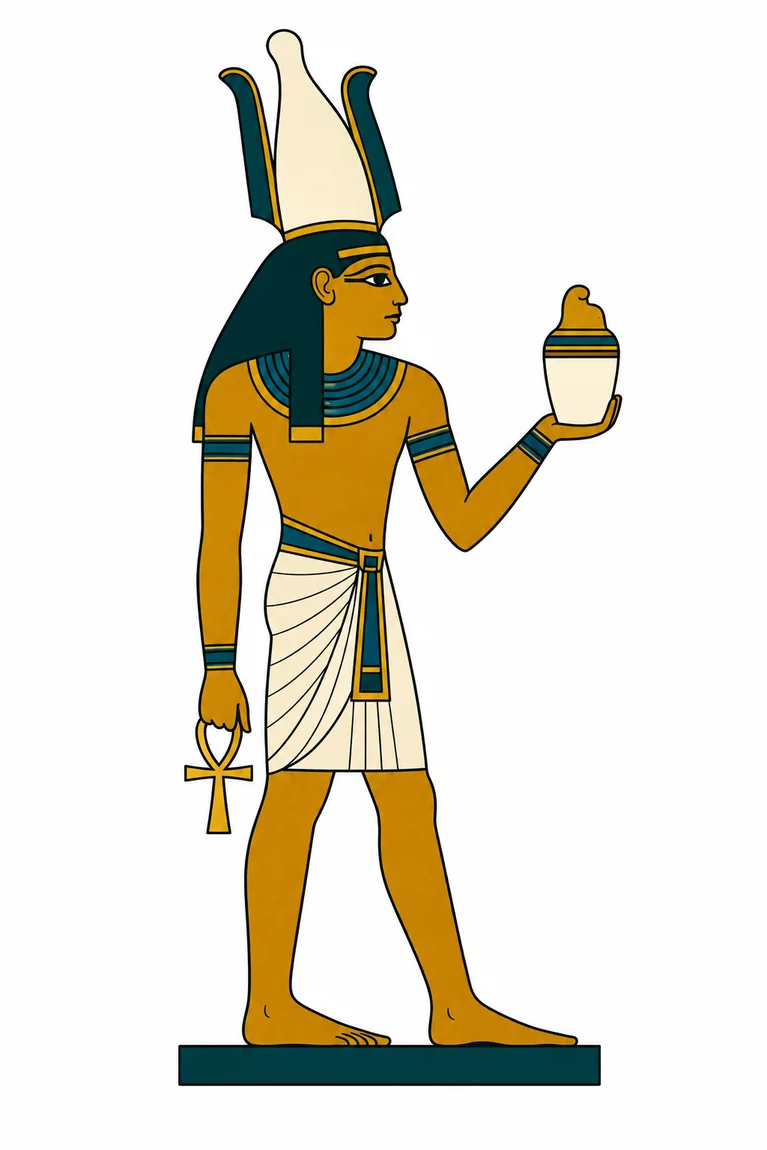
Imsety, written Amset in French and also Imseti depending on the transcription, belongs to the group of the four sons of Horus. These figures protect the deceased and the organs prepared during mummification. Imsety stands out by his human head and his link with the liver. His role seems precise, but it opens onto a broader question: how did the Egyptians think a person could be preserved beyond death? The jars, figurines and funerary texts show that the answer called on both material acts and divine protection.
One protector among four
Imsety cannot be understood in isolation. With Hapi, son of Horus, Duamutef and Qebehsenuef, he forms a group of four guardians. In a distribution commonly presented by museums, Imsety protects the liver, Hapi the lungs, Duamutef the stomach and Qebehsenuef the intestines. Their heads allow them to be told apart: human for Imsety, baboon for Hapi, canine for Duamutef and falcon for Qebehsenuef.
The four sons are not mere labels stuck on four containers. They personify a protection given to the body of the dead and take part in the order of the funerary ritual. The number four also evokes a complete organisation, able to surround the deceased. An ancient image may show them side by side, as a coherent group. That is why a representation of Imsety is best read together with those of his companions and the inscriptions that name them.
The liver, the jar and the mummy
During embalming, internal organs could be removed, treated and kept separately. The so-called canopic jars often bore stoppers depicting the four sons of Horus. A jar with a human-headed stopper then refers to Imsety. Practices were not the same in every period, however: some organs were put back in the body after preparation, accompanied by small protective figures. An example in the Metropolitan Museum thus presents figurines found in a mummy, among them a human figure associated with Imsety.
This variety matters. Seeing an image of Imsety does not by itself prove that a liver was in the container or in the mummy at that spot. Archaeologists must compare the form, the inscription, the contents and the context of discovery. The god’s name designates a religious function, while the object bears witness to a concrete practice that may have changed.
A shared protection
Imsety is placed under the protection of Isis in a common distribution of the funerary guardians. Each of the four sons of Horus then enjoys the vigilance of a goddess. This network of protections links the preservation of the body to ritual words and images. The preserved organs, the formulas recited and the painted or carved figures together contribute to the survival of the deceased.
The link with Horus also gives Imsety a place in the family and in royal protection. Yet ‘son’ should not be read as a simple modern genealogy. Family relationships between deities serve to organise their functions and can vary from text to text. In the tomb, what matters is the help given to the dead person, whatever their rank.
How do you recognise Imsety?
His human head is his most useful sign when he appears with the three other guardians. He can be shown as a small mummiform figure, on a jar stopper, as a figurine or in a funerary scene. The illustration on this page shows him standing with a jar: it is a graphic evocation meant to make his role legible, not a copy of a particular object. For an archaeological piece, reading its inscription remains decisive.
Imsety is a reminder that Egyptian funerary beliefs did not radically separate the body from identity. Preserving an organ was not simply a matter of keeping a substance. It meant maintaining the conditions of a transformed existence, surrounded by the gods. Under his human appearance, this guardian watches over one part of the body so as to contribute to the continuity of the whole person.
Sources and references
- British Museum, the four sons of Horus
- Metropolitan Museum of Art, figurine of Imsety
- Global Egyptian Museum, set of canopic jars
Reference works
- Richard H. Wilkinson, The Complete Gods and Goddesses of Ancient Egypt, London, Thames & Hudson, 2003, entry Four Sons of Horus
- Christian Leitz (ed.), Lexikon der ägyptischen Götter und Götterbezeichnungen, 8 vols, Leuven, Peeters, 2002–2003 (Orientalia Lovaniensia Analecta 110–116 and 129)