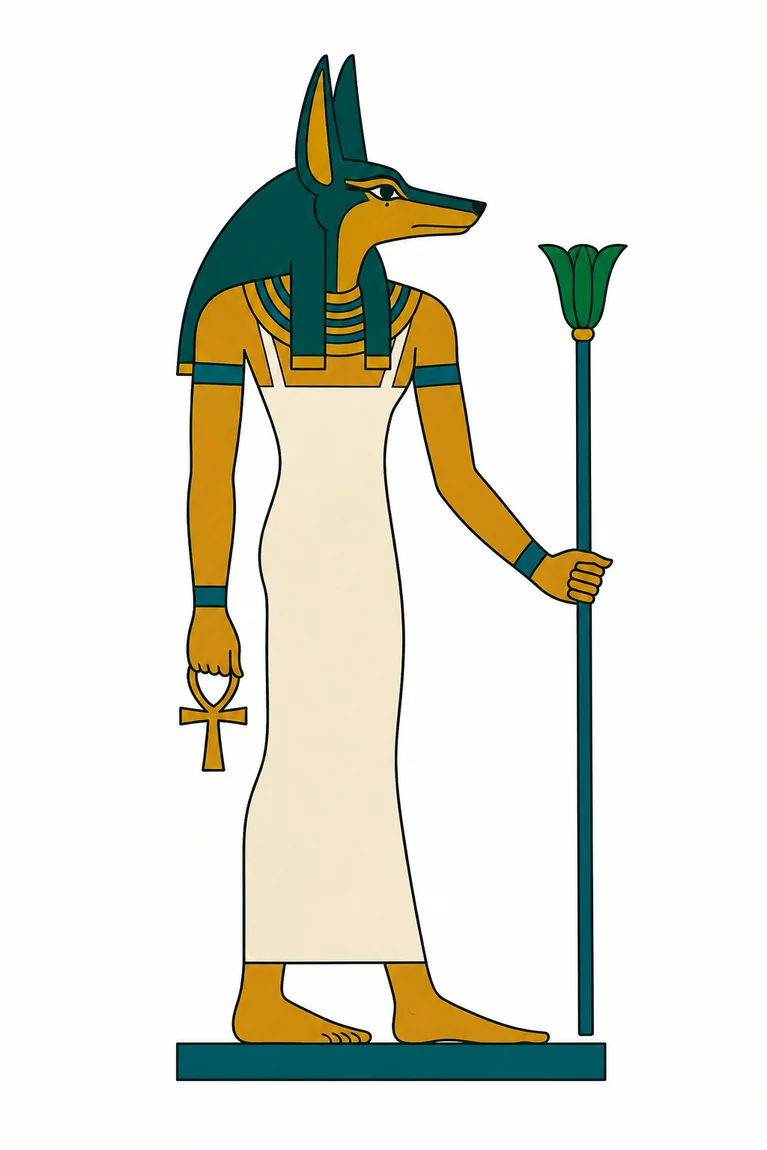
Duamutef is one of the four sons of Horus, a group of deities devoted to protecting the body in Egyptian funerary rites. His jackal’s head usually distinguishes him from the other three. Canopic jars, figurines and texts link him in particular to the stomach of the deceased. His role takes on its full meaning once we understand that preserving the body had to go together with the survival and transformation of the person after death.
One of the four guardians of the body
With Imsety, Hapi, son of Horus and Qebehsenuef, Duamutef forms a group that recurs in tomb equipment. Each member is associated with an organ, an appearance and often a direction. The most widespread attributions give the liver to Imsety, the lungs to Hapi, the stomach to Duamutef and the intestines to Qebehsenuef. This organisation makes a coordinated protection visible: no guardian works alone.
The four gods can appear on the lids of canopic jars. Their images are also found on chests, coffins and small figurines placed with the mummy. Mummification techniques changed with the period and the means available. Organs could be kept in separate containers or put back in the body after treatment. The symbol of the four protectors remains important even when the material use of the jars changes. An image on a jar therefore does not by itself prove that it still holds the expected organ.
The jackal and the stomach
The Global Egyptian Museum describes Duamutef in human form or with a jackal’s head and confirms his association with the stomach. A lid with an animal head made it possible to recognise his place quickly in a set of four. Yet the inscription and the excavation context should be checked: a jackal silhouette does not automatically identify Duamutef. Anubis is also associated with this animal, but his role and iconography are not the same.
The relationships between the sons of Horus and certain goddesses strengthen their protection. Duamutef is traditionally assisted by Neith. In many funerary arrangements, the four protective goddesses answer to the four sons. These correspondences provide several circles of guard around the dead. They can vary in detail from one object to another; a modern table of associations should not be turned into an absolute rule for every period.
A place in the geography of the tomb
Duamutef is also linked to the east in some sources. The Global Egyptian Museum notes his presence on the eastern side of the foot end of coffins of the Middle Kingdom and later periods. This orientation places the guardian within the concrete space of the coffin. The body, the four points of the horizon and the divine powers then form a network of protection. This is not a simple anatomical label: the order of the images takes part in the ritual organisation of the tomb.
The illustration on this page gives him a human body and a jackal’s head, with the sceptre and ankh often seen in contemporary portraits of the gods. It serves to recognise the figure within the series. Ancient objects show more variants, sometimes with an entirely human form. To read a museum piece correctly, the drawing, the inscribed name and the function of the object must be compared.
The presence of Duamutef is finally a reminder that the Egyptians did not simply separate a perishable body from an abstract soul. The rites sought to preserve and make effective a whole set of relationships: organs, name, images, offerings and words. This guardian of the stomach belongs to that collective work of continuity.
Sources and references
Reference works
- Richard H. Wilkinson, The Complete Gods and Goddesses of Ancient Egypt, London, Thames & Hudson, 2003, entry Four Sons of Horus
- Christian Leitz (ed.), Lexikon der ägyptischen Götter und Götterbezeichnungen, 8 vols, Leuven, Peeters, 2002–2003 (Orientalia Lovaniensia Analecta 110–116 and 129)