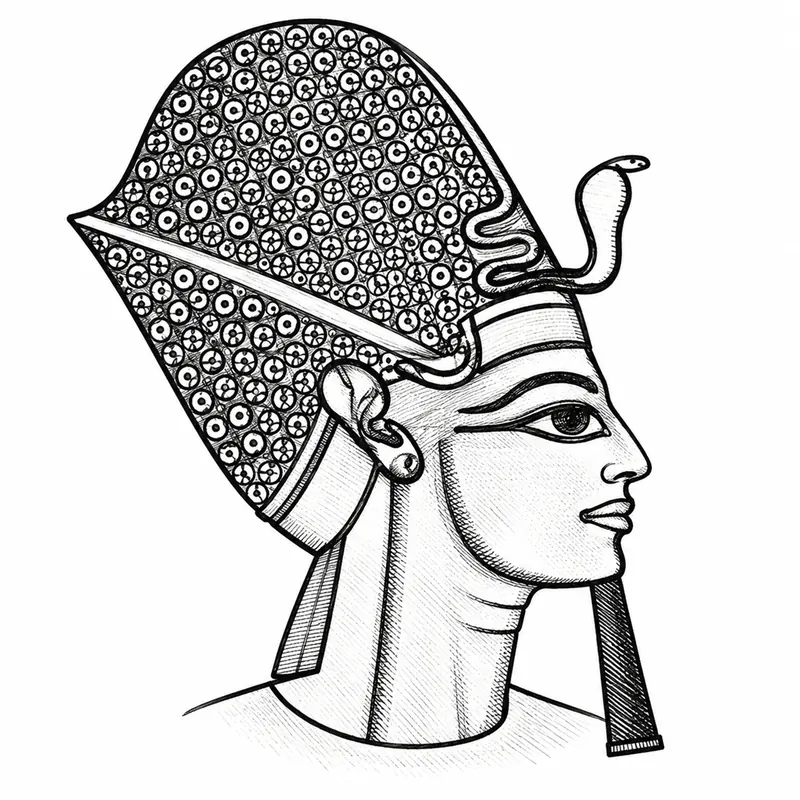
A successor under the weight of a great reign
Ramses IV, Usermaatre or Heqamaatre Setepenamun depending on the form of his titulary, succeeded Ramses III. UCL Digital Egypt places his reign approximately from 1152 or 1151 to 1145 or 1144 BC. He inherited a state still rich in monuments, but also marked by the tensions of the end of the previous reign. His name appears in quarries, in sanctuaries and in the Valley of the Kings. The short length of his rule invites us to distinguish projects begun from buildings completed. The inscriptions of his reign show a will to maintain royal visibility and to obtain the resources needed for the cults and the tomb, even if the scale of the achievements was limited by time.
The Great Harris Papyrus as an act of succession
The Great Harris Papyrus was drawn up under Ramses IV to summarise the works of Ramses III and the donations to the gods. It has often been studied for the father’s reign, but its production is also a political fact of the son’s reign. By setting down the benefactions of his predecessor, Ramses IV legitimised a transmission of power after the harem conspiracy. The text presents a coherent image of the dynasty and of the favoured sanctuaries. It does not say exactly how daily decisions were taken, nor whether all the donations announced were carried out as the narrative claims. Its existence nevertheless shows the power of writing in Ramesside continuity.
The Wadi Hammamat and the supply of stone
The inscriptions of Ramses IV in the Wadi Hammamat bear witness to expeditions to the quarries of the Eastern Desert. Bringing blocks to the valley required teams, rations, animals and the maintenance of routes. The texts carved on the spot display the success of the operation and the king’s name. They allow the actors and resources mobilised to be followed, but they do not give a complete budget. This activity shows that the court did not give up on great materials after Ramses III. The quarries were also a space of contact between the needs of the temples, the logistics of the desert and the administrations responsible for transport. Their study enriches the portrait of the reign beyond the sanctuaries alone.
Karnak, Abydos and Sinai
Stelae and inscriptions of Ramses IV are known at Karnak, Luxor, Abydos and Coptos and in Sinai, notably at Serabit el-Khadim. A statue from Memphis and an obelisk from Heliopolis complete the map. These monuments attest official activity along several axes of the country. Not all of them indicate completed monumental buildings: a commemorative stela, a foundation deposit and a statue have different functions. Their distribution nevertheless shows that kingship continued to assert its presence in the great cults and on the routes to resources. Workshops and local officials played a part in this spread. The study of the inscriptions must check provenances and possible reuse.
A planned mortuary temple at Thebes
Foundation deposits are linked to the planned mortuary temple of Ramses IV on the west bank of Thebes. This kind of discovery makes it possible to identify an intention to build, even if the building has not survived or was not completed. An attested architectural project must therefore be distinguished from a fully built temple. The other inscriptions on the west bank show the place of the necropolis among the priorities of the reign. The craftsmen of Deir el-Medina continued work on the tombs and the preparation of the cults. In a government lasting a few years, these traces of building work are particularly instructive: they reveal what the king wished to make lasting and the limits of the time available.
KV2 and the plan of the tomb
Ramses IV was buried in KV2, in the Valley of the Kings. An ancient plan of his tomb, kept in the museum in Turin, is exceptional evidence of the way the Egyptians represented an architectural space. The drawing must be compared with the dimensions and decoration of the present tomb, since a plan may show a project or simplify certain details. The burial shows a complete religious programme, with texts of the afterlife and a staging of the dead king. It is a major witness for a relatively short reign. It allows the choices of the craftsmen as well as the intentions of the court to be studied, by linking a drawn archive to a place still visible.
A short but well-attested reign
Ramses IV is not merely the successor of a famous father. The Harris Papyrus inscribes the dynasty in memory; the quarries show the organisation of works; the sanctuaries attest a national presence; KV2 and its plan reveal funerary preparation. These sources must be read according to their nature, since a text of donation, a quarry inscription and a drawing do not answer the same questions. Together, they show a court pursuing the fundamental acts of kingship after a palace crisis. The reign thus offers a precise view of the continuity of the state at the beginning of the second half of the 20th Dynasty.
Main sources
- UCL Digital Egypt, Ramses IV and his attestations
- UCL Digital Egypt, architectural plans and the tomb of Ramses IV
- UCL Digital Egypt, Ramses III and the Great Harris Papyrus
- Model for the line portrait: ancient sketch of Ramses IV, Metropolitan Museum 30.8.234.
Reference works
- Ian Shaw (ed.), The Oxford History of Ancient Egypt, Oxford, Oxford University Press, 2000, chronology pp. 479–483
- Aidan Dodson and Dyan Hilton, The Complete Royal Families of Ancient Egypt, London, Thames & Hudson, 2004