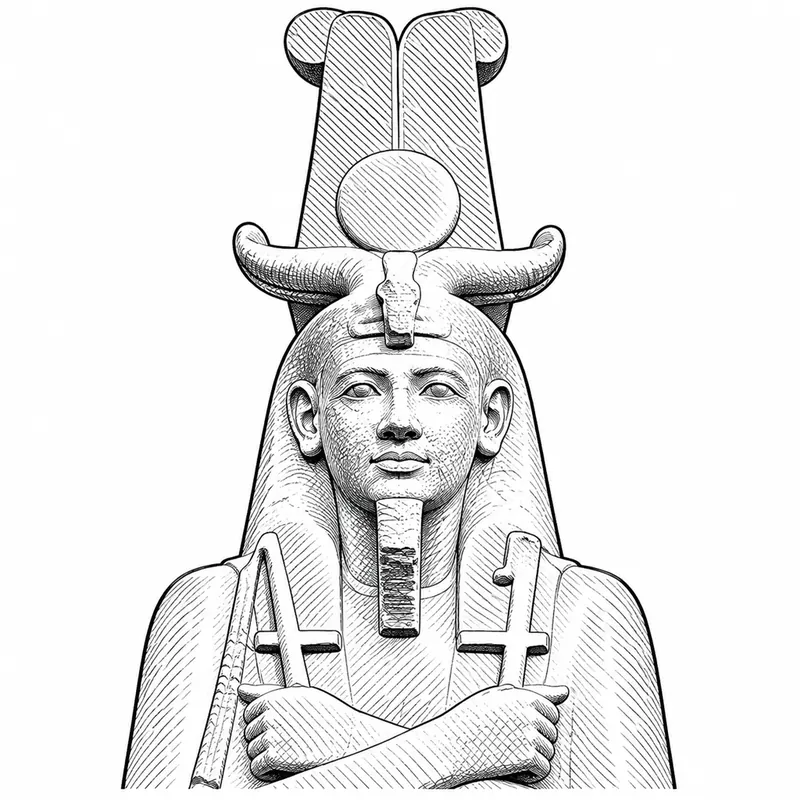
A long reign of the 20th Dynasty
Ramses III, Usermaatre Meryamun, reigned approximately from 1183 or 1182 to 1152 or 1151 BC. He belongs to the 20th Dynasty, after the transition opened by Sethnakht. His inscriptions give the image of a king protecting Egypt against several coalitions from the west and the Mediterranean. His temple at Medinet Habu, remarkably well preserved, makes these campaigns very visible. The reign cannot, however, be reduced to a series of battles. The archives of the necropolis, administrative papyri and judicial documents also reveal the resources mobilised, the tensions at court and the difficulties of the last years. He is one of the best-documented rulers of the late New Kingdom.
The Libyans and the ‘Sea Peoples’
The reliefs of Medinet Habu describe clashes with Libyan groups and with peoples that the texts place on the side of the islands or the sea. The modern term ‘Sea Peoples’ groups together different ancient names; it does not designate a single nation. The scenes of land and naval combat show what the court wished to be remembered: a victorious king in the midst of a period of regional upheaval. The material evidence from the Near East qualifies the idea of a single invasion that alone explains the end of the Bronze Age. The inscriptions of Ramses are therefore major witnesses, but they must be compared with other archaeological contexts and with the chronology of each region.
Medinet Habu, a political monument
The great temple of Ramses III at Medinet Habu served the cult of the king and the ceremonies of Amun (in French). Its pylons and courts bear long military inscriptions, while its inner spaces follow a religious programme. The surviving building allows us to understand how a victory narrative was placed on the route of processions and visitors. It also has a history after the reign, with occupations and transformations. Each relief should not be read as a photograph of a battle; the compositions follow pharaonic conventions. But their detail, their names of peoples and their relationship with the architecture make them an exceptional source on how the state explained its protection of the country.
The Great Harris Papyrus
After the death of Ramses III, his successor Ramses IV had a long document drawn up summarising the achievements and donations of the reign: the Great Harris Papyrus, kept in the British Museum. It is among the longest Egyptian papyrus rolls preserved. The text emphasises the offerings to the sanctuaries and the king’s benefactions. Its value is considerable for studying the resources transferred to the temples and the ideology of the successor. It must nevertheless be read as a retrospective official presentation, not as an exhaustive and independent account. The mass of donations announced invites us to examine the relations between the palace, the estates of the gods and the local administrations, particularly at Thebes.
Deir el-Medina and the life of the workmen
The reign of Ramses III was also a time of difficulties for the craftsmen of Deir el-Medina, responsible for the royal tombs. The documents of the community describe delays in rations and work stoppages. This history is important because it gives a voice to agents of the state whom the triumphal reliefs do not show. The causes of the shortages and their direct relationship with the campaigns remain debated. Each delay should not be taken as a sign of general collapse. The papyri and ostraca reveal rather concrete tensions in distribution, within a monarchy still able to build and write on a large scale. Their comparison with the donations of the Harris Papyrus is particularly instructive.
The harem conspiracy and the king’s death
Judicial documents report a conspiracy involving members of the court against Ramses III. A study published in the British Medical Journal in 2012 examined the mummy by imaging and noted a deep wound to the throat, consistent with a violent death. This convergence between a judicial text and the observation of the body is rare. It does not allow us to identify with certainty the hand that struck the blow or to reconstruct every stage of the conspiracy. The trials themselves are documents produced by the state, with their own language. Read together with medical science, they can support a strong conclusion about the violence suffered, without inventing a complete scene of assassination.
A reign to be read from several angles
Ramses III is often presented as the last great pharaoh of the New Kingdom. The phrase can be useful as a reminder of the scale of his monuments, but it risks reducing the following reigns to an automatic decline. His record shows at once campaigns, a major temple, vast donations, supply problems and a palace crisis. Each of these sources has its own logic. These facts coexist, without a single cause explaining them all. The reign sheds light on the capacity of the Ramesside state to mobilise resources and on the tensions that appear when this mobilisation reaches the workmen, the temples and the royal family.
Main sources
- UCL Digital Egypt, Ramses III and his monuments
- British Medical Journal, forensic study of the death of Ramses III
- UCL Digital Egypt, ostraca from Deir el-Medina
- Model for the line portrait: lid of the sarcophagus of Ramses III, Fitzwilliam Museum, E.1.1823.
- Reference photograph: Geni, CC BY-SA 4.0.
Reference works
- Ian Shaw (ed.), The Oxford History of Ancient Egypt, Oxford, Oxford University Press, 2000, chronology pp. 479–483
- Aidan Dodson and Dyan Hilton, The Complete Royal Families of Ancient Egypt, London, Thames & Hudson, 2004