In brief
Serabit el-Khadim is a desert plateau in south-western Sinai where Egyptian expeditions came for turquoise and, in the region, copper. The exploitation of the mines of Sinai, begun at least under the 1st Dynasty, stopped during the First Intermediate Period and resumed in the Middle Kingdom. On the plateau, a sanctuary of Hathor, ‘mistress of turquoise’, accompanied these expeditions. Its first installations are probably no earlier than Senusret I; it reached maturity under Amenemhat II, was enlarged under Amenemhat III and remained in use in the New Kingdom. No royal inscription later than the New Kingdom is known there.
What you discover
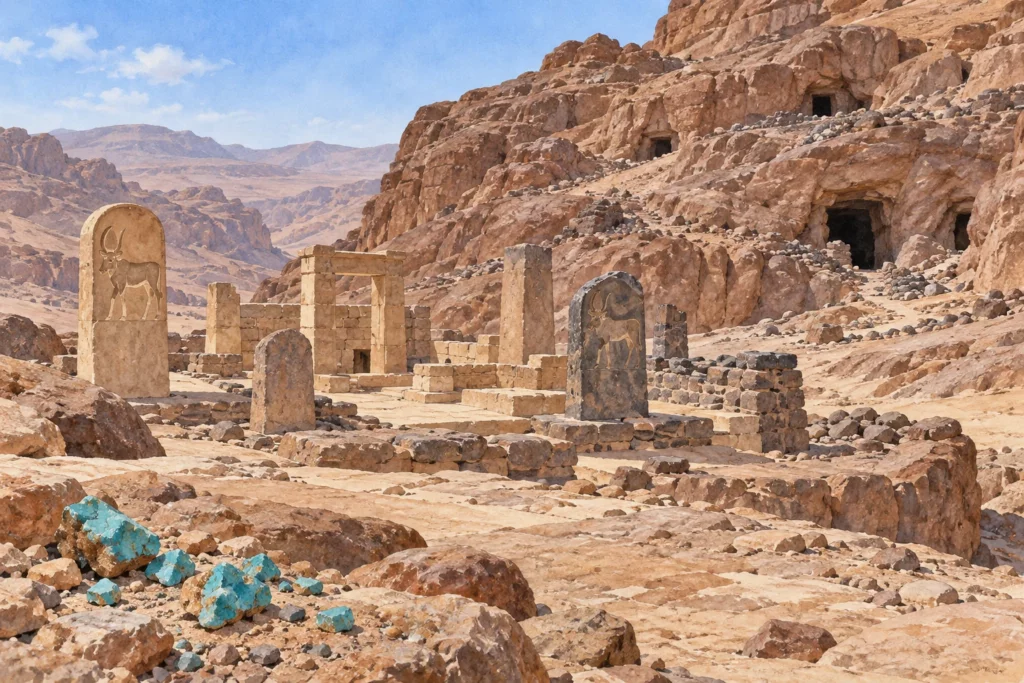
The temple does not resemble the sanctuaries of the Nile Valley. In the east of the complex open speos, chapels cut into the rock, dedicated to Hathor and Ptah; the oldest rock-cut chamber dates from the 12th Dynasty and was enlarged under Hatshepsut and Thutmose III. To the north, the Chapel of the Kings associated the goddess with the cult of kingship. A sanctuary of Sopdu, god of the eastern deserts, was added in the New Kingdom. The site has yielded royal and private stelae and thousands of votive offerings.
South and south-west of the temple extend the turquoise mines, numbered I to XII and then XV by archaeologists. The Egyptians followed the beds of the wadis to reach the promising layers, then scraped the rock face along the veins, until they had dug out true chambers. The group of mines VII and VIII was the most intensively worked, as the size of the spoil heaps around it shows.
What to look at
In front of the main entrance of mine VIII, on the west bank of the Wadi Khesif el-Soghair, a rock stela in the name of Amenemhat II was documented again in 2009 by the mission of the Institut français d’archéologie orientale (IFAO, French Institute for Oriental Archaeology) and Paris-Sorbonne University. Its date, partly lost, falls between year 26 and year 29 of the reign; it names Sneferu, son of Meket, ‘prince by the chapel of Geb’. For Pierre Tallet, this rare title may designate the building that archaeologists call the Chapel of the Kings: Geb, god of the earth and holder of mineral wealth, would have received there a cult linked to royal legitimacy.
A second object, kept in the British Museum, sums up the site. This small sphinx of local reddish sandstone, 23 centimetres long and dated to around 1800 BC, bears on its right shoulder the hieroglyphic inscription ‘beloved of Hathor, mistress of turquoise’, and on its left shoulder and base Proto-Sinaitic signs, in which the name of the Semitic goddess Baalat can be read. According to the museum, these inscriptions were probably written by Asiatics working in Sinai alongside the Egyptians.
Its history
Flinders Petrie excavated the temple in 1904–1905 for the Egypt Exploration Fund; the objects collected were dispersed among several collections, including those of the British Museum and University College London. The inscriptions of the plateau were then gathered in the corpus The Inscriptions of Sinai. From 1993 to 1995, a Franco-Swiss mission of the universities of Lille III and Geneva resumed the study of the temple, at the request of the Egyptian authorities, to present the ruins better and protect decorated blocks damaged by visitors.
Several questions remain open: the exact reading of the Proto-Sinaitic signs, often regarded as one of the first forms of alphabetic writing, the dating of each inscription and the distribution of the mines between reigns.
Sources
Consulted on 30 September 2026: Pierre Tallet, ‘Amenemhat II et la chapelle des rois. À propos d’une stèle rupestre redécouverte à Sérabit al-Khadim’, BIFAO 109, 2010, Institut français d’archéologie orientale (in French); Sphinx from Serabit el-Khadim (EA41748), British Museum; Serabit el-Khadim, Sinai, Griffith Institute.