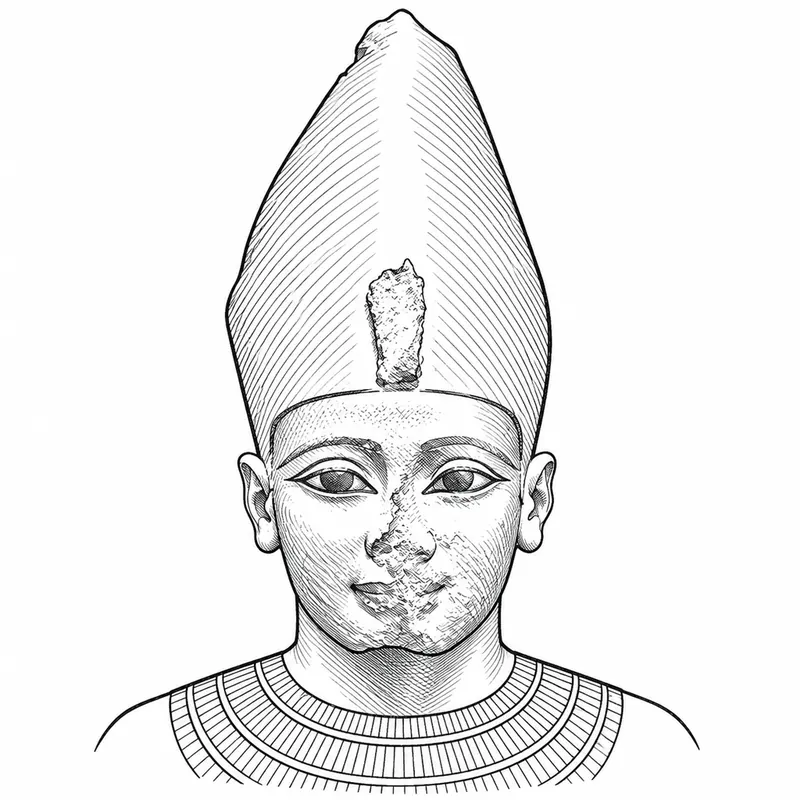
A reign at the end of a long struggle
Ahmose I, Nebpehtyre in his throne titulary, is the first king of the 18th Dynasty. He succeeded the Theban generation of Seqenenre Tao and Kamose, which had begun the war against the Hyksos kings of Avaris. UCL Digital Egypt places his reign approximately between 1550 and 1525 BC. These dates serve as landmarks, but the precise year of the final capture of Avaris is not known. Ahmose should not be reduced to a single military episode: reunification also required the restoration of institutions, sanctuaries and links between regions. The sources are numerous for this transition, but they come mainly from official monuments and from the biographies of the king’s servants.
Avaris and the northern campaigns
The autobiographies of Ahmose son of Ibana and Ahmose Pennekhbet, carved in their tombs at El-Kab, recount their part in the campaigns of Ahmose. They refer to the fighting around Avaris, then to operations towards the southern Levant. These texts are essential because they give details about the soldiers, their rewards and the progress of the war. They are also career narratives, written to show the merit of their owners. Comparing them with each other and with the archaeology of the Delta makes it possible to distinguish the major military facts from the conventions of self-praise. The conquest of Avaris put an end to the power of the 15th Dynasty in its main centre, but its consequences extended over several years.
Nubia, another front of kingship
The reign of Ahmose also included operations in Nubia. The southern frontier was not a simple line: it combined fortresses, river routes, local communities and economic interests. The biographies of the officers mention campaigns, but they do not tell the whole story of relations with the kingdom of Kush. Regaining lasting control required a military and administrative presence that his successors continued. It is therefore more accurate to speak of a decisive reorientation than of a conquest definitively completed within a single reign. The expansion to the south, parallel to the end of Avaris, explains why the advent of the 18th Dynasty changed the geographical scale of Egyptian power.
Abydos and the king’s monuments
Ahmose built an important complex at Abydos, comprising a commemorative pyramid and cult elements. The precise nature of his burial remains debated; UCL states that his original resting place is not known with certainty. Abydos was a choice charged with meaning, linked to Osiris (in French) and to the memory of earlier dynasties. Royal works are also attested at Karnak. These building projects show that reunification was expressed in visible acts of construction and restoration. They required materials, labour and networks for levying resources. The accompanying inscriptions claim that order had been restored, but archaeology allows the material reality of this investment to be studied.
Ahmose-Nefertari and dynastic continuity
The royal wife Ahmose-Nefertari held an important place in the new Theban order. Her titles and images associate her with the legitimacy of the family and with the cults of Amun (in French). She was the mother of Amenhotep I, the successor of Ahmose. Later monuments made the queen a figure honoured long after her lifetime. Her presence is a reminder that dynastic stabilisation was not only a matter of one man’s victory over Avaris. Family alliances, religious offices and the transmission of power formed a whole. The sources do not allow all her personal decisions to be reconstructed, but they show that she took part in the representation of the new monarchy and in its lasting memory.
The sources and their silences
The documentation of Ahmose is exceptional for a dynastic transition, but it leaves questions open. The officers recount the campaigns that founded their prestige; the royal stelae highlight the restoration of order; the monuments show what the court chose to build. None of these media gives a neutral and complete chronicle. The exact dates of several episodes, the extent of the losses and the organisation of the post-war period remain open to discussion. Comparison with the archaeological levels at Tell el-Dab’a and the inscriptions of Thebes helps to check the narrative. It reveals a gradual transformation, more complex than a single scene of liberation.
A founder whose work went beyond war
Ahmose I founded the New Kingdom in the political sense: he reunited the valley and set in motion a state able to act towards Nubia and the Levant. His successors would amplify this dynamic, without all their successes being attributable to him. His legacy includes the campaigns, the restoration of sanctuaries, the monuments of Abydos and the continuity of a Theban royal family. Each of these threads can be followed, and the testimony of soldiers intersects with that of the temples. Caution about dates does not diminish his role; it allows us to see what is certain. The formation of the New Kingdom then appears as a series of decisions and building projects, not as an isolated event.
Main sources
- UCL Digital Egypt, Ahmose I and his attestations
- UCL Digital Egypt, kings of the New Kingdom
- UCL Digital Egypt, Ahmose-Nefertari
- Austrian Academy of Sciences, Tell el-Dab’a
- Model for the line portrait: head of Ahmose I, Metropolitan Museum of Art.
Reference works
- Ian Shaw (ed.), The Oxford History of Ancient Egypt, Oxford, Oxford University Press, 2000, chronology pp. 479–483
- Aidan Dodson and Dyan Hilton, The Complete Royal Families of Ancient Egypt, London, Thames & Hudson, 2004