After the reunification
Amenhotep I, Djeserkare in his throne titulary, succeeded Ahmose I at the beginning of the 18th Dynasty. UCL Digital Egypt places his reign approximately between 1525 and 1504 BC. He inherited a reunified state and a policy turned towards the south, but his action cannot be reduced to a mechanical continuation of his father’s. The sources of his time tell us about campaigns, buildings and the setting of the court; much later evidence adds another dimension, that of his cult after death. Distinguishing these two periods is essential. Amenhotep the ruler and Amenhotep deified at Deir el-Medina are not documented by the same objects.
A visible royal family
Ahmose-Nefertari, mother of Amenhotep I, holds a very visible place in the memory of the dynasty. The monuments present her with important religious and royal titles. The frequent association of mother and son in the later cult shows the strength of their shared image, but it does not allow us to infer automatically a co-regency or a precise division of decisions during the reign. The family served as a support for legitimising a recent monarchy. The legacy of Ahmose, the cult functions of Ahmose-Nefertari and the succession of Amenhotep formed a political language intelligible to the Theban elites. The study of the inscriptions seeks to separate attested titles from the roles that historians reconstruct.
Nubia and the frontiers
Amenhotep I continued Egyptian activity in Nubia. The monuments and the biographies of officials show that the region remained a priority for the court. Control of a southern frontier depended on troop movements, relations with local communities and the maintenance of the Nile routes. Royal inscriptions naturally present this action as a display of power. They tell us less about the concrete arrangements that ensured a lasting presence. We should avoid regarding Nubia as a passive space: its powers and populations pursued their own strategies. The reign of Amenhotep marks a time of consolidation between the recovery begun by Ahmose and the wider expansion of Thutmose I.
The monuments of Thebes
The building programme of Amenhotep I is attested at Thebes and in other places. Fragments preserved or reused make it possible to follow religious architecture, even when the buildings were transformed by later reigns. This difficulty is typical of Karnak, where kings built for centuries. A block bearing the name of Amenhotep proves an intervention, but its first context must be analysed to reconstruct the building. The building projects bear witness to a court economy able to mobilise craftsmen and materials after the wars of reunification. They also show the importance of Amun (in French) in the staging of Theban power. The limits of preservation explain why the full extent of the works remains uncertain.
The burial and the royal craftsmen
The exact location of the original tomb of Amenhotep I is debated. His name is nevertheless closely linked, in later memory, with the craftsmen responsible for the royal burials on the west bank of Thebes. The Metropolitan Museum points out that the inhabitants of Deir el-Medina celebrated several festivals in honour of the deified king and regarded him as the founder of their community. This tradition is not enough, on its own, to date the material creation of the village to his reign. The archaeological levels and the texts must be examined separately. The distinction is important: it respects the value of the cult without turning a collective memory into a contemporary administrative document.
A cult shared with Ahmose-Nefertari
A stela in the Museo Egizio in Turin associates Amenhotep I and Ahmose-Nefertari in the devotion of later generations. Works in the Metropolitan Museum and the Brooklyn Museum also bear witness to this lasting presence. The craftsmen of Deir el-Medina represented them as protectors of their work and their place of life. The cult turns the history of a reign into a religious resource for a much later community. The date of these stelae must not be confused with that of Amenhotep himself. Above all, the works show how the 18th Dynasty was remembered by those who dug and decorated the tombs of the following rulers.
A king between history and memory
Amenhotep I links two histories. The first is that of the state at the beginning of the New Kingdom, busy strengthening its frontiers and its sanctuaries. The second is that of a king and a queen who became protective figures in the Theban necropolis. The contemporary and later sources are complementary, provided they are not asked for the same kind of proof. Museum objects, inscriptions and the archaeology of Deir el-Medina allow this transformation to be followed. It explains why a ruler less famous for his campaigns than his neighbours left a singular religious imprint. His afterlife is a historical fact in itself, distinct from the events of his government.
Main sources
- UCL Digital Egypt, kings of the New Kingdom
- UCL Digital Egypt, Ahmose-Nefertari
- Metropolitan Museum of Art, the deified Amenhotep I at Deir el-Medina
- Museo Egizio, stela dedicated to Amenhotep I and Ahmose-Nefertari
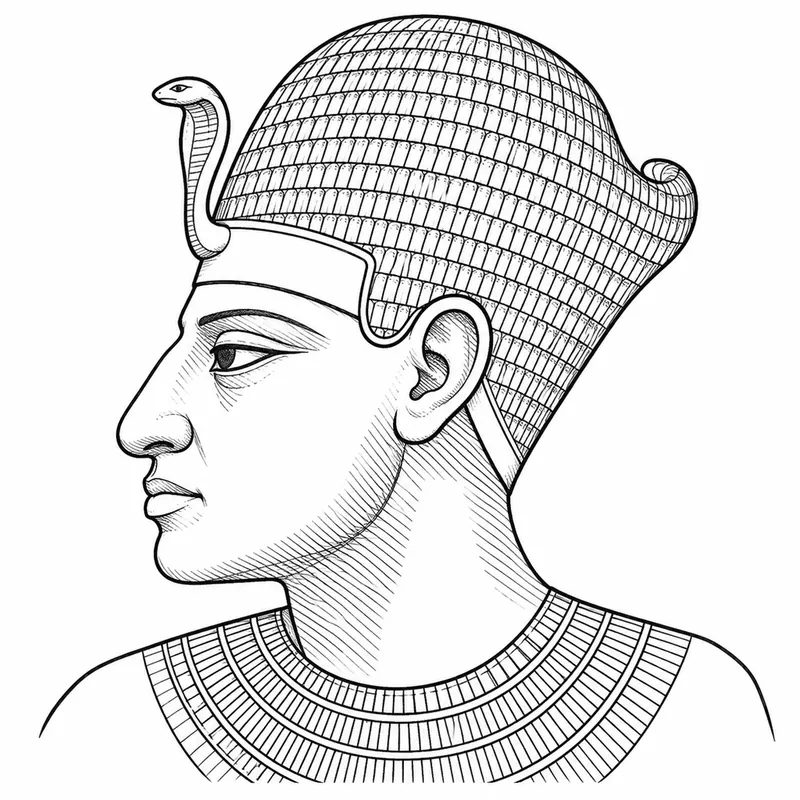
- Model for the line portrait: relief with the head of Amenhotep I, Metropolitan Museum of Art, 45.2.7.
Reference works
- Ian Shaw (ed.), The Oxford History of Ancient Egypt, Oxford, Oxford University Press, 2000, chronology pp. 479–483
- Aidan Dodson and Dyan Hilton, The Complete Royal Families of Ancient Egypt, London, Thames & Hudson, 2004