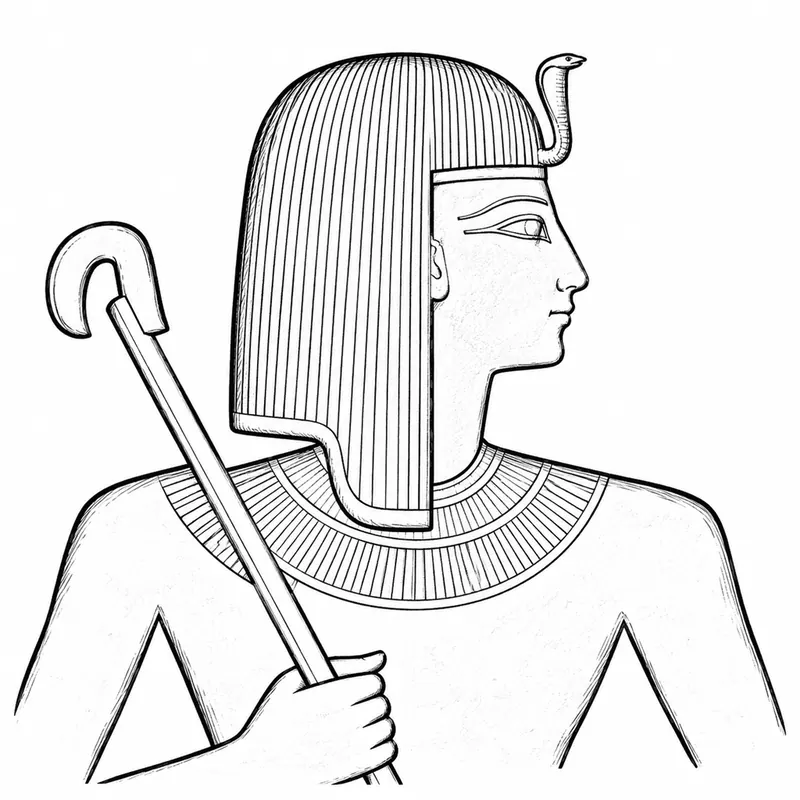
A long reign at the end of the 20th Dynasty
Ramses IX, Neferkare Setepenre, reigned approximately from 1125 or 1121 to 1107 or 1103 BC according to UCL Digital Egypt. His rule belongs to a phase in which the institutions of the New Kingdom were still active, but in which the documents from Thebes reveal tensions in the management of resources and of the necropolis. He is known above all for the investigations into tomb robberies, though these trials do not sum up his whole reign. Monuments at Karnak, Memphis, Heliopolis and in Nubia show a kingship still able to commission works and spread its name. The chronology must be handled with caution, since absolute years vary between reconstructions of the 20th Dynasty.
The Abbott Papyrus and the inspections
The Abbott Papyrus, kept in the British Museum, reports inspections of Theban tombs under Ramses IX. The authorities checked accusations of violations in the necropolis and recorded the state of several burials. The document takes the reader into a concrete administration: officials, witnesses, places visited and procedural formulas. It should not be read as proof that all the royal tombs had already been plundered. The results of the inspections distinguish the monuments affected from those that appeared intact at the time of the enquiry. The papyrus also has a dimension of rivalry between local officials. This complexity makes it an exceptional source for the history of justice and of funerary heritage.
Robberies, trials and economic life
Other judicial papyri of the period record interrogations and accusations linked to the theft of precious metals and funerary objects. They show the economic value of tombs in a society where raw materials were sought after. It would be too simple to explain all the robberies by a single general crisis or by universal corruption. The files concern specific people and cases, taken up by an administration still able to investigate and draw up long reports. The existence of a procedure is therefore also a sign of institutional functioning. Comparing the different papyri allows us to understand the alleged networks of complicity, the evidence accepted and the limits of royal justice.
Karnak and the sanctuaries
Ramses IX had a gateway of the temple of Amun (in French) at Karnak built and left a stela and other inscriptions in the sanctuary. Monuments are also known at Heliopolis, Memphis and on Elephantine (in French). They prove that the king continued to be represented in several great centres. These works do not on their own give a picture of the country’s economy, but they prevent the reign from being reduced to the history of the robberies alone. Blocks found outside their original context require their provenance to be checked. Comparing inscriptions and buildings reveals forms of royal patronage that persisted, even if their scale differed from that of the great kings of the 19th Dynasty.
Nubia in the attestations
A text from the temple at Amara West, in Nubia, bears the name of Ramses IX. This attestation is a reminder that the Egyptian networks of the south did not cease instantly at the end of the New Kingdom. It does not, however, prove control identical to that of the 18th Dynasty. The presence of a cartouche may result from a cult act, a local administration or a limited building project. To measure effective authority, it must be compared with the sites and the other regional documents. This caution also applies to the monuments of the valley. The map of the reign is a map of surviving evidence, not a political frontier drawn once and for all.
KV6 and the ancient plans
Ramses IX was buried in tomb KV6 in the Valley of the Kings. An ancient plan of this burial is known, proof of the Egyptian attention to the representation of funerary spaces. The decoration of the tomb bears witness to beliefs about the king’s journey after death, in a context where the robbery trials show the material vulnerability of the burials. Each scene should not be linked mechanically to an immediate fear of plundering: the funerary texts follow longer traditions. The coexistence of KV6, the plans and the investigations nevertheless allows us to understand the necropolis as a place of cult, work, surveillance and conflict.
A period more nuanced than decline
The sources for the reign of Ramses IX offer unusual voices: not only royal inscriptions, but reports of investigations and plans. They describe a monarchy that sought to protect tombs while continuing acts of building. The existence of robberies is not enough to declare the state collapsed; the existence of monuments is not enough to deny the difficulties. By comparing these documents, we can see how the authorities identified specific problems and tried to respond to them. The reign is an excellent vantage point on the end of the New Kingdom, where the continuity of institutions and social tensions can be read in the same archives.
Main sources
- UCL Digital Egypt, Ramses IX and his attestations
- British Museum, papyrus of the investigation into tomb robberies
- UCL Digital Egypt, plans of royal tombs
- Model for the line portrait: relief of Ramses IX, Metropolitan Museum 59.51a,b.
Reference works
- Ian Shaw (ed.), The Oxford History of Ancient Egypt, Oxford, Oxford University Press, 2000, chronology pp. 479–483
- Aidan Dodson and Dyan Hilton, The Complete Royal Families of Ancient Egypt, London, Thames & Hudson, 2004