A king who was not the heir
Thutmose IV was the son of Amenhotep II and Queen Tiaa. He was not the designated crown prince: other sons of Amenhotep II seemed better placed to succeed their father. The circumstances of his accession remain obscure. He then reigned for about ten years, c. 1400–1390 BC, depending on the chronology. His reign is short compared with those of his father and his son Amenhotep III. It is nevertheless significant, because it combines an exceptional narrative of legitimacy, the Dream Stela, with a new foreign policy based on alliance rather than war.
The Dream Stela
The most famous monument of Thutmose IV stands between the paws of the Great Sphinx of Giza. This large granite stela, dated to year 1 of the reign, tells of a dream. While hunting near Giza, the young prince fell asleep in the shade of the Sphinx, then largely buried in sand. The god appeared to him in a dream and promised him the kingship if he would clear it. The lower part of the text is now illegible. The story remains one of the most famous in Egyptian royal literature.
A narrative of legitimation
Many Egyptologists read the Dream Stela as a justification. A king who was not the designated heir claims to have been chosen directly by a god. The Sphinx is honoured there as a form of Horus of the horizon, and the Memphite region holds a central place. The stela also confirms that the Sphinx was cleared and restored at this time. The monument is a reminder that the pharaohs of the New Kingdom already regarded the monuments of Giza, more than a thousand years old, as a sacred heritage.
The alliance with Mitanni
Under Thutmose IV, the peace with Mitanni begun under his father became an alliance. The king married a daughter of the Mitannian ruler Artatama I. A letter found at Amarna, written later by a king of Mitanni, recalls that Menkheperure, the throne name of Thutmose IV, had asked several times for this princess before obtaining her. This marriage opened a period of diplomacy between the great courts of the Near East, which the Amarna letters would document under Amenhotep III and Akhenaten.
Nubia and great monuments
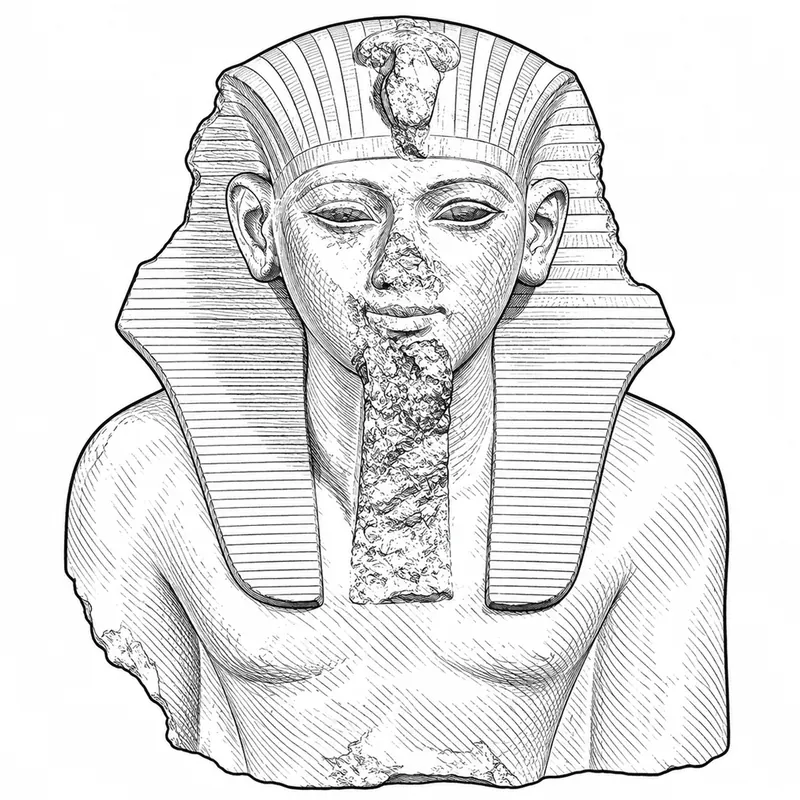
In year 8, Thutmose IV put down an uprising in Nubia, as reported by a stela carved at Konosso, near Aswan. At Karnak, he completed an obelisk begun by Thutmose III, which had remained unfinished. This monument, the tallest known Egyptian obelisk, now stands in Rome, in the Piazza San Giovanni in Laterano. The pink granite bust found at Medamud and kept in the Louvre, dated to his reign, served as the model for the portrait on this page. It bears no name inscription, but the museum catalogue assigns it to his time.
Tomb KV43
Thutmose IV was buried in the Valley of the Kings, in tomb KV43, discovered in 1903 by Howard Carter. The grave goods had been plundered in antiquity, but the tomb still contained the body of a chariot and many objects. An inscription left in the tomb under the reign of Horemheb records that it was inspected and put back in order after a first robbery. The king’s mummy was no longer there: it was found in 1898 in the royal cache of the tomb of Amenhotep II, KV35.
What this reign reveals
The reign of Thutmose IV links the conquering Egypt of Thutmose III with the prosperous and diplomatic Egypt of Amenhotep III. The Dream Stela shows the importance of religious narrative in legitimising a king, and the Mitannian marriage heralds the world of the Amarna letters. His wife Mutemwia would be the mother of Amenhotep III, under whom Egypt reached one of the peaks of its wealth. Short and often overshadowed, this reign nevertheless prepared one of the most brilliant ages in Egyptian history.
Main sources
- Harvard Gazette, the Dream Stela of Thutmose IV, 2018
- Musée du Louvre, royal bust from the time of Thutmose IV, E 13889
- UCL Digital Egypt, chronology of the Egyptian kings
Reference works
- Ian Shaw (ed.), The Oxford History of Ancient Egypt, Oxford, Oxford University Press, 2000, chronology pp. 479–483
- Aidan Dodson and Dyan Hilton, The Complete Royal Families of Ancient Egypt, London, Thames & Hudson, 2004