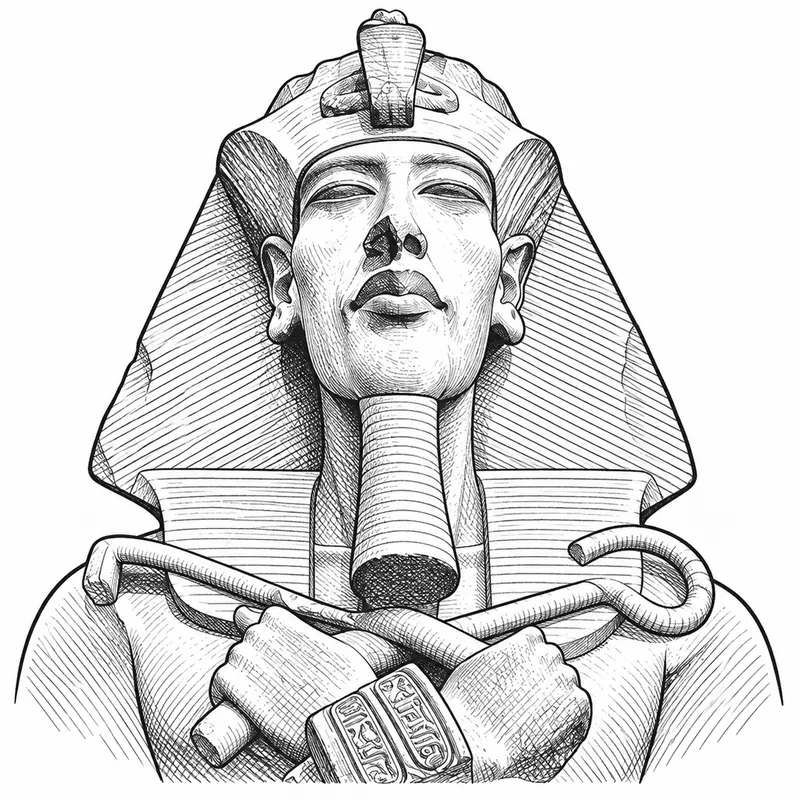
From Amenhotep IV to Akhenaten
Akhenaten was born Amenhotep IV, son of Amenhotep III and Tiye. UCL Digital Egypt places his reign c. 1351–1334 BC. He changed his name during the first years to assert his link with the Aten, the sun disc. This choice belongs to a religious and political programme of exceptional scope. The monuments of the reign are numerous, but reading them is complicated by their destruction and reuse after the end of the Amarna Period. Two opposite simplifications must be avoided: describing Akhenaten as an isolated thinker, or reducing the change to a court manoeuvre. The inscriptions show a real transformation of rites, images, names and the space of power.
The Aten and a new religious language
At Amarna, the Aten is represented as a disc whose rays end in hands bringing life to the king and his family. The cult exalts sunlight and the ruler’s privileged relationship with it. The place of the other gods, notably Amun (in French), was greatly reduced; their names and images were erased on many monuments. The debate over the use of the term ‘monotheism’ remains open, since it projects a modern category onto complex ancient practices. The hymns and ritual scenes allow us to describe precisely what the court expressed. They do not always tell us how the population lived through the changes outside the great sanctuaries.
The founding of Akhetaten
Akhenaten founded a new capital, Akhetaten, on the site now called Amarna, in Middle Egypt. Boundary stelae symbolically fix its territory and set out the king’s intentions. The city brought together palaces, temples, residential districts, workshops and tombs. Its plan offers archaeologists a rare snapshot of a capital occupied for a relatively short time. The foundation inscriptions give the official voice; the excavations of the houses show a society more diverse than the royal circle alone. Creating the city required materials, labour and considerable flows of supplies. It marks a visible redistribution of the political and religious centre of Egypt.
Nefertiti and the royal family
Nefertiti, also called Neferneferuaten Nefertiti, holds a central place in the images and inscriptions of the period. She is shown with Akhenaten and their daughters in scenes where the rays of the Aten touch the family. This visual language gives the queen an unusually strong public role. It does not, however, settle all the questions about her status in the last years of the reign. Researchers debate the identity of the ruler called Neferneferuaten after, or at the end of, Akhenaten’s reign. The well-attested Nefertiti as great royal wife must be distinguished from this hypothesis of succession. Similar names are not enough to remove the chronological and epigraphic uncertainties.
Diplomacy and administration
The Amarna letters reveal the exchanges between the Egyptian court and the rulers or governors of the Near East. They speak of gifts, local conflicts, requests for help and loyalty. Their presence in the capital shows that the religious revolution did not interrupt the diplomatic tasks of the state. They also offer a perspective different from the cult reliefs: the external partners express their own interests in them. It would be too simple to attribute all the troubles of the Levant to a supposed indifference on Akhenaten’s part, since the correspondence is incomplete and covers varied local situations. Studying the letters and the archaeology together allows a more measured political history.
Images, destruction and rediscovery
Amarna art shows elongated bodies, family scenes and a new attention to certain everyday gestures. These forms serve a precise royal programme and should not be read as photographic portraits. After Akhetaten was abandoned, many monuments were dismantled, reused or deliberately erased. Their fragments, notably the talatat blocks, now allow partial reconstructions. The destruction long distorted knowledge of the reign; it is itself a historical fact, linked to the restoration of the traditional cults. Archaeologists and conservators distinguish reconstructed scenes from the parts actually preserved, so as not to offer too complete an image of a broken programme.
A turning point with a complex legacy
Akhenaten changed the places, images and vocabulary of kingship. The experiment was relatively short: under Tutankhamun, the court returned to the old cults and centres. Its brevity does not make it superficial. The temples, the boundary stelae and an entire city bear witness to a considerable effort by the state. The reform can be explained without the anachronism of a modern forerunner and without reducing the period to a catastrophe. The evidence, the debates on chronology and the effects of the later erasure set its framework. The reign sheds light both on the creative power of the monarchy and on the limits of a transformation that depended closely on one person.
Main sources
- UCL Digital Egypt, Akhenaten and his attestations
- UCL Digital Egypt, beliefs at Amarna
- UCL Digital Egypt, boundary stelae of Akhetaten
- Model for the line portrait: colossus of Akhenaten from the Aten temple at Karnak, Egyptian Museum, Cairo.
- Reference photograph: Prof. Mortel, CC BY 2.0.
Reference works
- Ian Shaw (ed.), The Oxford History of Ancient Egypt, Oxford, Oxford University Press, 2000, chronology pp. 479–483
- Aidan Dodson and Dyan Hilton, The Complete Royal Families of Ancient Egypt, London, Thames & Hudson, 2004