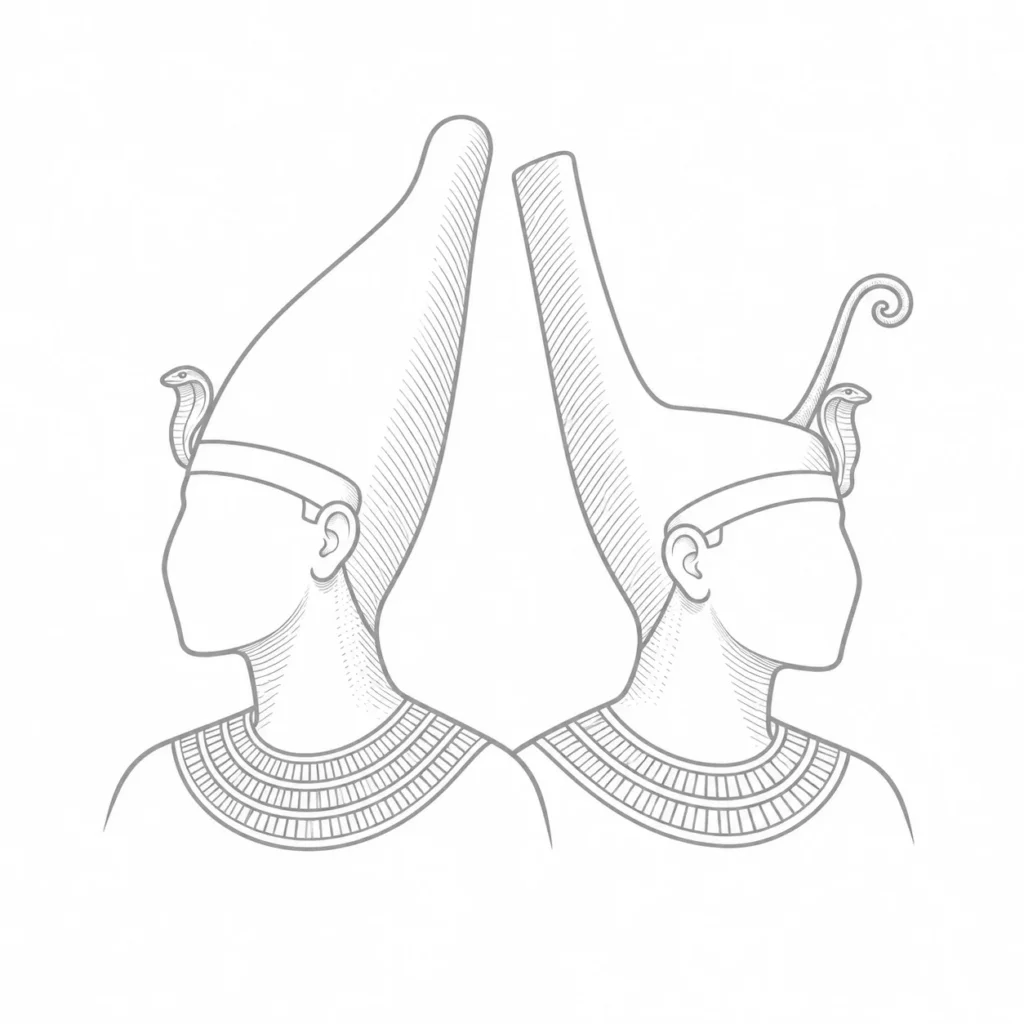
A king of the 12th Dynasty
Amenemhat II succeeded Senusret I in the 12th Dynasty. His throne name, Nubkaure, appears on seals, objects and scattered monuments. He had his pyramid built at Dahshur, whereas his predecessor had chosen Lisht. The exact dates of his reign vary between syntheses, but his archaeological record is rich enough to study the monarchy beyond his tomb. A treasure discovered in the temple of Montu (in French) at Tod, fragments of annals and inscriptions in several regions reveal movements of goods and an active administration. A distinction must nevertheless be drawn between what these objects directly attest and the routes and diplomatic relations that researchers reconstruct from them. In the chronology of Ian Shaw (Oxford, 2000), his reign falls c. 1911–1877 BC.
The pyramid at Dahshur
The funerary complex of Amenemhat II lay at Dahshur, in the south of the Memphite region. The pyramid has lost much of its shape, but excavations of the site and of the neighbouring tombs show the importance of the place for the court. The change of necropolis from Lisht does not allow us to infer a break with Senusret I. The rulers of the Middle Kingdom chose among several sites close to the centres of government and cult. The structures of the pyramid, the associated burials and the objects found provide information on the royal family and on funerary practices. Their interpretation must separate the date of construction from later deposits or alterations.
The Tod treasure
At Tod, chests bearing the name of Amenemhat II were discovered beneath the temple of Montu. They contained many objects, including silver vessels, seals and precious materials. The Louvre holds part of this group. Its composition reveals the arrival in Egypt of goods of varied origins and styles, but it does not give the details of each piece’s journey. Some items have often been compared with the Near East; this comparison must take into account exchanges, gifts, reuse and possible cult deposits. Above all, the treasure is an exceptional material source on the court’s ability to gather rare objects and dedicate them in a sanctuary.
The fragments of annals from Memphis
Fragments of an annalistic stone covering the reign have been found at Memphis. They offer a form of documentation different from private biographies and foundation inscriptions. Annals listed facts by year or by period, but their fragmentary state prevents a complete narrative from being reconstructed. Each surviving passage must be placed in its sequence and compared with the other sources. Their existence is a reminder that the royal administration kept track of the time of the reign and of the events considered worth recording. It does not mean that all the actions of Amenemhat II are known to us. The gaps in the stone are as important as the lines still legible for measuring the weight of the evidence.
Temples and regional attestations
A gateway at Hermopolis, inscriptions near Aswan and a stela in the Wadi Umm Balad widen the map of the reign. They show that the royal name appeared in sanctuaries, on desert routes and at places of passage. A monument at Hermopolis reveals a relationship with the local cult; a rock inscription may document a particular mission. These categories must not be confused. Their spread is nevertheless consistent with the workings of a monarchy that intervened in several nomes and controlled supply routes. The objects in the Petrie Museum, notably seals and fragments bearing the titulary, complete this network without allowing the timetable of decisions to be reconstructed from them alone.
The king and external exchanges
The reign of Amenemhat II is sometimes presented through exchanges with Western Asia. The Tod treasure is at the centre of this discussion, because it mixes non-Egyptian materials and forms. The presence of foreign goods does not automatically prove a single embassy or military domination. Complex chains of exchange could bring the objects to the court, then to a religious deposit. The fragments of annals and the regional inscriptions provide other clues to be compared with this group. The historical interest of the reign lies in this documentary diversity: royal monuments, inventories of objects and administrative writing allow precise questions to be asked about the networks of the Middle Kingdom.
A monarchy known from its material traces
Amenemhat II is not as famous as some of his successors, but his sources give access to several scales of his government. The pyramid shows the funerary programme; the annals suggest the recording of royal activities; the Tod treasure reveals the accumulation and dedication of precious objects. The attestations from Hermopolis, Aswan and the desert routes complete this picture. The exact relationships between these elements sometimes remain hypothetical. Setting them side by side nevertheless allows us to understand an active reign, at the heart of a 12th Dynasty able to maintain its institutions and to take part in the circulation of goods well beyond the royal residence.
Main sources
- UCL Digital Egypt, Amenemhat II
- Musée du Louvre, Tod treasure
- Metropolitan Museum of Art, royal name scarabs of Amenemhat II
- Crowns drawn from the statue of Senusret I and the relief of Ahmose, Metropolitan Museum of Art.
Reference works
- Ian Shaw (ed.), The Oxford History of Ancient Egypt, Oxford, Oxford University Press, 2000, chronology pp. 479–483
- Aidan Dodson and Dyan Hilton, The Complete Royal Families of Ancient Egypt, London, Thames & Hudson, 2004