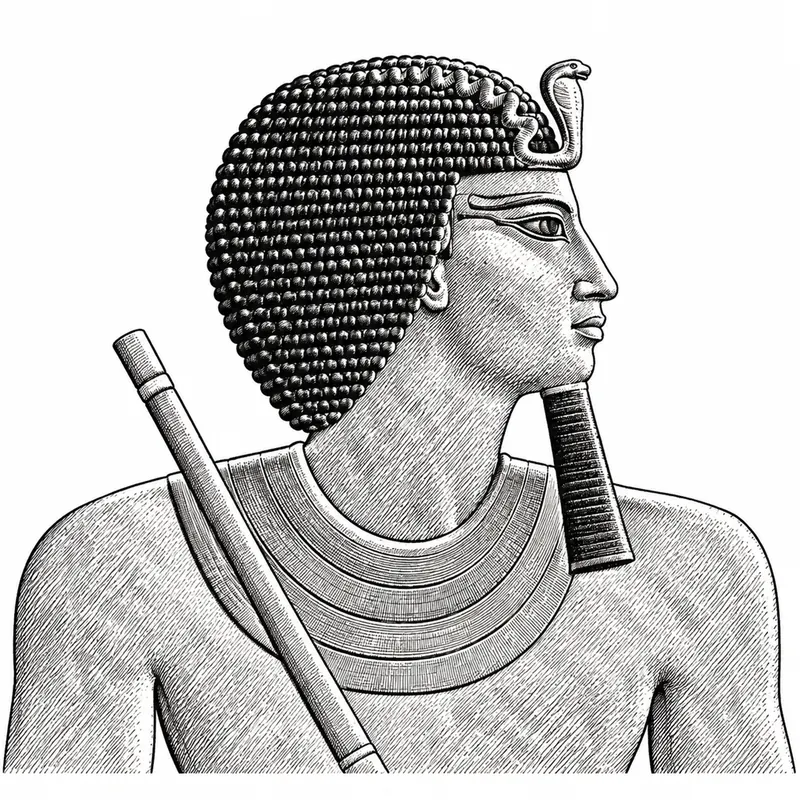
A new centre for the kingdom
Amenemhat I opens the 12th Dynasty in modern chronologies. He succeeded the line of the Mentuhoteps and established a new residence called Itjtawy, probably located in the region of Lisht, at the junction of Upper and Lower Egypt. His reign marks a reorganisation of the geography of power after the Theban reunification. The exact circumstances of his accession remain debated, and absolute dates vary from one work to another. His pyramid at Lisht, scattered inscriptions and several literary works associated with his name make up a rich but uneven record. Contemporary monuments must be distinguished from narratives composed to reflect on power and its legitimacy. In the chronology of Ian Shaw (Oxford, 2000), his reign falls c. 1985–1956 BC.
Itjtawy and the choice of Lisht
The name of the new residence means roughly ‘Amenemhat seizes the Two Lands’. It expresses a clear political claim, even though the precise location of the town has not been definitively identified. The region of Lisht, where the king had his pyramid built, offered a strategic position close to the traditional boundary between the two parts of Egypt. Moving the centre of government did not mean erasing Thebes or the earlier sanctuaries. The choice rather created a new space for the court, the administration and the royal necropolis. The remains at Lisht allow the funerary foundation to be studied; the residence itself is less visible. The exact relationship between the two places therefore depends on careful historical reconstruction.
The pyramid and the ancient traditions
The funerary complex of Amenemhat I at Lisht takes up the pyramidal form associated with the Old Kingdom, after the Theban monuments of the 11th Dynasty. Its materials and techniques differ from those of the great pyramids of Giza, and blocks from older buildings were also used. This practice must be studied in the context of construction, without assuming that it always amounted to a wish to destroy earlier works. The pyramid placed the new dynasty within a recognised royal tradition while responding to the means and choices of its time. Its present state shows only part of the original programme. Temples, tombs of the royal circle and access routes shed light on the function of a complex intended to last beyond the ruler.
Relations with Senusret I
The succession between Amenemhat I and his son Senusret I has often been described as a co-regency of about ten years. This interpretation rests on dated documents and on the way the two names appear in the sources; it has, however, been contested. The co-regency should therefore be presented as an important proposal, not as an undisputed fact. The question matters for understanding how the new dynasty sought to stabilise the transmission of power. Whether there was a formal joint rule or another form of association, Senusret appears on the political horizon of the end of the reign. Chronologies must be compared with this uncertainty in mind, rather than mechanically adding together the years attributed to the two rulers.
Three literary works and their limits
Amenemhat I is mentioned in the Tale of Sinuhe, the Teaching of Amenemhat and the Prophecy of Neferti. These texts are fundamental to the memory of the beginning of the 12th Dynasty, but their date of composition and literary status must be examined separately from the events they stage. The Teaching tells of a king addressing his son after an attack on his person; it is not a contemporary record of the circumstances of his death. The Tale of Sinuhe sets a flight at the announcement of the ruler’s death. The works shed light on how the Egyptians thought about legitimacy, loyalty and succession, more than they provide biographical details that can all be verified.
Inscriptions outside the residence
Blocks bearing the name of Amenemhat I are known at Coptos, Bubastis and near Qantir, while rock inscriptions are found on Elephantine (in French) and at Ain Sukhna. These attestations show that the reign was not confined to Lisht. They document activities in the sanctuaries and on supply routes, but each has its own archaeological context. A displaced block cannot be treated as a whole building preserved in place. Their distribution nevertheless attests the exercise of authority over several regions and the court’s interest in the routes leading to the Red Sea. They provide a material counterpoint to the literary narratives that often dominate the presentation of the king.
The significance of a dynastic foundation
Amenemhat I is not just the first name in a list of rulers. The new residence, the pyramid at Lisht, the transmission to Senusret and the activity in the sanctuaries show a concrete transformation of the monarchy of the Middle Kingdom. The literary works gave this reign an exceptional afterlife, while making careful criticism of the sources necessary. Not all the stages of his accession or the exact circumstances of his death are known with certainty. The monuments and texts nevertheless allow us to understand why the beginning of the 12th Dynasty was perceived as a moment of consolidation and redefinition of royal power.
Main sources
- UCL Digital Egypt, Amenemhat I
- UCL Digital Egypt, kings of the Middle Kingdom
- Metropolitan Museum of Art, studies on Amenemhat I at Thebes
- Model for the line portrait: painted lintel showing Amenemhat I, Metropolitan Museum of Art, 08.200.5.
Reference works
- Ian Shaw (ed.), The Oxford History of Ancient Egypt, Oxford, Oxford University Press, 2000, chronology pp. 479–483
- Aidan Dodson and Dyan Hilton, The Complete Royal Families of Ancient Egypt, London, Thames & Hudson, 2004