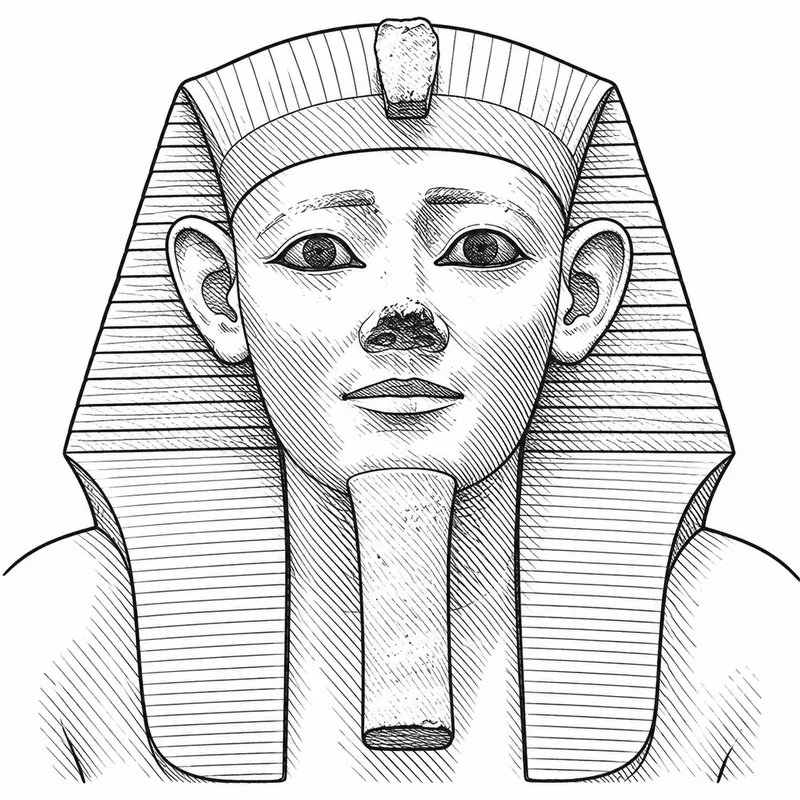
A long reign after Amenemhat I
Senusret I, or Sesostris I, is the second ruler of the 12th Dynasty. The question of an initial co-regency with his father Amenemhat I is still debated, but his personal reign is firmly attested by monuments in many regions. He had his pyramid built at Lisht and led operations towards Nubia. His religious programme is particularly remarkable: several sanctuaries were rebuilt in stone or received new sculpted elements bearing his name. The exact dates proposed for his accession vary between chronological systems. Above all, the abundance of attestations allows us to follow how the new dynastic power sought to be present in the temples of the country. In the chronology of Ian Shaw (Oxford, 2000), his reign falls c. 1956–1911 BC.
The royal pyramid at Lisht
Senusret I chose Lisht, near the residence founded under Amenemhat I, for his funerary complex. The plan takes up features of the pyramids of the late Old Kingdom, while adapting them to the techniques of the Middle Kingdom. Around the monument were cult spaces and tombs linked to the royal family. The study of these remains sheds light on the organisation of a dynastic necropolis and on the persistence of the rites after the king’s death. The ruin does not allow the ancient appearance of the casing and temples to be seen directly. Excavations and inscription fragments remain indispensable for distinguishing the original project, the building phases and later transformations. The pyramid also expressed the stability the dynasty was seeking.
The White Chapel at Karnak
Among the best-known monuments of the reign is a stone chapel built at Karnak. Its blocks were reused in later buildings, then found and reassembled by modern researchers. This history explains why the chapel can be studied today even though it no longer survived in place. Its reliefs and inscriptions show the care taken over the representation of the king and his relationship with the Theban deities. Senusret’s presence at Karnak does not mean that the court had left its residence at Lisht; rather, it shows the importance of the great southern sanctuary in a kingdom governed from another region. The reuse of the blocks means that close attention must be paid to their original context.
A programme in the provincial sanctuaries
Senusret I is attested on Elephantine (in French) and at Tod, Dendera, Abydos, Heliopolis, Bubastis and other places. According to UCL, his reign saw for the first time a systematic undertaking of rebuilding or decorating in stone in many temples of the country. This activity cannot be reduced to a single religious decision: it mobilised workshops, quarrymen, transport and local authorities. Each building has its own phases, sometimes erased by later construction. The repetition of royal names and reliefs nevertheless outlines a policy of visibility on the scale of the territory. It associated the king with local cults while giving a common form to the presence of the new dynasty.
Nubia and control of the southern routes
Campaigns of Senusret I towards Nubia are attested, as is the founding or development of fortresses, including Buhen. These operations show that the monarchy sought to secure the Nile routes beyond the First Cataract and to control trade. Military progress and the building of posts do not allow us to assume uniform domination over all the Nubian populations. They reveal rather the gradual establishment of infrastructure and power relations in a strategic region. Rock inscriptions near Aswan, one of them dated to year 32, complete the record. They provide chronological markers and recall the value of the southern passages for the kingdom.
The succession and the chronologies
The relationship between Senusret I and Amenemhat I has a direct effect on the calculation of regnal years. Some documents have been interpreted as proof of joint rule for about ten years; other researchers propose a different reading. The debate shows that two carved dates do not automatically turn into a simple absolute chronology. The succession is nevertheless secure enough to allow the continuities between the two rulers to be studied: the residence at Lisht, neighbouring pyramids and the construction of an administration able to endure. The monuments of Senusret show a dynasty that no longer depended solely on the legitimacy of its founder. It could extend its action in the temples and on the frontiers.
An influence visible in stone
Senusret I is one of the great builders of the Middle Kingdom. His pyramid, the White Chapel and the blocks preserved in many sanctuaries show the territorial reach of his reign. The Nubian operations add a strategic dimension to this activity. The sources do not allow all the king’s personal decisions to be described, but they show institutions able to coordinate works very far apart from one another. The ruler’s influence also lies in the quality of the reliefs and in the long history of their reuse. His reign is an essential moment for understanding how the 12th Dynasty gave kingship a lasting presence in the sacred landscapes of Egypt.
Main sources
- UCL Digital Egypt, Senusret I
- UCL Digital Egypt, kings of the Middle Kingdom
- Metropolitan Museum of Art, studies on the early 12th Dynasty
- Model for the line portrait: seated statue of Senusret I, Grand Egyptian Museum, GEM 1689.
Reference works
- Ian Shaw (ed.), The Oxford History of Ancient Egypt, Oxford, Oxford University Press, 2000, chronology pp. 479–483
- Aidan Dodson and Dyan Hilton, The Complete Royal Families of Ancient Egypt, London, Thames & Hudson, 2004