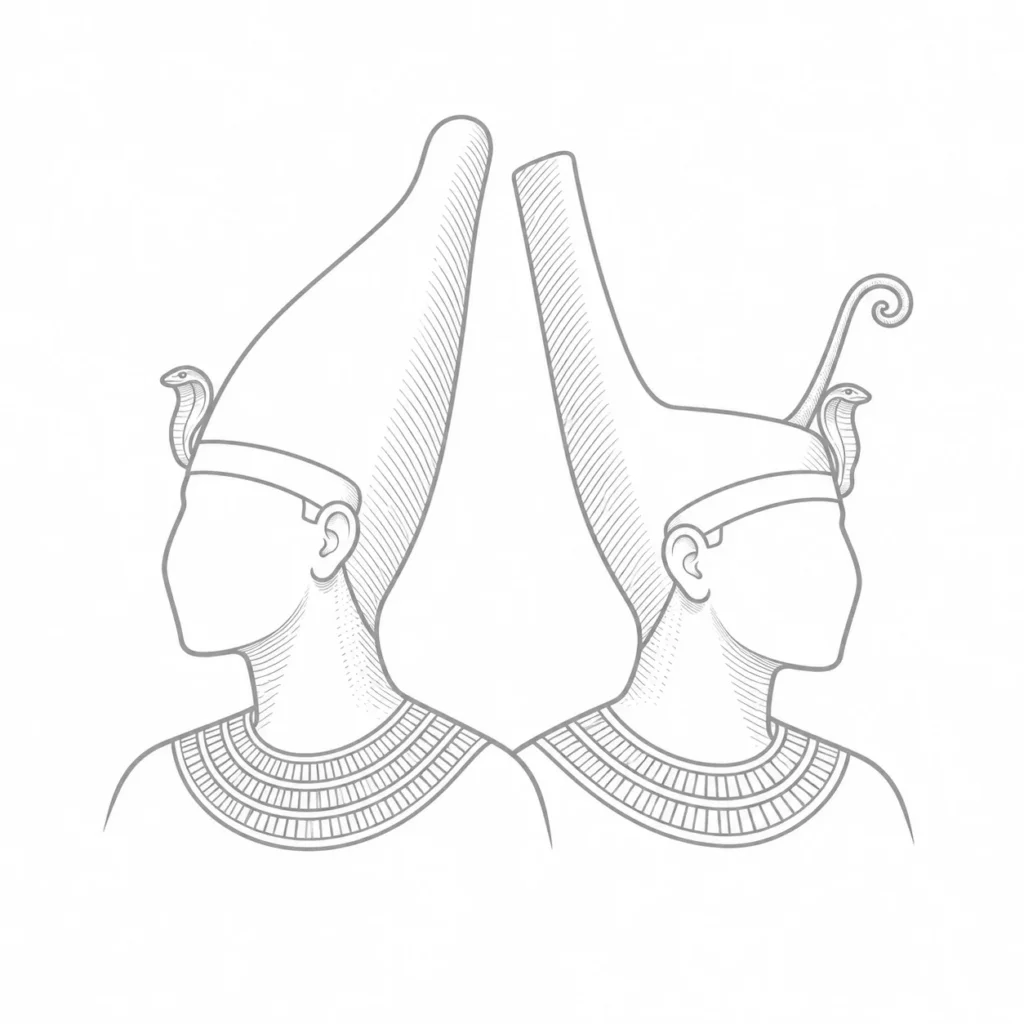
A king known from his necropolis
Senusret II, or Sesostris II, belongs to the 12th Dynasty and succeeded Amenemhat II. His reign is relatively short in most chronologies, but his pyramid complex at Lahun has left an archaeological record of great richness. Near the monument lies one of the largest surviving towns of the Middle Kingdom, often called Kahun in early publications. Many papyri were discovered there, although a large part of them dates from later reigns. A distinction must therefore be drawn between what was founded or built under Senusret II and what the community went on producing after his death. The site allows the royal cult, settlement and administration to be studied together. In the chronology of Ian Shaw (Oxford, 2000), his reign falls c. 1877–1870 BC.
The pyramid near the Faiyum
The pyramid of Senusret II stands at Lahun, near the entrance to the Faiyum depression. Its core and fittings reflect the techniques of the Middle Kingdom, different from the great limestone masses of Giza. The complex included temples and spaces linked to the burial and cult of the king. Its geographical position connects the royal necropolis, the Nile Valley and an agricultural region whose importance would grow under his successors. The present ruins are marked by erosion and early excavations; they do not directly show the original volumes. The plans, fragments and discoveries around the monument give a better understanding of its programme, without assuming that every detail was completed during the king’s lifetime.
A town associated with the royal cult
Close to the pyramid, the town of Lahun housed people linked to the activities of the complex and to other functions. Its plan, partly cleared during the excavations of Flinders Petrie (in French), shows districts and houses of different sizes. It offers a rare opportunity to study a Middle Kingdom settlement, but the surviving portion does not necessarily represent the whole population or the whole history of the place. The town continued to be occupied after Senusret II. It is a reminder that a pyramid did not stand alone in the desert: it depended on people responsible for maintaining the site, for offerings, for works and for the movement of goods. Monument and settlement form a single historical record.
The papyri and their dates
The Lahun papyri include accounts, lists of personnel, letters and other writings. A large part of the documents relating directly to the king’s cult dates from the reigns of Senusret III and Amenemhat III. This chronology is essential: they shed light on the long life of Senusret II’s foundation, but they do not necessarily describe the administration during his own regnal years. The manuscripts from other parts of the town also cover the end of the 12th and the beginning of the 13th Dynasty. The diversity of the texts gives access to work, movements and writing practices. It requires each document to be placed in its find-spot and date before any conclusion is drawn about the king.
The royal family and prestige objects
Tombs near the complex belonged to the family and circle of Senusret II. The finds there show that the necropolis associated the king’s memory with that of high-ranking relatives. A queen named Weret is attested by a fragment from Lahun; the exact links between the various royal women must be studied from the inscriptions. A sphinx attributed to the king, from Heliopolis, bears witness to the presence of his image outside the necropolis. These objects complete the picture of a ruler often presented only through his town. They are also a reminder that the present dispersal of works among museums can hide the ancient relationships between tombs, temples and workshops.
Attestations in the south
The name of Senusret II appears in rock inscriptions near Aswan, sometimes beside that of Amenemhat II. These traces provide reference points for discussing the succession and the court’s activities in the south. They do not on their own allow a detailed Nubian campaign comparable to those of Senusret III to be reconstructed. The reading of the name, the date and the location of each inscription matter more than a general interpretation of ‘Egyptian presence’. The reign belongs to a kingdom whose southern routes were essential to trade and to its frontiers. These passing inscriptions thus complement the exceptionally rich record of Lahun with a wider geography.
What Lahun reveals about kingship
The importance of Senusret II lies in a documentary paradox: his relatively short reign founded a complex whose archives mainly shed light on the following generations. The pyramid, the town, the tombs of his circle and the papyri show how a royal programme could shape a territory and its inhabitants over the long term. The later documents should not be presented as the king’s direct decisions; they bear witness to the institution he left behind. This distinction makes his history more precise. It allows us to see Middle Kingdom kingship through its buildings, but also through the daily life and writing of the communities that served his memory.
Main sources
- UCL Digital Egypt, Senusret II
- UCL Digital Egypt, Lahun in the Middle Kingdom
- UCL Digital Egypt, the Lahun papyri
- UCL Petrie Museum, One day in Lahun
- Crowns drawn from the statue of Senusret I and the relief of Ahmose, Metropolitan Museum of Art.
Reference works
- Ian Shaw (ed.), The Oxford History of Ancient Egypt, Oxford, Oxford University Press, 2000, chronology pp. 479–483
- Aidan Dodson and Dyan Hilton, The Complete Royal Families of Ancient Egypt, London, Thames & Hudson, 2004