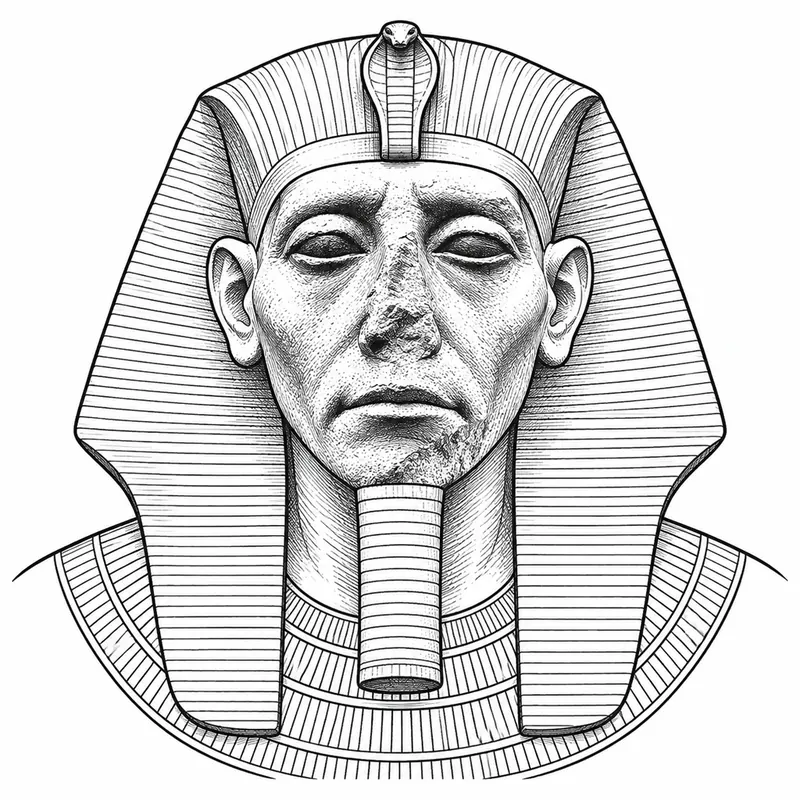
A major ruler of the Middle Kingdom
Senusret III, or Sesostris III, belongs to the 12th Dynasty and is among the best-documented kings of the Middle Kingdom. His campaigns in Nubia, his fortresses at the Second Cataract and his boundary stelae give his reign precise political content. He also had a pyramid built at Dahshur and a funerary complex at Abydos, whose relationship is still being studied. The absolute dates proposed differ between chronologies. The documentation nevertheless allows us to examine how the court defined a territorial limit, organised movements and transformed its administrative practices. It must be read carefully, since royal texts seek to exalt the ruler’s authority as much as to record facts. In the chronology of Ian Shaw (Oxford, 2000), his reign falls c. 1870–1831 BC.
The campaigns towards the Second Cataract
Senusret III led several operations in Nubia. The texts associate his name with an advance of the Egyptian frontier and with the surveillance of the Nile routes. The fortresses of the Semna region formed a system intended to control passage, trade and security. Their existence does not mean that all the populations to the south lived under an administration identical to that of the Egyptian nomes. The frontier was a zone of contact as much as a claimed political line. The remains of the posts, the stelae and the expedition inscriptions must be brought together to understand the court’s aims. They show a monarchy able to invest durably in infrastructure far from its residence.
The Semna stelae
The boundary stelae attributed to Senusret III proclaim the king’s success and ask his successors to preserve the limit he had set. Their language contrasts courage with retreat, in a rhetoric designed to make expansion a royal duty. These texts are essential historical sources, but they are not neutral records of all relations with the Nubians. They express the ideology of a power seeking to control the passage of the river and access to resources. The Metropolitan Museum also points out that Nubians lived in Egypt and sometimes served in its armies: the reality of contacts therefore cannot be reduced to the hostility staged by the boundary inscriptions.
The pyramid at Dahshur
The pyramid complex of Senusret III at Dahshur included the king’s monument, tombs of royal women and cult spaces. The Metropolitan Museum has studied its construction and the jewellery from the neighbouring burials. The king’s burial chamber has a granite sarcophagus, but the absence of human remains and the state of the interior have led researchers to suggest that he was buried elsewhere. This hypothesis must be distinguished from the certain fact that the pyramid was dedicated to him. Later destruction has profoundly altered the site. Reading it nevertheless reveals the scale of the funerary programme and the place given to the royal family in the necropolis of Dahshur.
The complex at Abydos
At Abydos, Senusret III had another complex laid out, comprising a tomb, a temple and an associated settlement. The existence of this second complex complicates the identification of where he was actually buried. It also shows the religious value of Abydos, centre of the cult of Osiris (in French), for the monarchy of the Middle Kingdom. The excavations have revealed a programme distinct from that of Dahshur, rather than a simple copy of the pyramid. It would be unwise to give a definitive answer to the question of the burial while the evidence remains debated. The two sites must be studied together to understand how the king linked the northern residence, the southern frontier and a high place of religious memory.
Administrative and social transformations
UCL notes significant changes under Senusret III in material culture, funerary customs and the place of provincial centres. The large rock-cut tombs of some governors become less frequent, while the cemeteries near the residence gain in importance. These trends have often been interpreted as signs of increased centralisation. Analysis nevertheless requires distinguishing a transformation of funerary practices from an actual reorganisation of offices: a vanished tomb does not automatically prove that a function was abolished. Objects, titles and locations make it possible to follow a real development, but its stages and causes must be discussed on the basis of several categories of source.
The memory of a powerful king
The image of Senusret III had a long afterlife, notably in the southern regions where his cult was maintained. His statues with their pronounced features have also fed many interpretations about the individuality of the royal portrait. We should avoid reading in them his character or age directly: court art responded to conventional and political choices. The ruler’s historical importance lies rather in the combination of his campaigns, the fortresses, the stelae and his funerary complexes. These sources show a monarchy that defined its frontier and asserted its means on several stages at once. They explain the major place of this reign in the history of the Middle Kingdom.
Main sources
- UCL Digital Egypt, Senusret III
- Metropolitan Museum of Art, pyramid complex of Senusret III
- Metropolitan Museum of Art, Nubia
- Metropolitan Museum of Art, soldiers of Senusret III
- Model for the line portrait: head of Senusret III.
Reference works
- Ian Shaw (ed.), The Oxford History of Ancient Egypt, Oxford, Oxford University Press, 2000, chronology pp. 479–483
- Aidan Dodson and Dyan Hilton, The Complete Royal Families of Ancient Egypt, London, Thames & Hudson, 2004