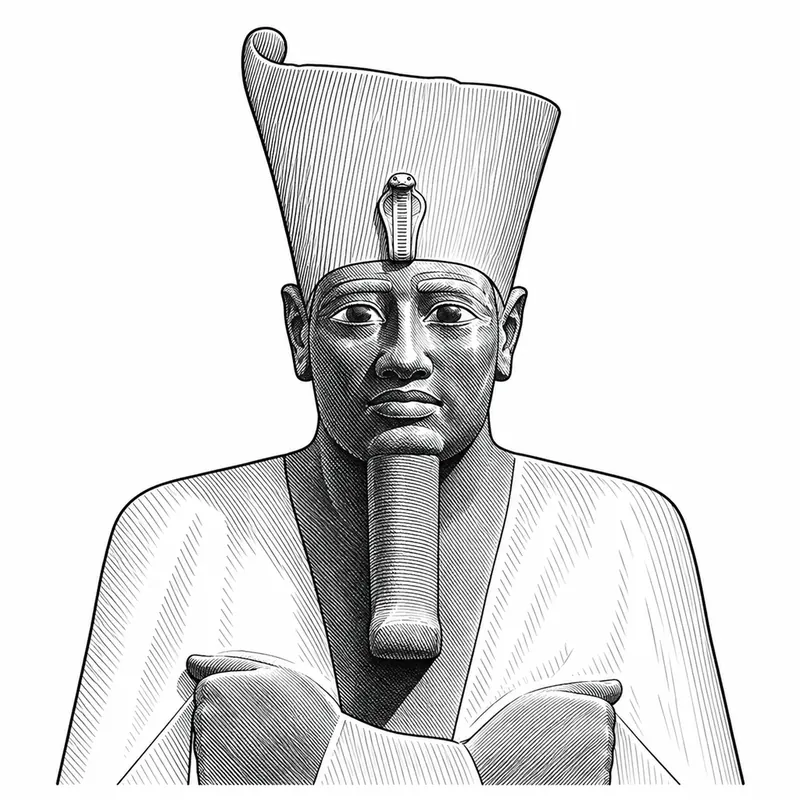
A Theban king who became ruler of the country
Mentuhotep II, whose throne name is Nebhepetre, belongs to the 11th Dynasty. Heir to the Theban monarchy, he restored the political unity of Egypt after the divisions of the First Intermediate Period. The precise date of this reunification depends on the chronology adopted, and the operations that led to it are not known in every detail. The king is nevertheless attested by monuments at Thebes and in several regions of the valley. His reign is a major landmark between the Old and the Middle Kingdom. Its military and administrative dimension must be studied, but so must the religious programme through which the court presented the ruler as the restorer of order. In the chronology of Ian Shaw (Oxford, 2000), his reign falls c. 2055–2004 BC.
Reunification as a process
Unification should not be reduced to a single battle whose date and exact protagonists are known. Earlier Theban kings had already extended their power in the south and confronted the rulers of Herakleopolis. Mentuhotep II completed this progress and established a recognised authority over the whole country. The royal titles and monuments celebrate the union of the Two Lands, but the actual setting up of the networks of government no doubt took time. Local inscriptions and the careers of officials help to follow this transformation. Their fragmentary state rules out drawing a complete administrative map for each stage. The decisive event nevertheless remains the assertion of a single monarchy after a long period of competition.
Deir el-Bahri, a new landscape
Mentuhotep II had his vast funerary complex built at Deir el-Bahri, at the foot of the western cliffs of Thebes. The site combined the royal burial, cult spaces and monuments for women of the family. Its terraces and courts created a spectacular relationship with the mountain. The form of the central part of the monument has been reconstructed in different ways; the surviving remains must therefore be distinguished from the drawings that imagine the building’s complete appearance. This complex is not to be understood only as a tomb. It also commemorated the ruler’s achievements and served as a sanctuary in which restored kingship took on a lasting religious dimension.
Montu, the queens and the rites
The complex at Deir el-Bahri was linked to Montu, a Theban god whose cult was part of the dynasty’s identity. Chapels and burials of royal women were set within the enclosure, which reveals the place of the family in the funerary programme. The fragments from the chapel of Henhenet, studied by the Metropolitan Museum, show how these spaces were decorated. It would be unwise to describe each ceremony in detail: the buildings have suffered destruction and the texts do not preserve the whole ritual. The relationships between the king, the women of his court and Montu nevertheless show a conception of kingship in which political victory, divine protection and family memory were linked.
Works along the valley
The name of Mentuhotep II appears on Elephantine, at Tod, at El-Kab and in rock inscriptions near Aswan or at Shatt er-Rigal. These attestations show a royal presence in sanctuaries and places beyond Thebes. Rebuilding temples could accompany the consolidation of authority over the regions. Each trace must be studied on its own terms: a reused block, a passing inscription and a surviving building do not carry the same weight. Their distribution is nevertheless consistent with a power that sought to make itself visible in the reunified valley. Religious works thus provide a material complement to the titularies that proclaim the unity of the Two Lands.
A lasting Theban memory
Mentuhotep II was honoured in the Theban region long after his death. His complex remained a major landmark of the sacred landscape; later, the temple of Hatshepsut was built right beside it, bearing witness to the lasting importance of Deir el-Bahri. Later veneration should not be confused with the exact practices of his reign. It does show, however, that the memory of the reunifying king remained active in the construction of local memory. Statues, reliefs and inscriptions from different periods must be dated separately to understand this long history. The ruler’s influence can be measured as much in the initial political restoration as in the place given to his monument by later generations.
The beginning of a new balance
The history of the Middle Kingdom often begins with Mentuhotep II, because his reign put an end to the political division inherited from the First Intermediate Period. This chronological formula is useful, but it should not erase the changes prepared by his predecessors or the difficulties of governing a reunited country. His record combines a major political event, an exceptional funerary complex and works in several sanctuaries. It allows us to follow the way the monarchy presented the reunion of the territory as a return to order. Despite the gaps in the narrative of events, Mentuhotep II emerges as one of the rulers whose influence most profoundly redefined the history of ancient Egypt.
Main sources
- UCL Digital Egypt, Mentuhotep II
- Metropolitan Museum of Art, chapel of Queen Henhenet
- Metropolitan Museum of Art, stela of Intef II
- Model for the line portrait: statue of Mentuhotep II, Egyptian Ministry of Antiquities, JE 36195.
Reference works
- Ian Shaw (ed.), The Oxford History of Ancient Egypt, Oxford, Oxford University Press, 2000, chronology pp. 479–483
- Aidan Dodson and Dyan Hilton, The Complete Royal Families of Ancient Egypt, London, Thames & Hudson, 2004