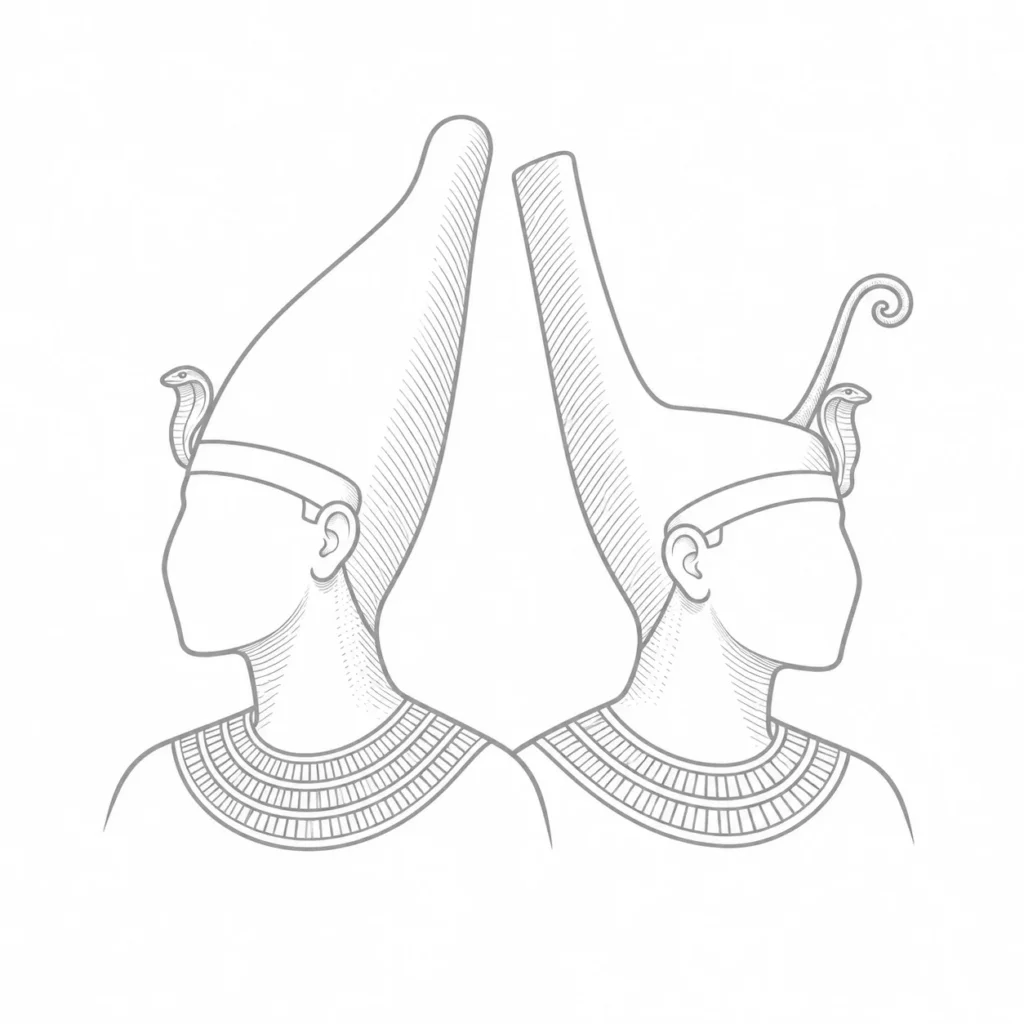
A reign after the reunification
Mentuhotep III, called Sankhkare, succeeded Mentuhotep II in the 11th Dynasty. He inherited a recently reunified kingdom whose consolidation required the court’s presence in the sanctuaries and on the routes to resources. His chronology is less detailed than that of some kings of the 12th Dynasty, and his exact tomb remains debated. Temple works at Thebes and at Tod, together with a famous expedition inscription in the Wadi Hammamat, nevertheless give his reign precise content. These documents show a kingship active beyond the valley, without allowing all his decisions to be recounted year by year or the ruler to be known personally. In the chronology of Ian Shaw (Oxford, 2000), his reign falls c. 2004–1992 BC.
The continuity of the Theban court
The passage from Mentuhotep II to Mentuhotep III should not be seen as a mere repetition of a programme already completed. Political reunification had opened up new possibilities, but it also raised questions of supply, communication and the local assertion of authority. The monuments of Mentuhotep III at Thebes and around Tod belong to this phase of consolidation. They show the continuation of religious investment linked to the Theban milieu. Their fragmentary state makes it difficult to reconstruct each project. They are enough, however, to recall that the nascent Middle Kingdom did not rest only on a past victory: kingship had to be maintained through buildings, rites and staff in several places.
A Theban sanctuary found by excavation
A chapel attributed to Sankhkare has been studied in the Theban area. The remains and decorated fragments make it possible to place the king within the development of local temples after the reunification. Modern excavations have revealed phases and reuses that call for careful reading. It would be risky to complete the vanished parts automatically on the model of later temples. The fragments nevertheless show the importance given to the royal presence in the sanctuaries, even when the ruler’s burial has not been identified with certainty. This difference between an attested place of worship and a probable tomb is a reminder that religious and funerary architecture follow distinct documentary records.
The inscription of Henenu in the Wadi Hammamat
The great steward Henenu had an inscription carved in the Wadi Hammamat, the Eastern Desert route linking the Nile Valley with the Red Sea. It describes a mission carried out under Mentuhotep III, combining the movement of men, the preparation of a sea voyage and the search for stone for royal projects. The text is an exceptional source on the logistics of an expedition, but it also celebrates the competence of the man in charge. The figures and episodes must be read within this rhetoric. The inscription shows that a court operation required water, provisions, staging posts and specialised teams. It makes visible the work needed to cross a desert space often reduced on maps to a simple line.
The Red Sea and the land of Punt
Henenu’s mission is linked to relations with the land of Punt and to the Red Sea route. The details of the sea voyage, the place reached and the goods transported are open to interpretation; the desert inscription is not a complete ship’s log. It nevertheless attests that the government of Mentuhotep III projected its activities beyond the Nile. The search for exotic products and for materials for monuments was part of the prestige and economy of the court. A distinction must be drawn between the project described, the operations actually carried out and modern conclusions about the geography of Punt. This caution makes the expedition more instructive, since it allows us to study what the document really says.
Resources mobilised on a large scale
The Wadi Hammamat supplied a stone prized for statues and monuments. Organising a mission in this region required an administration able to gather men from several nomes, supply them and protect the routes. The long inscription attributes success to the king’s favour and to his agent’s efficiency. It does not provide the full accounts of the operation, but it shows links between religious aims, the extraction of materials and movement towards the coast. The temples of Thebes and Tod recall where some of these resources could take on meaning. The reign thus reveals a power whose action combined local building projects with distant networks.
An important transition to the 12th Dynasty
Mentuhotep III is sometimes overshadowed by the reunifier who preceded him and by the rulers of the 12th Dynasty who followed. The available attestations nevertheless give a distinct portrait: that of a king who maintained the sanctuaries and exploited the routes of the Eastern Desert. Questions of succession, tomb and precise length of reign remain open. They should not make us forget the value of the inscription of Henenu, a rare piece of evidence on the organisation of a mission at the beginning of the Middle Kingdom. The reign shows that the restored unity could now be put at the service of projects mobilising several regions, from the quarries to the paths leading to the Red Sea.
Main sources
- UCL Digital Egypt, Mentuhotep III
- UCL Digital Egypt, chapel of Sankhkare at Thebes
- Harvard University, early translation of the inscription of Henenu
- Crowns drawn from the statue of Senusret I and the relief of Ahmose, Metropolitan Museum of Art.
Reference works
- Ian Shaw (ed.), The Oxford History of Ancient Egypt, Oxford, Oxford University Press, 2000, chronology pp. 479–483
- Aidan Dodson and Dyan Hilton, The Complete Royal Families of Ancient Egypt, London, Thames & Hudson, 2004