In brief
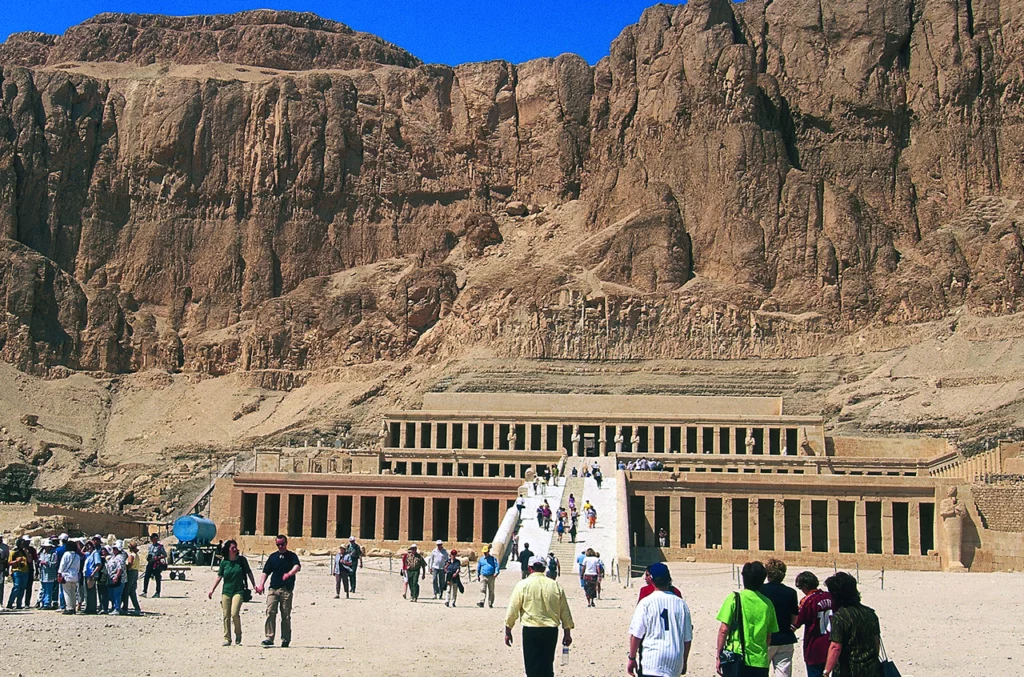
On the west bank at Thebes, facing Karnak, the temple of Queen Hatshepsut is set against the cliffs of Deir el-Bahri. Called Djeser-djeseru, ‘the Holy of Holies’, it was designed, according to the Egyptian Ministry of Tourism and Antiquities, by the architect Senenmut. The ruler reigned c. 1473–1458 BC. Its terraced plan breaks with the mortuary temples of the Old Kingdom, which were more inward-looking: here, the building was made to be seen and walked through.
What you discover
Three levels of terraces, linked by ramps, rise at the foot of the cliff. Each is punctuated by a portico. The upper level opens onto a court where mummiform statues of Hatshepsut as Osiris stand against the pillars. The Metropolitan Museum refers to twenty-six Osiride colossi originally along the façade. On the central axis, the sanctuary of Amun is cut into the rock, in the place of honour. Other spaces are dedicated to Thutmose I, the queen’s father, to Hathor, to Anubis and to Ra-Horakhty. The painted walls show ceremonies, festivals and the transport of obelisks to Karnak.
What to look at
The portico of the middle level deserves the longest time. It bears the reliefs of the expedition to the land of Punt, which the ministry describes as very lively documentation: inhabitants, houses, fauna and trade goods are shown in detail, in a region placed near present-day Eritrea. These images are also a discourse. Nearby, the scenes of divine birth assert Hatshepsut’s descent from Amun and ground her right to rule. These surfaces should be read as political and religious texts as much as travel accounts.
A second look concerns the stone itself. Some parts are restored, blocks have been put back in place, and the statues of the ruler are not all where they once stood. Distinguishing the ancient from the reconstructed helps to understand what one is really seeing.
Its history
The work was carried out during the co-regency of Hatshepsut and Thutmose III, over fourteen to sixteen years according to the Metropolitan Museum, probably under the supervision of Senenmut. On the queen’s death, Thutmose III had her statues destroyed, and further damage followed in the Amarna period, around 1340 BC. The Metropolitan Museum worked on the site from 1911. In 1926, the team discovered a mass of fragments of broken statues of the queen near the causeway of Mentuhotep. Since 1961, the Polish-Egyptian mission has been restoring the monument.
Why this place matters
UNESCO’s World Heritage List includes Deir el-Bahri in Ancient Thebes with its Necropolis, citing the porticoes, the superimposed terraces and the paintings of the voyage to Punt. The temple brings together funerary cult, a sanctuary of Amun and the assertion of the power of a woman who became king. Several questions remain open, notably the exact order of the works and the original position of many fragmentary scenes.
Sources
Consulted on 30 September 2026: Ancient Thebes with its Necropolis, UNESCO; Hatshepsut Temple, Egyptian Ministry of Tourism and Antiquities; Model of the Temple of Hatshepsut at Deir el-Bahri, Metropolitan Museum of Art.