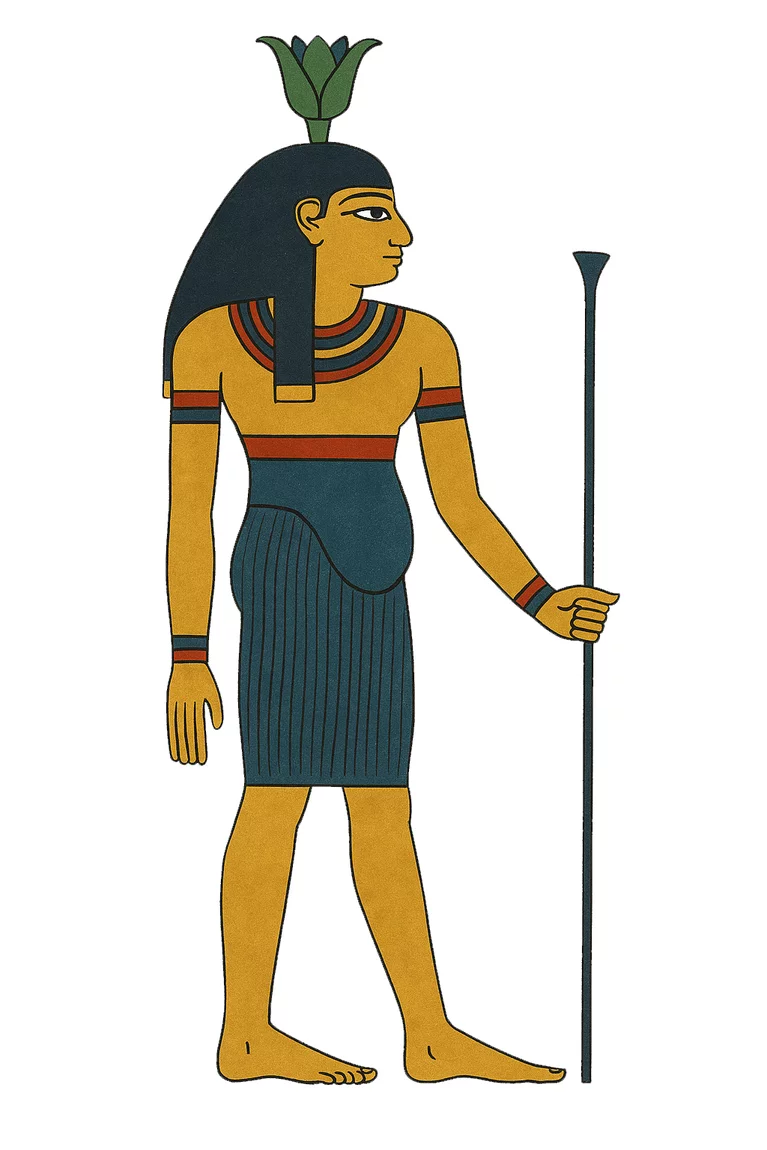
Hapy personifies the flood of the Nile, an event essential to the agriculture of ancient Egypt. Each rise of the waters left fertile alluvium on the banks and made a new cycle of crops possible. The god does not simply represent the river in all its aspects: above all he embodies the abundance brought by the inundation. This function explains his nourishing body and the aquatic plants that often accompany his images.
A power of abundance
Ancient representations frequently give Hapy a full belly and developed breasts. These features combine a male body with the capacity to feed and to make things grow. It would be misleading to project our present-day categories of gender directly onto them. Egyptian artists used a visual combination to express the fertility of the flood. The blue of the water, plants and offering trays often complete the whole.
The Global Egyptian Museum places important cult sites near Aswan and Silsila, in the neighbourhood of the First Cataract. In this region the Egyptians watched the rise of the waters coming from the south. Rites and images answered a concrete concern: a flood that was too low threatened the harvest, while an excessive one could destroy buildings and works. Honouring Hapy expressed the hope of a favourable water level rather than any technical control of the river.
The Nile in the temples
In the lower part of many temple walls, figures carrying the products of the land personify the nomes, or administrative regions. They sometimes take the form of Hapy. The emblems of Upper and Lower Egypt, among them the lotus and the papyrus, appear in these processions. A famous motif shows two figures tying plants around a sign of union: it evokes the unification of the Two Lands. The presence of Hapy in this visual language links the gift of water to the whole country.
The flood can also be linked to Osiris and his power of renewal. At Elephantine, Khnum also belongs to the stories and cults associated with the waters of the Nile. These links do not erase the identity of Hapy. They show that several gods could explain, each within his own framework, the same vital phenomenon. A religion as long-lived and varied as that of Egypt does not offer a single answer to the question of where the inundation came from.
Two gods not to be confused
The name Hapy is very close to that of Hapi, son of Horus, a baboon-headed funerary deity who protects the lungs. Their Egyptian names were not written in the same way. The Global Egyptian Museum insists on this difference. A water figure carrying offerings in a temple belongs to the flood; a canopic jar lid in the form of a baboon belongs to the group of the four guardians of the organs.
Our illustration shows the god of the inundation standing, with a Nile plant. It gives a point of reference within a series of portraits, without claiming to reproduce any particular statue. Ancient forms vary with the medium: temple reliefs, offering scenes and isolated images do not stress the same details. The meaning comes from the composition as much as from the attributes.
Hapy is finally a reminder that abundance was never guaranteed. Farming life depended on a natural rhythm that was watched, awaited and celebrated. Giving the flood a face made it possible to express gratitude for its benefits and anxiety about its uncertainty. It is this relationship with the Nile, more than an abstract power over ‘all waters’, that defines the god.
Sources and references
Reference works
- Richard H. Wilkinson, The Complete Gods and Goddesses of Ancient Egypt, London, Thames & Hudson, 2003, entry Hapy
- Christian Leitz (ed.), Lexikon der ägyptischen Götter und Götterbezeichnungen, 8 vols, Leuven, Peeters, 2002–2003 (Orientalia Lovaniensia Analecta 110–116 and 129)