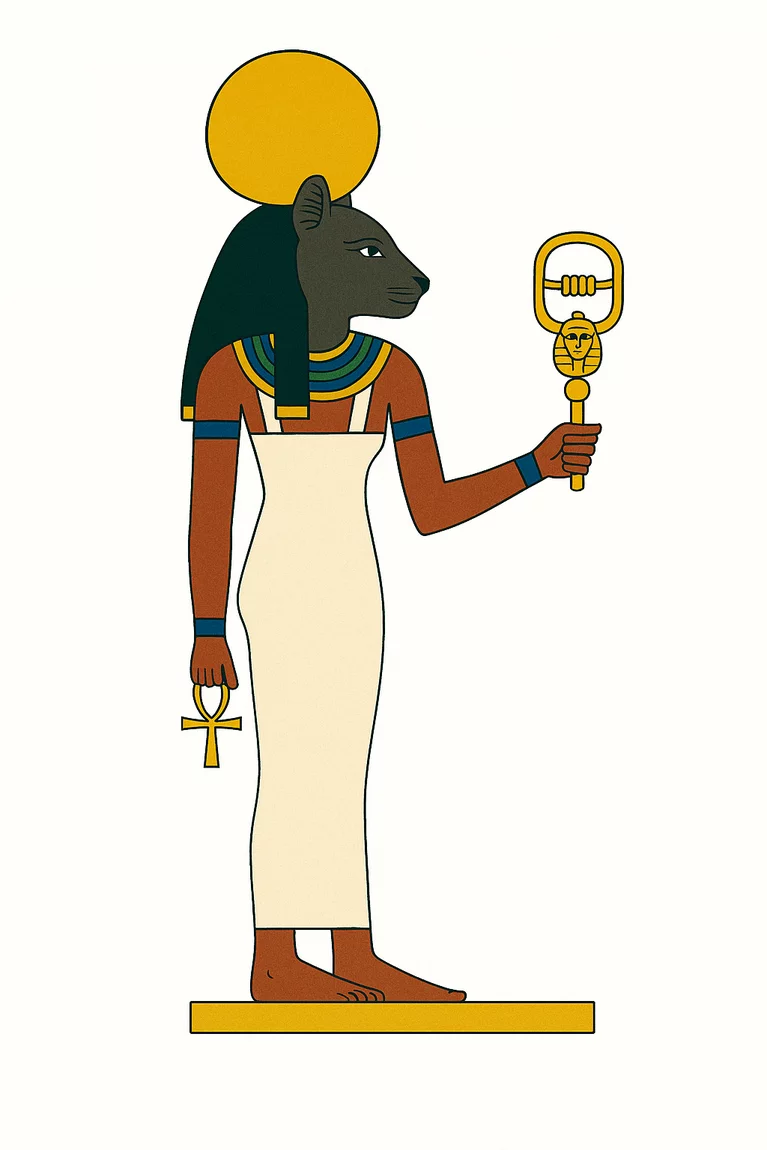
Bastet is one of the most recognisable feline deities of ancient Egypt. Her image as a cat, or as a woman with a cat’s head, today suggests the gentleness of the home. The ancient sources give her a richer personality, though: she protects, delights in music and can also show the dangerous power of a solar goddess. Her great cult centre was Bubastis, in the Nile Delta. To understand her, we need to look at objects, festivals and the development of her images together.
From lioness to cat
Images of Bastet did not always look the same. Early representations can give her a lioness’s head; the cat form becomes especially familiar in later periods. This iconographic development does not simply tell of a violent goddess turning into a harmless one. The protective and fearsome qualities of a feline power can coexist. A mother cat defends her kittens, and the lioness imposes her strength: these animals offered several ways of thinking about one divine presence.
Bastet is sometimes linked with Sekhmet, another feline goddess with a lioness’s head. That does not mean the two should be merged into one figure. The links change with period and place. The Global Egyptian Museum entry recalls the association of Bastet with solar power and with protection. When a text or image brings in the Eye of Ra, the precise context must be examined before attributing all the stories of that divine figure to Bastet.
Bubastis, the city of Bastet
The main sanctuary of Bastet was at Bubastis, also called Per-Bastet, ‘house of Bastet’. The city lay in the eastern Delta. Its name shows how far the cult of the goddess could shape the identity of a place. Temples, offerings and votive objects made her presence visible there. The cult was not shut up in a single city, however: figurines of Bastet and feline amulets have been found in different regions of Egypt.
Greek authors described a great festival at Bubastis, with journeys by boat, music and a large crowd. Their account is precious, but it reflects the view of outside observers and of one particular period. It cannot by itself reconstruct the whole history of the festival. Music and joy nevertheless suit a goddess whom cult objects frequently show with a sistrum, an instrument also found in the world of Hathor.
A protection close to people
Small images of Bastet circulated well beyond the great temples. A statuette or an amulet could go with wishes for health, fertility and safety. This presence in houses and among personal belongings helps to explain her popularity. It does not mean that every living cat was an individual incarnation of the goddess. We must distinguish the household animal, the animal linked to a sanctuary and the divine image made for ritual use.
Mummified cats are another witness to her cult. Some were deposited as offerings, within a religious and economic system that varied over time. An animal necropolis is therefore not just a sign of a modern affection for cats. It tells us about votive practices, the organisation of sanctuaries and the relations between worshippers and deity. The objects kept in museums allow the material and form of these devotions to be studied.
Reading her image
In the illustration on this page, Bastet appears standing, with a feline head, a sistrum and colourful jewellery. The drawing takes up easily recognised attributes without claiming to represent every ancient variant. In Egyptian art, a seated cat, a cat-headed woman or a more leonine figure can all evoke Bastet, depending on the context. The name written near an image, its findspot and the object that carries it remain decisive for identifying it.
The goddess thus brings together several scales of religious life: the city that bears her name, the collective festival, the object offered to the temple and the amulet kept close at hand. Her lasting success may lie in this ability to bring joy and vigilance into dialogue. Bastet protects a living space; her gentleness never entirely erases the strength of the feline.
Sources and references
Reference works
- Richard H. Wilkinson, The Complete Gods and Goddesses of Ancient Egypt, London, Thames & Hudson, 2003, entry Bastet
- Christian Leitz (ed.), Lexikon der ägyptischen Götter und Götterbezeichnungen, 8 vols, Leuven, Peeters, 2002–2003 (Orientalia Lovaniensia Analecta 110–116 and 129)