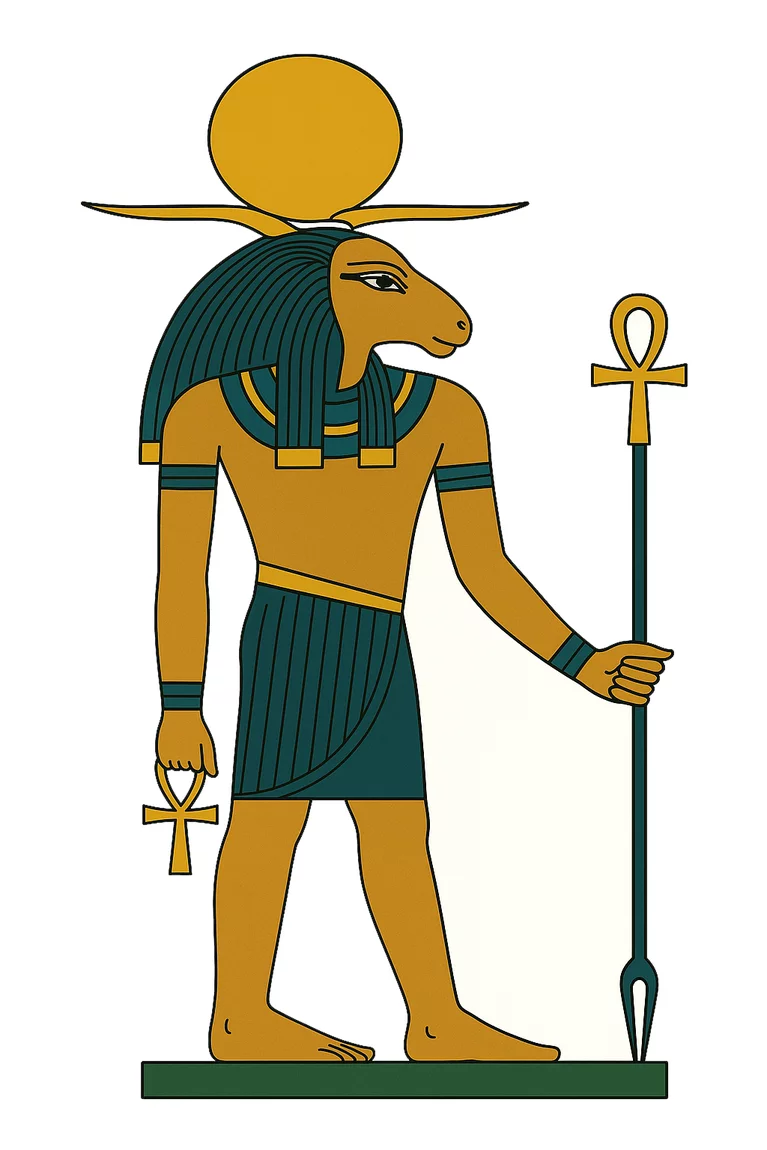
Khnum is a ram-headed god closely linked to Elephantine, near Aswan, and to Esna. The traditions of these places present him as lord of the waters of the First Cataract and as a creator who shapes beings on a potter’s wheel. His image brings together the fertile silt, birth and the vital power of the ram. Yet the stories differ from one sanctuary to another: the Khnum of Elephantine and the Khnum of Esna cannot be reduced to a single story.
The water of the Nile at Elephantine
Elephantine lies on an ancient frontier of Egyptian territory, where the Nile passes through a region of rocks and rapids. Its waters were imagined to come from a primordial reservoir linked to Nun. Khnum could be regarded as the protector of this source and of the flood. The water brought with it the silt on which the crops depended. The landscape thus gave concrete force to the stories of creation and fertility.
At Elephantine, Khnum is associated with Satet and Anuket. Their relationship in the local cult expresses the wealth of a single place: cataract, fresh water, fertility and protection. Triads are not always families in the strict human sense. You have to look at the inscriptions and festivals to understand how each sanctuary ordered its divine powers.
The potter of living beings
Another major theme shows Khnum forming humans on his potter’s wheel. He can shape the body and the ka, the vital dimension of the person. Moist earth then becomes the material of a birth. This story should not be read as a description of a craft literally practised by a divine statue. The potter’s gesture makes an idea visible: giving life a singular form. In some images and texts, Khnum even contributes to the growth of the child in its mother’s womb.
The goddess Heqet is sometimes linked to this birth. She animates or protects what Khnum shapes. The Global Egyptian Museum stresses this cooperation, as well as the variety of creative roles attributed to the god. At Esna, other local theologies enlarge his circle further. Describing Khnum as ‘the potter of humankind’ is therefore right, but it does not sum up his whole cult.
One ram among others
The ram’s head sets Khnum apart in many images. His horizontal, twisted horns can help to recognise him. Amun often wears other forms of horn, and Banebdjedet has his own cult centre at Mendes. The animal alone is therefore not enough to name a figure. Inscriptions and provenance remain decisive, especially when attributes have been borrowed or reinterpreted.
The drawing shows him standing, with a ram’s head and his usual attributes. Ancient images also show Khnum as a whole ram. One temple representation may stress his creative role, another the cataract, yet another a solar relationship. The iconography serves the function of the place rather than a single official portrait.
Khnum finally invites us to link two realities we sometimes keep apart: matter and life. Water, silt and the potter’s work offer a language for thinking about how a being is formed. His cult thus gives the landscape of the Nile a religious meaning, while keeping the local variants that each site developed over time.
Sources and references
Reference works
- Richard H. Wilkinson, The Complete Gods and Goddesses of Ancient Egypt, London, Thames & Hudson, 2003, entry Khnum
- Christian Leitz (ed.), Lexikon der ägyptischen Götter und Götterbezeichnungen, 8 vols, Leuven, Peeters, 2002–2003 (Orientalia Lovaniensia Analecta 110–116 and 129)