A presence beside families
Thoueris is the Greek name, often used in French, for Taweret, a goddess who protected pregnancy, childbirth and young children. The British Museum presents her among the powers whose image could accompany domestic life. Her place is not only that of a temple figure. A small amulet, a household object or an image worn close to the body answers a very concrete worry: getting through a birth unharmed and defending a fragile life. The material evidence thus gives access to everyday hopes that the great royal monuments do not always tell.
The Metropolitan Museum also associates Taweret with safety in childbirth and with the health of the newborn. This does not allow us to reconstruct a precise ritual automatically for each surviving object. A figurine could be worn, deposited or kept in a domestic space depending on its type and context. Museums describe the objects available; many have lost part of their history. The frequency of protective images nevertheless shows that concern for mother and child was strongly present in Egyptian religious life.
A composite body made to protect
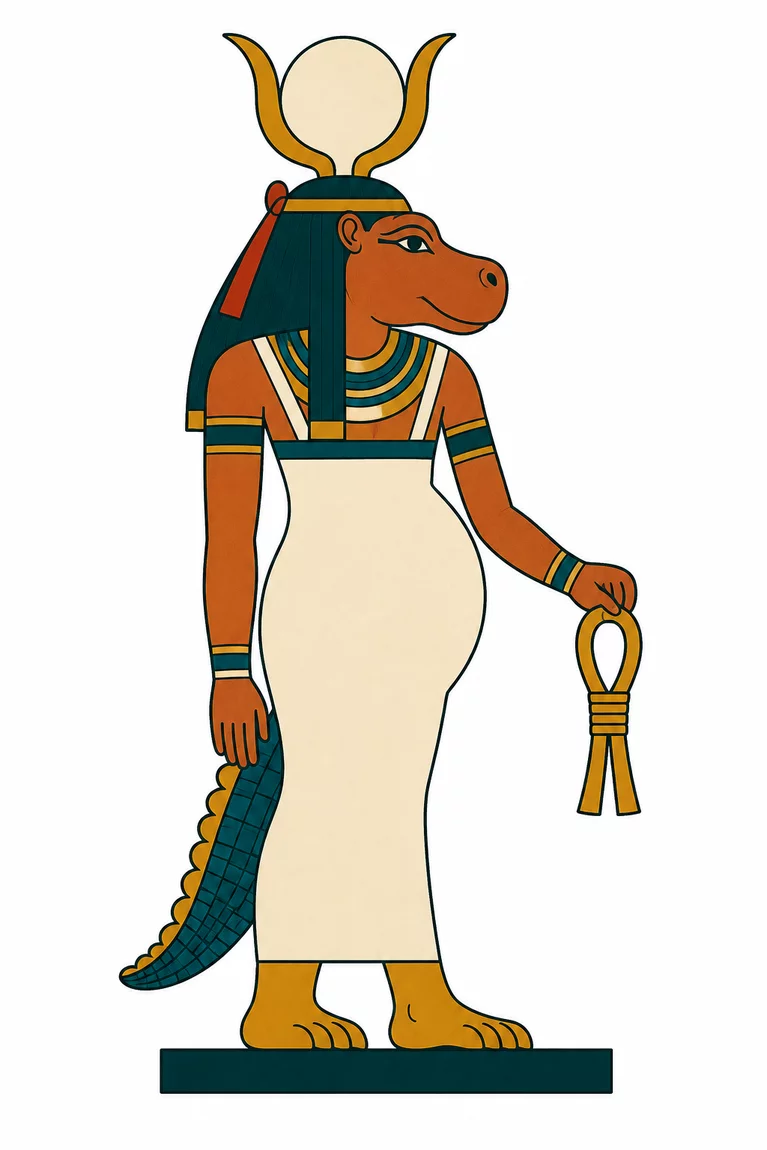
Taweret has a singular appearance: the head of a hippopotamus, a rounded belly, powerful limbs and often a crocodile’s tail. The British Museum and the Walters Art Museum describe these elements on particular works. The composite body should not be understood as a disturbing creature meant to frighten the family. It gathers animal strengths able to drive back a danger. The female hippopotamus fiercely protects her young, an image that helps a modern eye grasp why this silhouette could evoke maternal defence.
Our contemporary illustration takes up the main documented features and shows the goddess standing on a base, in the style of the other figures on the site. An ancient work may show more detail or a different posture. Some representations carry a sign of protection; the object in question must be examined before generalising. The marked belly indicates her relationship with pregnancy, but the goddess is not reduced to an anatomical allegory. Her power was directed at the house, the people in it and the delicate passage towards a new life.
A shared protection
Bes also appears among the protective powers of birth and childhood. Bringing them together helps us understand a practice in which several images could answer the same fear, without making the two deities identical. Hathor and Isis also take part in traditions linked to motherhood, but their stories and cults are wider. Taweret keeps her own silhouette and uses. Egyptian households did not need a perfectly classified theological system in order to ask several gods for protection.
Amulets make it possible to follow Taweret over a long period, but we should avoid freezing her cult in a single era. Material, technique and findspot change the possible meaning of an object. An image displayed in a museum today first belonged to a world of gestures, bodies and fears. The name Thoueris brings French-speaking readers closer to this goddess, while Taweret connects them to international catalogues. Together, these two forms name a presence whose protective strength was thought of as very close to human life.
Sources and references
- British Museum, Taweret
- British Museum, Taweret amulet
- Metropolitan Museum, Taweret and birth
- Walters Art Museum, figure of Taweret
Reference works
- Richard H. Wilkinson, The Complete Gods and Goddesses of Ancient Egypt, London, Thames & Hudson, 2003, entry Taweret
- Christian Leitz (ed.), Lexikon der ägyptischen Götter und Götterbezeichnungen, 8 vols, Leuven, Peeters, 2002–2003 (Orientalia Lovaniensia Analecta 110–116 and 129)