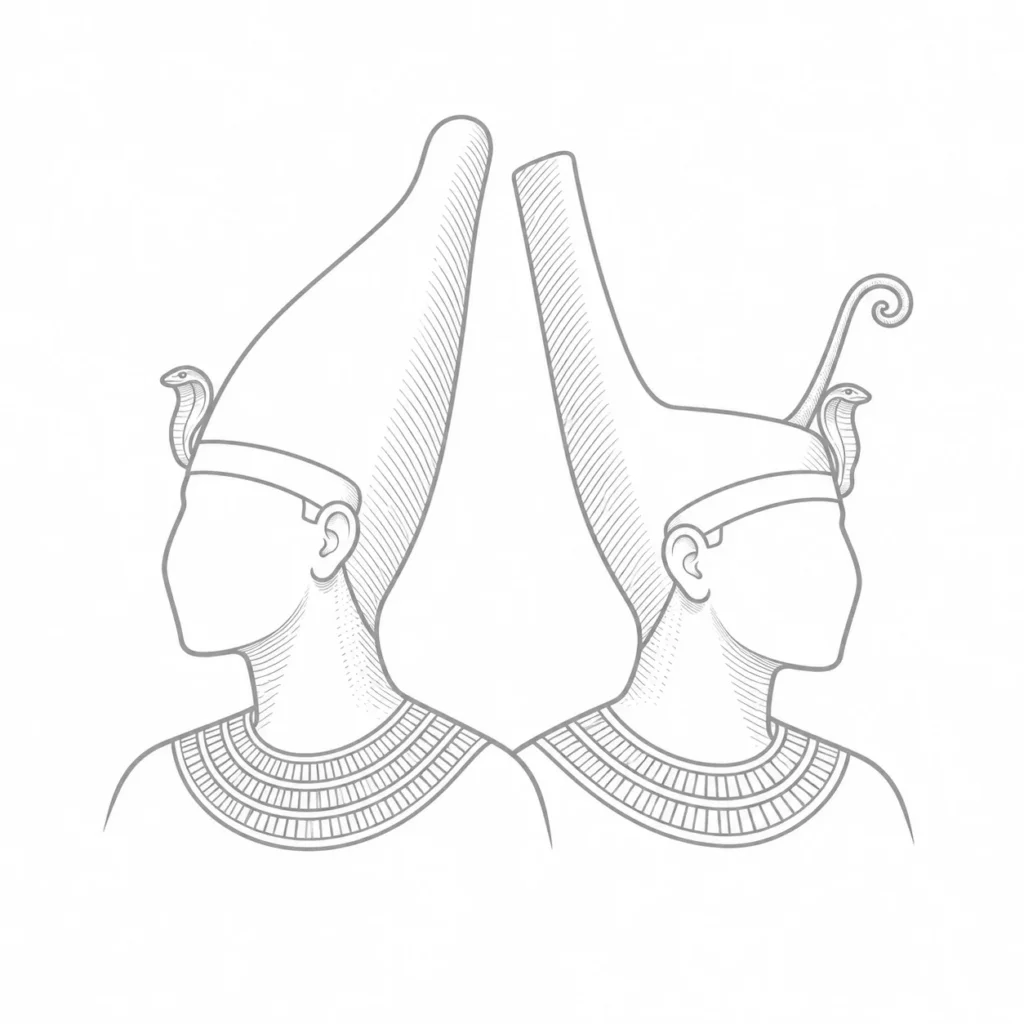
A king of the 5th Dynasty
Neferirkare, whose personal name was Kakai, reigned during the 5th Dynasty. He should not be confused with a ruler of the same name placed much later, in the 8th Dynasty, by some lists. His pyramid at Abusir and the archives of his mortuary temple give his history a particular depth. The exact dates of the reign depend on the chronology chosen; his place in the series of builder kings at Abusir is better established. The contemporary inscriptions do not form a continuous biography. They nevertheless make it possible to study the royal cult, the personnel who served it and the way an institution could go on functioning after the death of its founder. In the chronology of Ian Shaw (Oxford, 2000), his reign falls c. 2475–2455 BC.
The pyramid and its complex
Neferirkare had his funerary complex laid out in the necropolis of Abusir, already marked by the pyramid of Sahure. The form of the surviving monument results from building phases and later destruction; the original intentions must be distinguished from the state visible today. The adjoining temple was the centre of the rites and offerings intended for the dead king. Its operation required storerooms, cult objects, food and a regular organisation of service. The complex was therefore not a fixed construction completed for the funeral alone. It was conceived as a foundation meant to live on over time, under the responsibility of priests and administrators whose surviving documents reveal part of their tasks.
The papyri of the mortuary temple
The Abusir papyri associated with the cult of Neferirkare are among the most valuable groups of archives from the Old Kingdom. They do not recount the ruler’s exploits; they record ordinary activities: duty rosters, deliveries and tasks carried out in the temple. Their fragmentary nature calls for reconstruction, but it also allows us to hear an administrative voice contemporary with the royal institutions. The documents shed light on the gap between the ideal image of the eternal king and the daily work needed to maintain his cult. They show that monarchical memory rested on people, goods and calendars. Their exceptional preservation does not mean that all temples worked in the same way.
Staff on rotation
Some sheets of the archives present columns assigning tasks to individuals by day. A note may even record that a scheduled service was not carried out. These details give access to an administration attentive to the conduct of the rituals and to the responsibilities of the staff. They do not, however, provide the full set of rules for the temple’s recruitment, remuneration or hierarchy. The surviving names are a reminder that behind the great façades of Abusir worked real teams, responsible for offerings to the statues and for supplies. Neferirkare’s history thus continues well after his death: the institution created for him became a place of work and management that the papyri make exceptionally visible.
Decrees and private biographies
A decree concerning the personnel of a temple, discovered at Abydos, bears the name of Neferirkare. The biography of a dignitary named Rawer is another attestation of the ruler. These sources show different aspects of royal authority: the regulation of a religious establishment and the memory of a relationship with the court. Their interpretation must take account of the function of each inscription. A decree preserved on stone does not reveal the whole administration of the country; a funerary autobiography enhances the career of its owner. Together, however, they broaden the portrait of a king sometimes reduced to the papyri found in his complex. They attest that royal power was expressed through concrete interventions in institutions and through relations with the elites.
A sun temple not yet located
The sources mention for Neferirkare a sun temple called Setibre, but its location has not been identified with certainty. The absence of recognised remains should not lead us to deny its existence, any more than it allows us to imagine its plan freely. It is a reminder that the documentation of the 5th Dynasty is very uneven from one site and one material to another. The sun temple very probably completed the ruler’s programme, in a dynasty in which the association with Ra had a strong monumental expression. The pyramid, the mentions of the sanctuary and the archives of the funerary cult must be considered together, while keeping distinct the degree of certainty proper to each category of evidence.
A history of the reign and its memory
Neferirkare’s influence lies less in a list of known campaigns than in the abundance of traces left by his foundations. The pyramid places the king in the geography of Abusir; the decrees and biographies document the exercise of power; the papyri show how his ritual presence was maintained. This last aspect explains why his record is so important for the economic and religious history of the Old Kingdom. The archives should not be projected without care onto the years when he was still alive, since part of them belongs to the later operation of his temple. They nevertheless reveal the lasting system that a monarchy could create around its name and its tomb.
Main sources
- UCL Digital Egypt, Neferirkare
- UCL Digital Egypt, the Abusir papyri
- UCL Digital Egypt, translation of fragments of the Abusir papyri
- Crowns drawn from the statue of Senusret I and the relief of Ahmose, Metropolitan Museum of Art.
Reference works
- Ian Shaw (ed.), The Oxford History of Ancient Egypt, Oxford, Oxford University Press, 2000, chronology pp. 479–483
- Aidan Dodson and Dyan Hilton, The Complete Royal Families of Ancient Egypt, London, Thames & Hudson, 2004