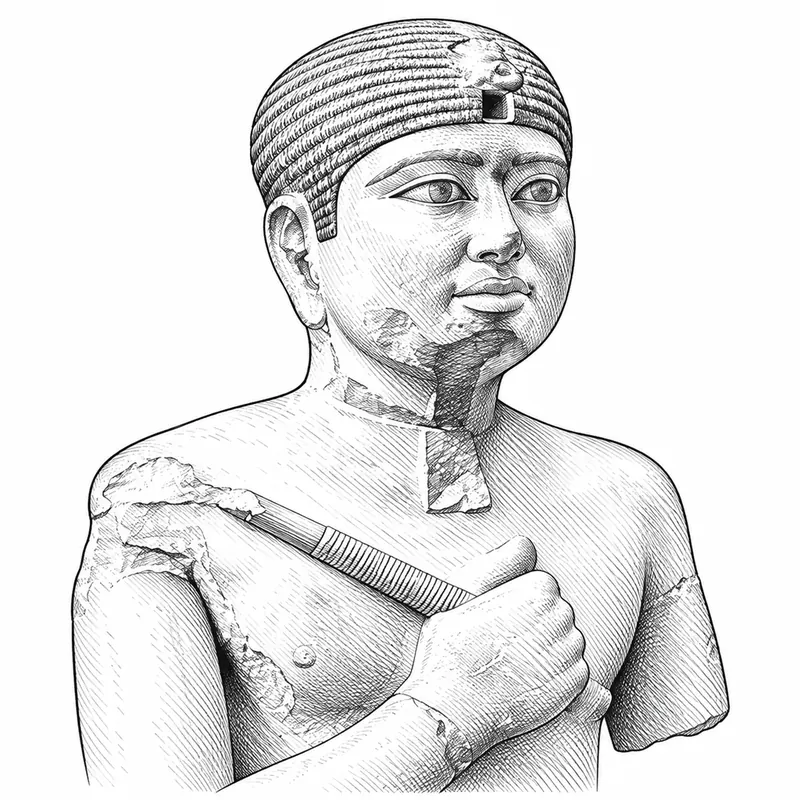
A ruler with a short reign
Neferefre, also called Raneferef in some publications, belongs to the 5th Dynasty and reigns after Neferirkare in the usual chronology. His reign seems to have been short, but the precise figures are not certain. This brevity left a remarkable material trace: the pyramid complex at Abusir was not raised according to its original plan. For a long time the ruined building seemed to offer little information. The excavations of the Czech Institute of Egyptology revealed, on the contrary, a royal tomb that had been used, a mortuary temple, sculptures and archives. The case of Neferefre shows that an unfinished monument can document a period abundantly, provided that the work undertaken under the king is distinguished from that carried out after his death. In the chronology of Ian Shaw (Oxford, 2000), his reign falls c. 2448–2445 BC.
A project turned into a tomb
The pyramid planned at Abusir did not get beyond the first stages of construction. After the ruler’s death, the builders had to adapt the structure to allow the funeral to take place and to maintain a place of worship. Researchers at Charles University describe a monument that took on the appearance of a large mound or low structure rather than a completed pyramid. A papyrus from the temple uses a term evoking the funerary mound. This ancient designation helps us understand how the Egyptians themselves could name the result. We must avoid projecting onto the present ruin the image of a building site simply abandoned: works were carried out to give the king a burial and a ritual memory.
The burial chamber and the human remains
The excavations uncovered fragments of the red granite sarcophagus and items of funerary equipment. Human remains found in the chamber have been studied and attributed to the king by the researchers, an attribution resting on the archaeological context and on specialist analyses. These discoveries reinforce the idea that the monument was indeed used as a tomb. They do not allow us to reconstruct all the rites performed at the funeral or the full appearance of the vanished grave goods. Plundering and destruction have profoundly altered the original deposit. The value of the record lies in the convergence of location, architecture, objects and archives, rather than in a single element presented as absolute proof.
A temple built to last
The mortuary temple was begun in stone near the monument, then largely completed in mud brick after the ruler’s death. This difference in materials makes visible the constraints of an interrupted building site and the solutions chosen by the successors. The royal cult could not wait for the hypothetical completion of a monumental pyramid: it needed rooms, storerooms, offerings and staff. Statues of the king and ritual objects found in the area show that the complex was indeed in use. The architecture is thus a reminder that a funerary complex was not defined by its superstructure alone. Its function also rested on a community of servants and on practices maintained after the funeral.
The Abusir papyri and seals
The administrative archives discovered in Neferefre’s temple are a major source on the services of the funerary cult. The papyri record tasks and resources, while numerous seal impressions give information on checks and movements within the institution. Studying these fragments calls for great caution: an isolated impression does not describe a whole office, and the surviving files represent only part of the original archives. Their abundance nevertheless makes it possible to link the spaces of the temple to concrete activities. Neferefre’s short reign thus had a long administrative afterlife, better documented than many longer reigns.
The royal family and the succession
The Abusir complex also includes the monument of Queen Khentkaus II, linked to the same dynastic circle. The proximity of the tombs and the inscriptions have helped researchers discuss the family relationships between Neferirkare, Neferefre and Niuserre. These reconstructions require distinguishing secure kinship from hypotheses about the exact order of the reigns. The continuation of the work after Neferefre’s death shows that a succession was not limited to building a new tomb: the heirs also had to settle the obligations left by the dead king. The changes of plan at Abusir are clues to this dynastic management. They are not enough to recount all the possible tensions at court.
The historical interest of an interrupted building site
Neferefre left no detailed account of his political actions, but his complex has become a laboratory for the history of the Old Kingdom. It shows the transformation of an architectural project, the rapid organisation of a functioning tomb, the production of statues and the continued management of a cult. The work of the Czech team has corrected the old impression of a pyramid abandoned before any use. The record also teaches a method: understanding a reign requires comparing building layers, objects and writings. What seems incomplete in stone can prove very rich when the traces of the institution that surrounded it are studied together.
Main sources
- UCL Digital Egypt, Neferefre
- Czech Institute of Egyptology, the unfinished pyramid of Neferefre
- Czech Institute of Egyptology, Abusir in the third millennium BC
- Charles University, study of the seal impressions of Raneferef
Reference works
- Ian Shaw (ed.), The Oxford History of Ancient Egypt, Oxford, Oxford University Press, 2000, chronology pp. 479–483
- Aidan Dodson and Dyan Hilton, The Complete Royal Families of Ancient Egypt, London, Thames & Hudson, 2004