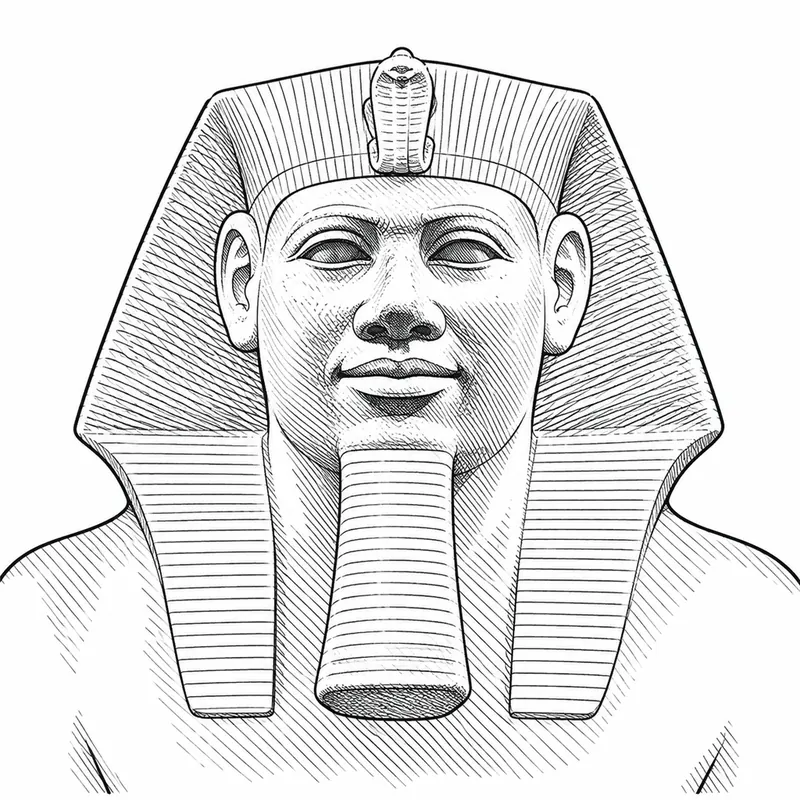
A king of the 5th Dynasty
Sahure succeeds Userkaf in the usual chronology of the 5th Dynasty. He had his pyramid complex built at Abusir, north of Saqqara, and his reign is particularly visible thanks to the reliefs of his temples. The exact dates differ from one work to another, but the ruler’s place among the first kings of the dynasty is well established. A sun temple bearing his name is mentioned in written sources, but its location has not been found. The surviving monuments tell us more about the king’s public image than about the sequence of his personal decisions. They nevertheless shed light on the scale of his architectural programme and on the relations of power with other regions. In the chronology of Ian Shaw (Oxford, 2000), his reign falls c. 2487–2475 BC.
The pyramid complex at Abusir
Sahure’s pyramid stood at the centre of a complex comprising temples, a causeway and the spaces needed for the funerary cult. The site of Abusir would become one of the main royal necropolises of the 5th Dynasty. Archaeological research has shown the attention paid to the layout of the courts, the materials and the decoration. The pyramid itself has lost much of its mass and casing, while parts of the temple make it possible to understand the original ambition. It would be misleading to judge this complex only by its present height or by comparison with Giza. In Sahure’s time, the temples and their programmes of images held a particularly important place in the expression of royal power.
Columns from Aswan
The court of the pyramid temple had sixteen monumental columns with capitals evoking palm fronds. A column in the Metropolitan Museum bears the king’s names and epithets. Carved from granite quarried at Aswan, it was transported over a very long distance to Abusir. Its form translates into stone older elements made of wood and plant fibres. The object bears witness both to a carefully developed architectural language and to a capacity for material organisation. Quarrying, shipping, carving and erection required a range of skills. The example does not on its own allow us to calculate the number of workers employed, but it makes tangible the chain of tasks behind a monument that is sometimes reduced to its pyramid alone.
The reliefs and the representation of power
The walls of the complex bore scenes of victory, of encounters with the gods and of the presentation of offerings. They displayed a ruler who was victorious, pious and able to draw wealth towards the sanctuaries. Reading them requires distinguishing the ritual message from the historical event: a triumph scene does not automatically prove a dated and accurately described campaign. The interest of these reliefs also lies in their quality and in the variety of the themes represented. They are a major source for the art of the Old Kingdom and for the study of royal ceremonies. Their fragmentary state calls for comparing the surviving blocks with early records and with the research carried out on the site.
Movements beyond the valley
Inscriptions at Wadi Maghara, in Sinai, bear the name of Sahure. They attest the court’s interest in areas of resources and routes outside the Nile Valley. Seals found at Buhen, in Nubia, widen the documentary geography of the reign still further. The reliefs have sometimes been used to reconstruct maritime expeditions and relations with the Levant or the southern regions; these interpretations must always be compared with the available objects and inscriptions. The presence of the royal name does not mean the same form of control everywhere. The record nevertheless shows that the monarchy of Abusir had networks of exchange and intervention reaching far beyond the Memphite necropolis.
The sun temple known from texts
The UCL chronology records a sun temple of Sahure, named Sekhetre, attested in written sources but not identified on the ground. This situation recalls a constant limit of Egyptian history: an institution may be known by its name even though its architecture has disappeared or has not been found. We must avoid freely drawing its plan from the better-known temple of Niuserre. Its mention nevertheless shows that Sahure took part in the series of solar foundations inaugurated under Userkaf. The coexistence of a sun temple and a pyramid complex links the cult of Ra with the ruler’s destiny. The details of the rites and of the administration of this sanctuary are less certain.
A lasting architectural influence
The study of Sahure’s temple shows that several solutions in its plan were taken up by later rulers. The columned court, the treatment of the reliefs and the organisation of the cult spaces are among the features that made the complex at Abusir an important model. This influence does not imply that all the following monuments were faithful copies: each reign adapted the legacy it received to its own terrain and resources. Sahure’s remains thus shed light on a time when royal prestige was expressed as much through decorated temples as through the mass of the pyramid. The man remains difficult to know, but his monumental programme is among the major landmarks of the 5th Dynasty.
Main sources
- UCL Digital Egypt, Sahure
- Metropolitan Museum of Art, Palm Column of Sahure
- Metropolitan Museum of Art, study of the column of Sahure
- Metropolitan Museum of Art, Egypt in the Old Kingdom
- Model for the line portrait: Sahure with a nome god, Metropolitan Museum of Art, 18.2.4.
Reference works
- Ian Shaw (ed.), The Oxford History of Ancient Egypt, Oxford, Oxford University Press, 2000, chronology pp. 479–483
- Aidan Dodson and Dyan Hilton, The Complete Royal Families of Ancient Egypt, London, Thames & Hudson, 2004