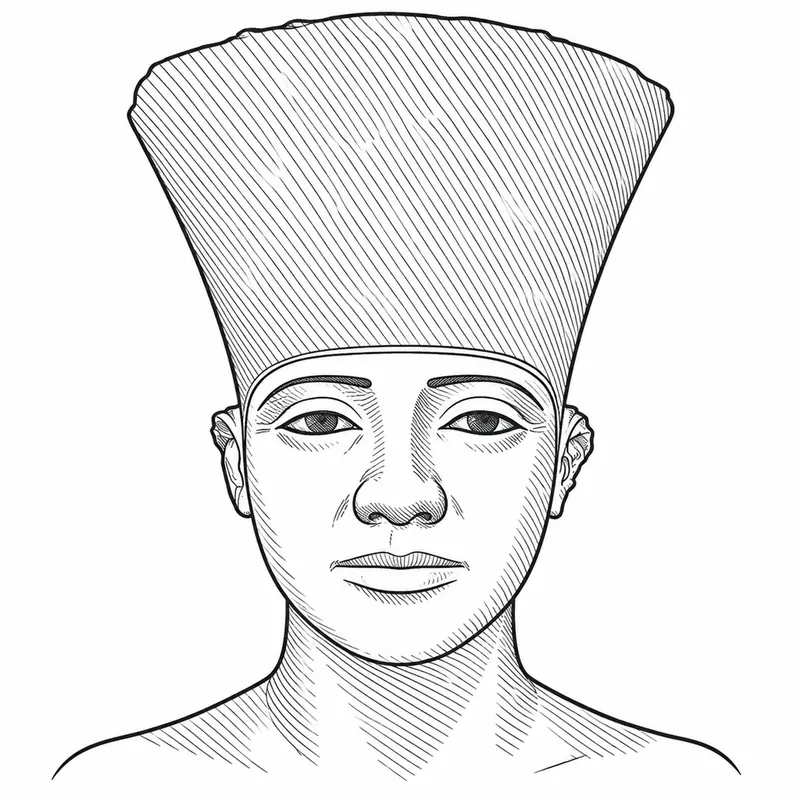
The beginning of the 5th Dynasty
Userkaf is generally placed at the beginning of the 5th Dynasty. The king lists compiled long after his time draw a dynastic boundary, but the remains also show continuities with the 4th Dynasty. His reign is known above all from a pyramid at Saqqara and from a temple dedicated to the sun at Abu Ghurab. This second monument holds a decisive place: it inaugurates a form of royal sanctuary that several successors would take up. The precise dates of the reign remain conventional for the Old Kingdom. Rather than looking for a single founding event, we should observe how the funerary and solar programmes complement each other in the representation of the monarchy. In the chronology of Ian Shaw (Oxford, 2000), his reign falls c. 2494–2487 BC.
A pyramid near Djoser
Userkaf chose Saqqara for his funerary complex, near the great complex of Djoser. His pyramid has suffered greatly from time and stone robbing; its ruins do not give a faithful picture of the original project. It had the expected components of a royal monument, notably cult spaces intended for offerings and for the memory of the ruler. The location recalls the historical depth of the Memphite necropolis. It should not, however, be taken as a documented wish to present himself as Djoser’s personal heir. The topography sheds light on a choice, while the king’s exact intentions remain less accessible than the walls, foundations and objects found on site.
The sun sanctuary at Abu Ghurab
Userkaf’s sun temple, named Nekhenre in the sources, stood at Abu Ghurab, north of Abusir. It is the oldest known royal sun temple in this series. It did not replace the pyramid: the two complexes served linked but distinct functions in the cult of the king and of the god Ra. The state of the site is the result of extensive destruction, so that reconstructing its plan and development requires archaeological study. The seals, pottery and a statue head found during the excavations complement the architecture. It is thus possible to follow the institution of the solar cult without projecting onto the first building all the better-preserved features of the temple of Niuserre.
Ra and the image of the ruler
The development of sun sanctuaries bears witness to the growing importance of Ra in the royal ideology of the 5th Dynasty. It would be misleading, however, to present Userkaf as the sudden inventor of a previously unknown cult: the sun already held a major place in Egyptian kingship. What was new was a specific monumental programme, built in addition to the pyramid. This choice made it possible to link the cult of the god, that of the living or deceased ruler and the resources assigned to royal foundations. The surviving texts do not detail all the ceremonies. The study of the monument and its personnel provides a safer framework than later stories about a supposed religious revolution.
Traces of the cult personnel
Private tombs offer a glimpse of how the institutions founded by Userkaf worked. Nikauhor, for example, is presented by the Metropolitan Museum as a priest of the sun temple and of the king’s funerary cult. His monument is a reminder that these establishments depended on people responsible for offerings, services and the transfer of resources. Biographies and titles do not give a complete organisational chart, but they link the great buildings to individual careers. A sun temple was therefore not only a spectacular architectural form; it belonged to a religious economy sustained over time. The reading of this evidence must take account of its funerary function and of the owners’ wish to celebrate their own status.
A transition without a simple break
The 5th Dynasty went on building pyramids while developing sun temples and more extensive reliefs in the royal complexes. Userkaf stands at the starting point of this new combination. The categories of ‘new dynasty’ and ‘religious change’ are useful, but they can give the impression of an immediate shift that the documents do not demonstrate. His pyramid continues older practices, his sun sanctuary opens a series of projects and his successors would make yet other choices. The significance of his reign lies in this interplay between continuity and innovation. The exact length of his rule and any military actions remain too poorly documented to hold a central place in his history.
What the remains allow us to establish
Userkaf emerges as a ruler whose funerary programme cannot be understood from a single site. Saqqara preserves the trace of his royal tomb; Abu Ghurab documents the first known example of a type of sun temple. The inscriptions and the tombs of priests show that these places were part of active institutions. The destroyed parts of the architecture limit the precision of reconstructions, and the king’s day-to-day decisions are poorly known. Despite these gaps, his monuments shed light on a lasting transformation of Old Kingdom kingship: a more visible connection between the solar cult and royal funerary memory.
Main sources
- UCL Digital Egypt, Userkaf
- UCL Digital Egypt, Abu Ghurab and Abusir
- Metropolitan Museum of Art, Nikauhor and Sekhemhathor
- Metropolitan Museum of Art, Egypt in the Old Kingdom
- Model for the line portrait: head known as Userkaf, Egyptian Museum, Cairo.
Reference works
- Ian Shaw (ed.), The Oxford History of Ancient Egypt, Oxford, Oxford University Press, 2000, chronology pp. 479–483
- Aidan Dodson and Dyan Hilton, The Complete Royal Families of Ancient Egypt, London, Thames & Hudson, 2004