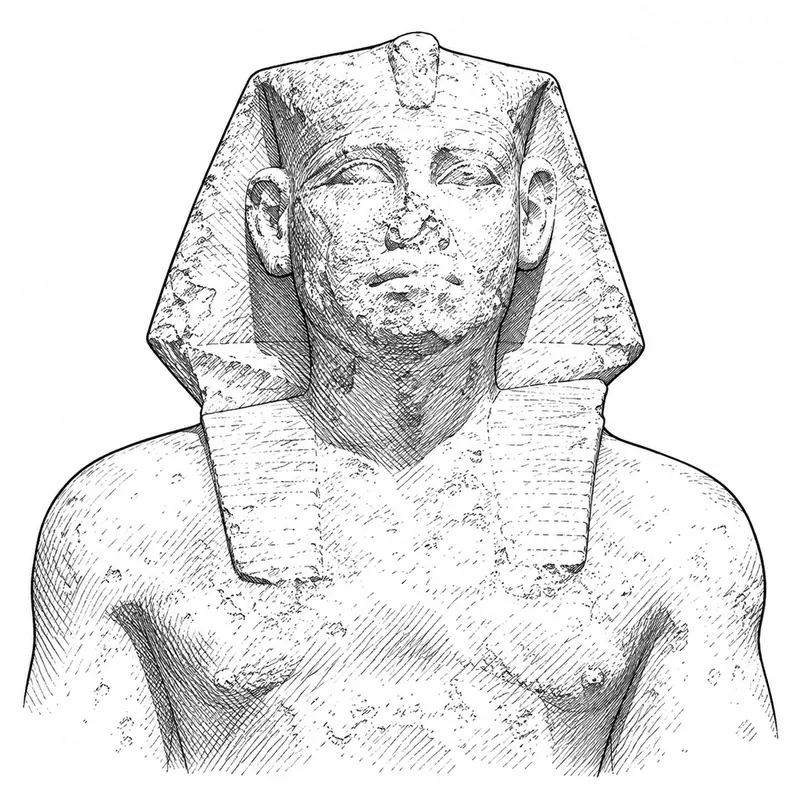
A king at the heart of the 5th Dynasty
Niuserre reigned during the 5th Dynasty, in a royal family linked to the monuments of Abusir. His place after Neferefre is generally accepted, even though the details of the succession have been debated. He has a pyramid at Abusir and a sun temple at Abu Ghurab, two complementary complexes for understanding how his power was expressed. The absolute dates of the reign remain approximate. Monuments and inscribed objects provide more solid documentation than later stories about the rulers of this period. Niuserre emerges above all as a king able to carry out great building works and to give the solar cult a particularly elaborate architectural and figurative form. In the chronology of Ian Shaw (Oxford, 2000), his reign falls c. 2445–2421 BC.
The pyramid within Abusir
Niuserre’s funerary complex rises among the other royal monuments of Abusir. This proximity obliges us to study the relationships between the projects of several reigns: access routes, temples and occupied spaces were not independent undertakings on empty ground. His pyramid, badly damaged, no longer gives the full picture of the original building. The temple and associated remains shed light on the organisation of the dead ruler’s cult. As with other kings of the 5th Dynasty, the historical value of the site goes beyond the height of the pyramid. The building phases and later transformations need to be distinguished, since the same funerary landscape continued to be maintained and adapted after the death of the first builders.
The sun temple and its obelisk
At Abu Ghurab, Niuserre built one of the best-known sun sanctuaries of the Old Kingdom. Its programme included a platform dominated by a monumental form evoking the obelisk, courts and decorated passages. The sanctuary was not a tomb; it belonged to another dimension of the royal cult, linked to Ra and the cycle of the sun. The excavations recovered elements of the plan and many fragments of reliefs. Their dispersal complicates the exact reconstruction of each wall, but it allows the chosen themes to be analysed. Comparison with the earlier temple of Userkaf shows that the rulers of the same dynasty developed a type of monument without reproducing it identically.
The reliefs of the Sed festival
Several sculpted groups in the temple depict the Sed festival, a ceremony linked to the renewal of royal power. The surviving fragments come notably from a corridor and a chapel near the obelisk platform. Their distribution is a reminder that an isolated scene, now displayed in a museum, belonged to a specific architectural route. Researchers estimate that a large part of the chapel reliefs has survived, while other series are almost entirely lost. These images are a first-rate source for the forms of the festival, without being a photographic record of a particular ceremony held under Niuserre. They present the ideal renewal of the king’s power in a sacred setting.
The Room of the Seasons
Another group of reliefs, called by Egyptologists the ‘Room of the Seasons’, showed aspects of nature and its rhythms. This decoration linked the sun sanctuary to the cyclical order of the world: the return of light, growth and human activities depended on a regular time that kingship had to preserve. The fragments do not allow every detail of the original composition to be reconstructed. They show, however, that the temple did not speak only of the king in court scenes; it pictured an ordered universe. We should avoid reading it as a complete scientific calendar. The richness of the representations lies in the combination of observation of living things and a religious conception of the solar cycle.
A wider network of attestations
Inscriptions of Niuserre are known at Wadi Maghara, in Sinai. A faience plaque from the temple of Satis on Elephantine and an object found at Byblos widen the map of attestations. These traces show that the king’s name circulated in several spaces, but each context has its own meaning. A quarry inscription, a deposit in a temple and an object that reached the Levant are not the same kind of political evidence. Bringing them together avoids reducing the reign to the monuments of Abusir, without inventing a detailed story of conquests. The surviving documentation remains selective and depends heavily on which places have been excavated.
The significance of a twofold monumental programme
Niuserre’s work combines the pyramid at Abusir and the sun temple at Abu Ghurab. The first secured a place for the dead ruler in the necropolis; the second associated his cult with the power of Ra and the regularity of the world. The reliefs of the Sed festival and of the seasons make this ideology exceptionally visible. They explain why his reign holds a central place in the study of the art and religion of the 5th Dynasty. The archives do not allow the day-to-day acts of government to be described as precisely. It is architecture, considered together with objects from other regions, that provides the most solid historical portrait of this king.
Main sources
- UCL Digital Egypt, Niuserre
- UCL Digital Egypt, reliefs of the sun temple
- UCL Digital Egypt, Abu Ghurab and Abusir
- Model for the line portrait: double statue of Niuserre, Staatliches Museum Ägyptischer Kunst, Munich, ÄS 6794.
- Reference photograph: Einsamer Schütze, CC BY-SA 3.0.
Reference works
- Ian Shaw (ed.), The Oxford History of Ancient Egypt, Oxford, Oxford University Press, 2000, chronology pp. 479–483
- Aidan Dodson and Dyan Hilton, The Complete Royal Families of Ancient Egypt, London, Thames & Hudson, 2004