The Achaemenid return to Egypt
Artaxerxes III reconquered Egypt in 343 BC and governed it within the Achaemenid empire until his death in 338. The victory put an end to the independent reign of Nectanebo II and opened a second period of Persian rule, much shorter than the first. UCL Digital Egypt stresses that the name of Artaxerxes is not attested in the surviving hieroglyphic inscriptions, but appears on a demotic papyrus and on coins probably struck at Memphis. This documentary difference is decisive. The king is fully present in imperial history, but his image as a traditional pharaoh is less visible than that of Darius I. This imbalance does not mean an absence of administration. In the chronology of Ian Shaw (Oxford, 2000), his reign runs from 343 to 338 BC.
The campaign against Nectanebo II
The reconquest of 343 is known mainly from later Greek accounts and from the new political situation it created. The authors describe the Persian forces, the Greek allies and the Egyptian defences with details that do not always agree. The loss of the Delta and then of the rest of the country forced Nectanebo II from power. The precise circumstances of his flight and of the surrender of the various towns are less certain. The date of the conquest, firmly established, must be distinguished from each dramatic scene. The operation proves the Achaemenid empire’s ability to return to a territory that had been independent for several decades. It also shows the difficulty for the 30th Dynasty of maintaining its alliances in the face of a large-scale offensive.
The coins of Memphis
Coins bearing the name of Artaxerxes in demotic script were probably issued at Memphis. Their iconography borrows from Greek models, notably a head of Athena, while the inscription links them to a Persian king ruling Egypt. This mixture is concrete proof of the cultural and administrative diversity of the late 4th century BC. A coin may circulate far from where it was struck; its attribution to a mint must therefore be supported by analyses of style, metal and distribution. On its own it does not measure the economy of the whole country. It nevertheless shows that an Achaemenid royal authority was expressed in a medium different from the hieroglyphic temple relief.
The demotic papyrus
The name of Artaxerxes III is also known from a document in demotic, the Egyptian script used for many administrative and private purposes. This attestation is a reminder that the absence of surviving hieroglyphic cartouches does not mean the king was unknown to Egyptian scribes. The scripts fulfilled different functions. The sanctuaries could favour monumental hieroglyphs, while deeds and accounts used demotic or Aramaic in the imperial context. The papyrus must be placed in its genre and its place of origin before being used to describe a general policy. Its primary value is to establish a dating and a recognition of the new ruler in a local writing milieu.
The stories of impiety and their context
Like Cambyses II, Artaxerxes III received in some Greek traditions a reputation as a ruler who was impious or brutal towards the Egyptian cults. These texts have their own history and aims. They may reflect real violence during the conquest, but their anecdotes should not be repeated without confirmation. The absence of a great temple programme in the name of Artaxerxes contrasts with the building works of Nectanebo II, without proving a single policy of destroying all the sanctuaries. The context of a military reconquest, followed by a short reign, also explains the scarcity of monuments. Literary accounts, archaeological traces and administrative documents must be compared to assess the period.
A short-lived domination
Artaxerxes III died a few years after retaking Egypt. The Persian succession continued under Arses and then Darius III, before the arrival of Alexander in 332 BC. This brevity explains why the second Achaemenid domination did not leave a monumental landscape comparable to that of the first under Darius I. It would nevertheless be wrong to treat it as a mere interlude without consequences. It changed commands, revenues and alliances, and placed Egypt back within an empire facing Macedonian expansion. The Egyptian documents show the presence of the royal name in written and monetary practice. The transition to Alexander can be understood from this immediate imperial history.
A reign known from other kinds of evidence
Artaxerxes III obliges us to change method from one period to another. For Nectanebo II, the temples provide an abundance of cartouches; for the Persian conqueror, the demotic papyrus, the coins and external accounts become central. The absence of a surviving hieroglyphic inscription must be noted without becoming a conclusion about the exercise of power. The reconquest of 343 is a major event in Egyptian history, and its aftermath prepared the Macedonian arrival. This second Persian domination, brief but real, was integrated into local practice while remaining less visible in the religious monuments.
Main sources
- UCL Digital Egypt, Artaxerxes III and his attestations
- UCL Digital Egypt, Nectanebo II and the reconquest
- UCL Digital Egypt, chronology of the Late Period
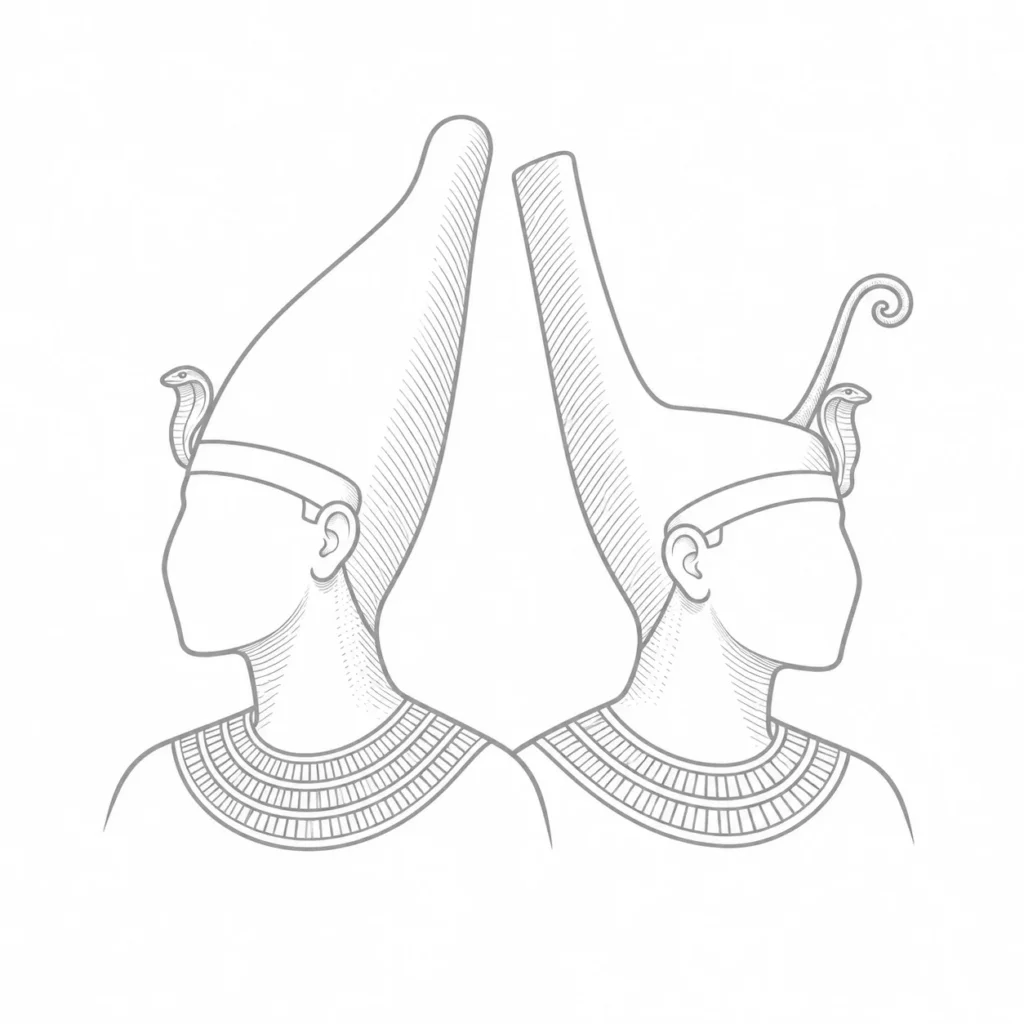
- Crowns drawn from the statue of Senusret I and the relief of Ahmose, Metropolitan Museum of Art.
Reference works
- Ian Shaw (ed.), The Oxford History of Ancient Egypt, Oxford, Oxford University Press, 2000, chronology pp. 479–483
- Aidan Dodson and Dyan Hilton, The Complete Royal Families of Ancient Egypt, London, Thames & Hudson, 2004