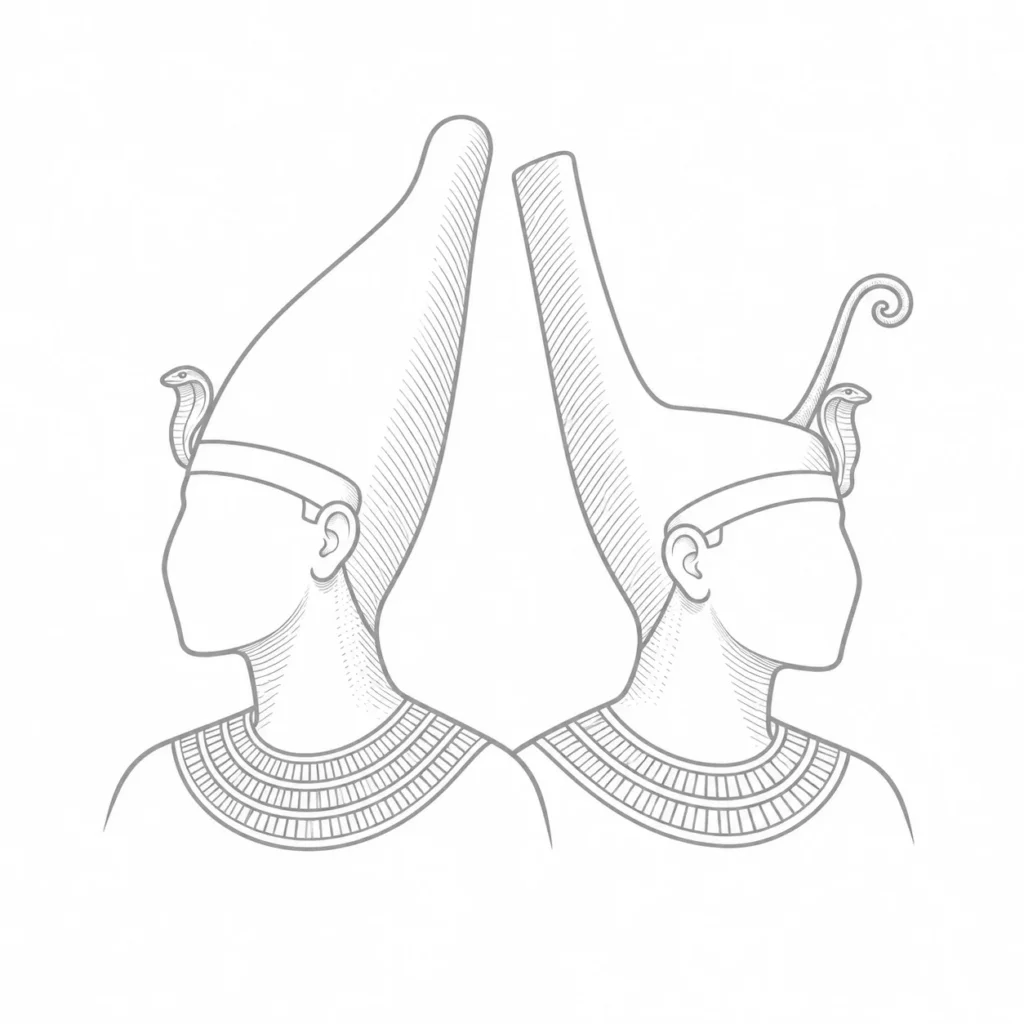
A king of the 26th Dynasty
Apries, whose Egyptian name is Wahibre and throne name Haaibre, reigned from 589 to 570 BC. He belongs to the dynasty of Sais and succeeded Psamtek II. His time was marked by the rise of the Babylonian empire in the Levant, by difficult relations with the Greek cities of Cyrenaica and by the revolt that brought Amasis to power. The Greek accounts give many details, but they must be compared with the Egyptian monuments. The palace at Memphis, the objects bearing his name and the external sources show an active monarchy, not simply an overthrown ruler. Understanding his fall requires first understanding the choices and constraints of the reign.
Facing Babylon in the Levant
Apries supported powers in the Levant opposed to Babylonian expansion. The capture of Jerusalem and the deportations of 586 BC fall during his rule. Groups from this region reached Egypt, where communities settled, notably on Elephantine (in French). The biblical, Babylonian and Egyptian documents do not have the same aims; comparing them allows the interventions of Apries to be studied without taking each account as a neutral fact. The king’s choices show that Saite Egypt was still seeking to act in Western Asia after the setbacks of Necho II. Foreign policy mobilised alliances, garrisons and resources, while exposing the court to failures.
The palace at Memphis
The palace attributed to Apries at Memphis is one of the most important surviving palatial complexes of the Late Period. UCL describes its raised platform and the spaces that may have belonged to a larger complex. The Metropolitan Museum holds a large relief from this area; its precise dating may concern Apries or Amasis, since the carved serekh never received a name. This caution is essential: a find in the palace does not guarantee that every work was made under the king with whom the building is traditionally associated. The architecture and reliefs nevertheless show a Memphite court on a large scale, whose artistic choices formed part of the Saite renewal.
The intervention towards Cyrene
Tradition relates that Apries intervened in a conflict between Libyan groups and the Greeks of Cyrenaica. An Egyptian expedition suffered a setback, and tensions in the army and at court worsened. The details handed down by Herodotus (in French) must be checked against the archaeological data and the other texts, since the Greek account also seeks to explain the legitimacy of the successor. The episode nevertheless shows the difficulty of managing the western frontier and the Greek settlements. The Egypt of the 26th Dynasty maintained trading relations with the Mediterranean peoples, but these links did not remove competition for land and routes. Apries thus faced external problems on several fronts.
The rise of Amasis
According to the ancient sources, Apries sent his general Ahmose to quell a revolt; the general was proclaimed king under the name of Amasis. The exact stages of the confrontation are not all certain, but the temporary coexistence of two claimants is an important fact of the end of the reign. The accounts may amplify the oppositions between ‘Egyptian’ and ‘Greek’ soldiers to give the crisis a simple cause. The inscribed objects and the dates of the two kings must be examined independently. The war of succession was resolved in favour of Amasis. It did not, however, automatically erase the monuments of Apries or the administrative legacy of the Saite dynasty.
A royal burial at Sais
UCL states that Apries was buried at Sais, despite his defeat, according to the surviving tradition. His tomb can no longer be identified in a city whose great buildings have largely disappeared. This situation must be distinguished from a complete absence of burial. The treatment of the defeated ruler by his successor is part of the ancient narratives of legitimation: it presents Amasis as respectful of the royal rites. The historical value of the detail must be assessed with caution. The palace at Memphis, on the other hand, offers a strong material presence of the reign. Together, these two records show the difference between narrative tradition and excavated remains in the study of a change of power.
A reign broader than its fall
The history of Apries links the policy in the Levant, the western frontier, the architecture of Memphis and a disputed succession. The temptation is great to write his reign solely from the standpoint of Amasis’s victory. The monuments and contemporary sources nevertheless show a government of nearly twenty years that pursued the ambitions of the 26th Dynasty. Criticism of the Greek accounts helps to distinguish solid facts from literary motifs about the overthrown king. The palaces of the Delta and of Memphis also count, even though their uneven preservation often distorts the perception of the Saite period.
Main sources
- UCL Digital Egypt, Apries and his succession
- UCL Digital Egypt, the palace of Apries at Memphis
- Metropolitan Museum of Art, relief from the palace
- Crowns drawn from the statue of Senusret I and the relief of Ahmose, Metropolitan Museum of Art.
Reference works
- Ian Shaw (ed.), The Oxford History of Ancient Egypt, Oxford, Oxford University Press, 2000, chronology pp. 479–483
- Aidan Dodson and Dyan Hilton, The Complete Royal Families of Ancient Egypt, London, Thames & Hudson, 2004