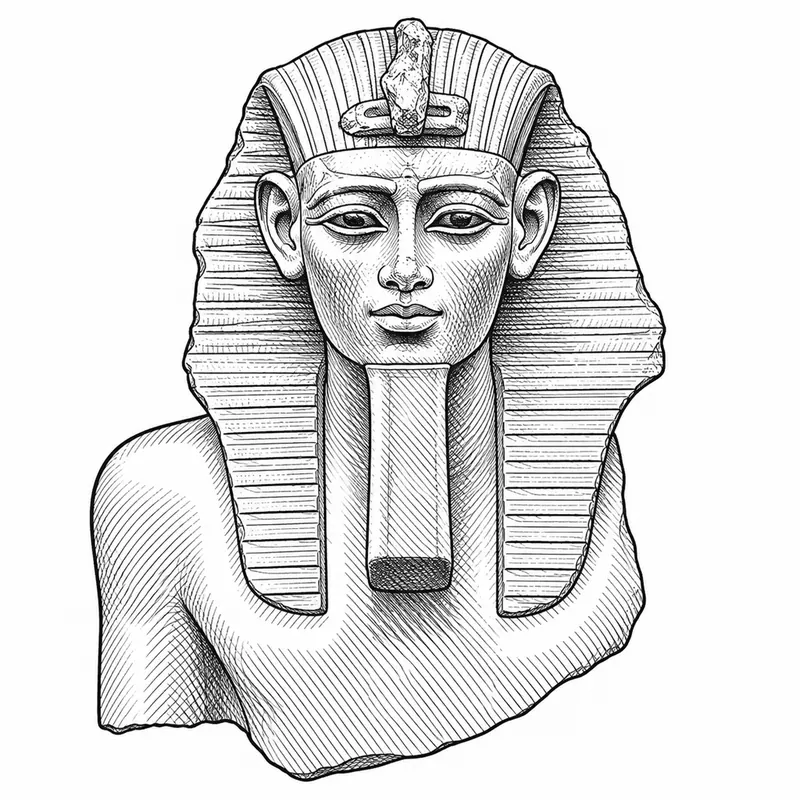
A long reign from Sais
Psamtek I, or Psammetichus I, bore the throne name Wahibre. He reigned from 664 to 610 BC according to UCL Digital Egypt. His career began in a Delta where Assyria and several local powers sought to weigh on the succession of the Kushite 25th Dynasty. He gradually became the ruler of a reunified Egypt, inaugurating the 26th Dynasty. The history of this rise must be read on several scales: Sais and the Delta, Thebes and the sanctuary of Amun (in French), the relations with Assyria and the mercenaries from the Mediterranean. The length of the reign allowed a policy of consolidation that the short-lived kings before him had not had time to pursue.
From governor to independent king
UCL presents Psamtek as first a governor at Sais in a framework linked to Assyrian rule. As the Assyrian empire withdrew or disengaged, he eliminated the other local rulers of the Delta and extended his authority. This process does not correspond to a single proclamation of independence for the whole country. The royal names appear in different regions at times that need to be dated. Military alliances and relations with the Delta towns count as much as the campaigns. Psamtek turned a regional position into a recognised monarchy, relying on ancient Egyptian institutions. His reign marks the passage from a mosaic of powers to a more stable Saite state.
Thebes and the Divine Adoratrice
The recognition of Psamtek at Thebes came in particular through the institution of the Divine Adoratrice of Amun. His daughter Nitocris was adopted into this office, according to a procedure documented by an important stela. This act linked the Saite family to the great sanctuary of the south without suppressing the local elites. The adoption created a visible religious and political continuity, able to outlast a reign. The Divine Adoratrice must be understood as an office endowed with personnel and resources, not as a mere honorific title. The Theban documents show how the monarchy of the Delta integrated a city whose Kushite and priestly past remained powerful. Reunification was also achieved through cult institutions.
Soldiers and Mediterranean contacts
Greek and archaeological sources refer to the employment of soldiers from the Aegean world and Anatolia under the Saite kings. Psamtek I is often associated with this military opening. The later accounts must be compared with the Egyptian inscriptions and the discoveries in the field, since they sometimes amplify the role of the mercenaries. Their presence nevertheless shows that the Saite state used Mediterranean networks to strengthen its army and its trade. Garrisons, routes and ports complemented the domestic policy of reunification. The Egypt of Psamtek was not isolated in a nostalgic return to the past; it took part in the transformations of the 7th century BC while keeping its pharaonic forms.
Sais, Memphis and the art of renewal
The capital of the 26th Dynasty was Sais, whose monuments have been very largely destroyed or reused. UCL stresses that this loss makes the period less visible than its real activity. Memphis, Heliopolis and Thebes preserve other evidence of the Saite artistic renaissance. The workshops drew on models from the Old and Middle Kingdom, but their works answered contemporary needs. Speaking of ‘archaism’ should not mean an absence of invention. The statues, stelae and elite tombs show choices of style intended to inscribe the new dynasty in a long national history. This visual policy accompanied the consolidation of power.
A more secure chronology
From the 26th Dynasty onwards, the absolute dates of Egyptian history become much more secure thanks to synchronisms with the Near East and the Greek world. The reign of Psamtek I is thus a major landmark. This better dating does not mean that all internal events are known year by year. The texts of Herodotus (in French), written later, provide much information and many stories that need checking. Contemporary inscriptions remain the priority for the king’s decisions. The history of Psamtek illustrates the value of cross-checking written traditions in different languages with the geography of the monuments. It allows the formation of the Saite state to be clarified without taking every ancient anecdote as fact.
The founder of a new stability
The reign of Psamtek I lastingly transformed the political balance of Egypt. Starting from Sais, he built authority over the Delta, obtained Theban recognition through the institution of Amun and opened the state to Mediterranean actors. The following decades would show the strength of this dynasty. This ‘renaissance’ was not a simple return to past greatness: the Saite monarchy invented a way of governing its own time, with its exchanges and its artistic choices. The archaeological gaps at Sais explain some areas of shadow; the stelae, tombs and external synchronisms illuminate others with remarkable precision.
Main sources
- UCL Digital Egypt, kings of the Late Period
- UCL Digital Egypt, guide to the Late Period and Psamtek I
- UCL Digital Egypt, the God’s Wife of Amun
- Model for the line portrait: Saite royal bust dated to the reign of Psamtek I, Metropolitan Museum of Art, X.358.
Reference works
- Ian Shaw (ed.), The Oxford History of Ancient Egypt, Oxford, Oxford University Press, 2000, chronology pp. 479–483
- Aidan Dodson and Dyan Hilton, The Complete Royal Families of Ancient Egypt, London, Thames & Hudson, 2004