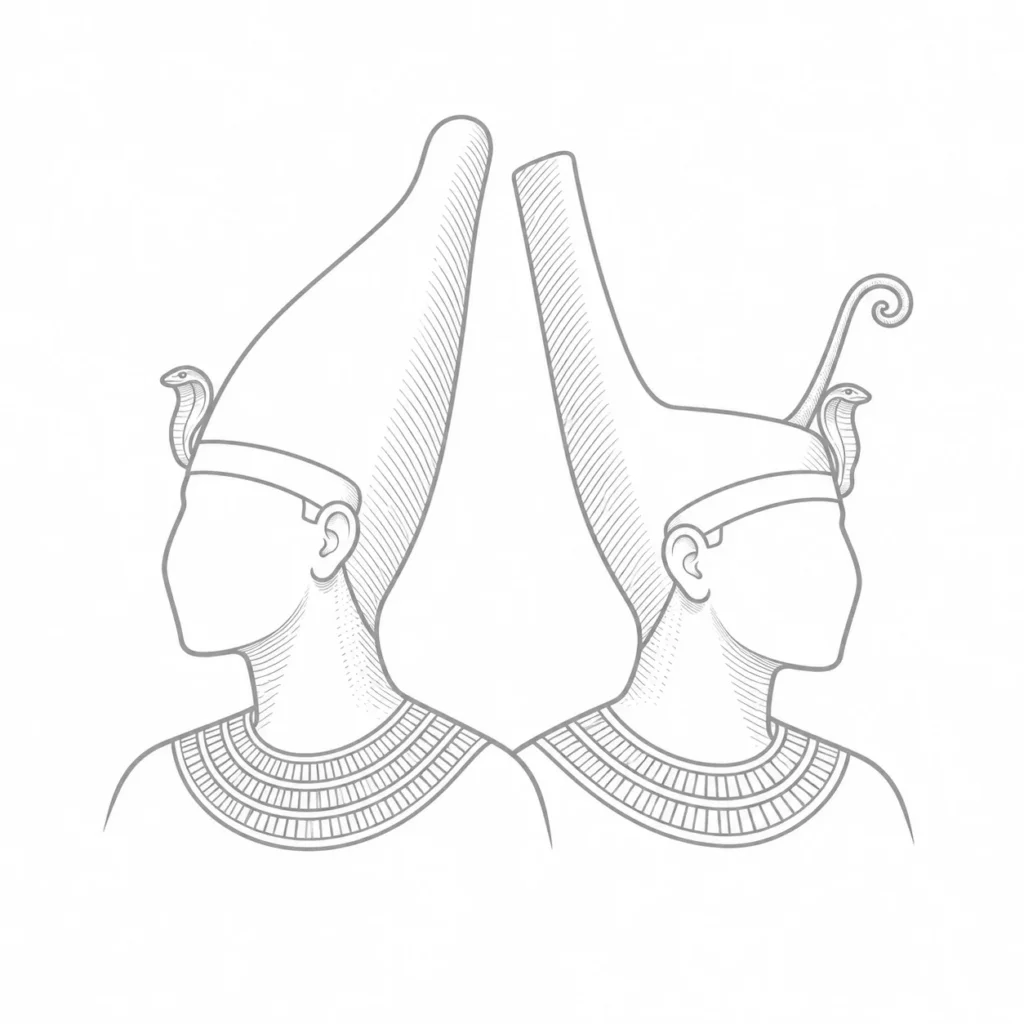
A Saite king turned towards the routes
Necho II, Wehemibre, succeeded Psamtek I and reigned from 610 to 595 BC. He belongs to the 26th Dynasty, at a time when the balance of the Near East was changing with the end of Assyrian power and the rise of Babylon. His name is associated with campaigns in Asia, with a project for a canal between the Nile and the Red Sea and with a sea expedition recounted by Herodotus (in French). These records do not all rest on evidence of the same kind. The Egyptian monuments attest the king and certain building works; the Greek and Near Eastern accounts describe external events from their own perspectives. Comparing them sheds light on the strategic ambition of his reign.
Policy in the Levant
After the death of Psamtek I, Necho intervened in the conflicts of the Levant. Egypt sought to preserve or extend its influence in the face of the new Mesopotamian powers. Babylonian and biblical sources, as well as Greek accounts, provide different versions of the campaigns and battles. Events attested by several traditions must be distinguished from the religious or political interpretations proper to each. The king had an army able to operate far from the valley, but his successes were not permanent. The defeat by Babylon changed the regional balance. It is a reminder that the 26th Dynasty, despite its internal stability, operated in a world of imperial competition.
The canal project
Herodotus attributes to Necho the beginning of a canal linking the Nile to the Red Sea. UCL states that the undertaking was completed under Darius I, much later. The archaeological traces and the inscriptions of Darius help to assess the history of the waterway, but the exact route and the phases of the work remain debated. A canal would have eased exchanges between the valley, the Red Sea and the routes to the East. It required a considerable capacity for earthmoving, water management and mobilisation of labour. Presenting Necho as the author of a fully navigable canal in his lifetime would go beyond the evidence. His role is that of a plausible initiator of a strategic project continued by others.
The voyage around Africa
Herodotus relates that Necho sent Phoenician sailors to sail around Africa. The account contains details that have aroused historians’ interest, but no contemporary Egyptian archive allows the voyage to be followed stage by stage. It must therefore be presented as a debated ancient tradition, not as a definitively proven exploration. Its interest is twofold: it shows the image of a king curious about sea routes in Greek memory, and it fits with a reign turned towards lines of communication. The distance between a possible event and the surviving text must remain clear. It avoids turning a fascinating story into a certainty without a direct source.
Sais and the monuments of the reign
UCL mentions additions to the temple of Neith (in French) at Sais, blocks found at Terenuthis and a stela from Elephantine (in French). These attestations show that Necho continued cult activities in several regions. Sais has been heavily destroyed, so the original scale of its buildings is difficult to measure. The objects in the Petrie Museum and the shabti of his wife Khedebneithirbinet complete the family record. The monuments do not tell of the policy in the Levant, but they bear witness to the court’s ability to maintain the great sanctuaries during the campaigns. Their study provides an Egyptian counterpoint to the Greek and Mesopotamian accounts.
The family and the succession
Necho was the father of Psamtek II. The objects of the royal family, including the shabti of Khedebneithirbinet, help to follow dynastic continuity. The transmission of the throne after fifteen years of rule shows a stability that contrasts with the transitions of the Third Intermediate Period. The sources do not, however, provide an intimate history of the family. Titles and burials tell us about official positions, not about all personal relationships. The king’s history must keep this distinction. It allows us to understand how the court of Sais combined a secure succession with risky external military commitments and infrastructure projects, some of which would only be completed under other dynasties.
An ambition to be measured by the evidence
The reign of Necho II touches three spaces: the Nile Valley, the Levant and the Red Sea. The campaigns show Egyptian involvement in the reshaping of the Near East; the canal reveals an ambition for circulation; the sea voyage belongs to an ancient tradition still to be verified. The monuments of Sais and Elephantine recall the pharaonic anchoring of this policy. Each source has its own value. A contemporary inscription, a foreign chronicle and Herodotus do not prove the same things. Comparing them, we see a ruler active in his century without crediting him with all the feats that posterity has attributed to him.
Main sources
- UCL Digital Egypt, Necho II and his monuments
- UCL Digital Egypt, the Late Period
- UCL Digital Egypt, kings of the 26th Dynasty
- Crowns drawn from the statue of Senusret I and the relief of Ahmose, Metropolitan Museum of Art.
Reference works
- Ian Shaw (ed.), The Oxford History of Ancient Egypt, Oxford, Oxford University Press, 2000, chronology pp. 479–483
- Aidan Dodson and Dyan Hilton, The Complete Royal Families of Ancient Egypt, London, Thames & Hudson, 2004