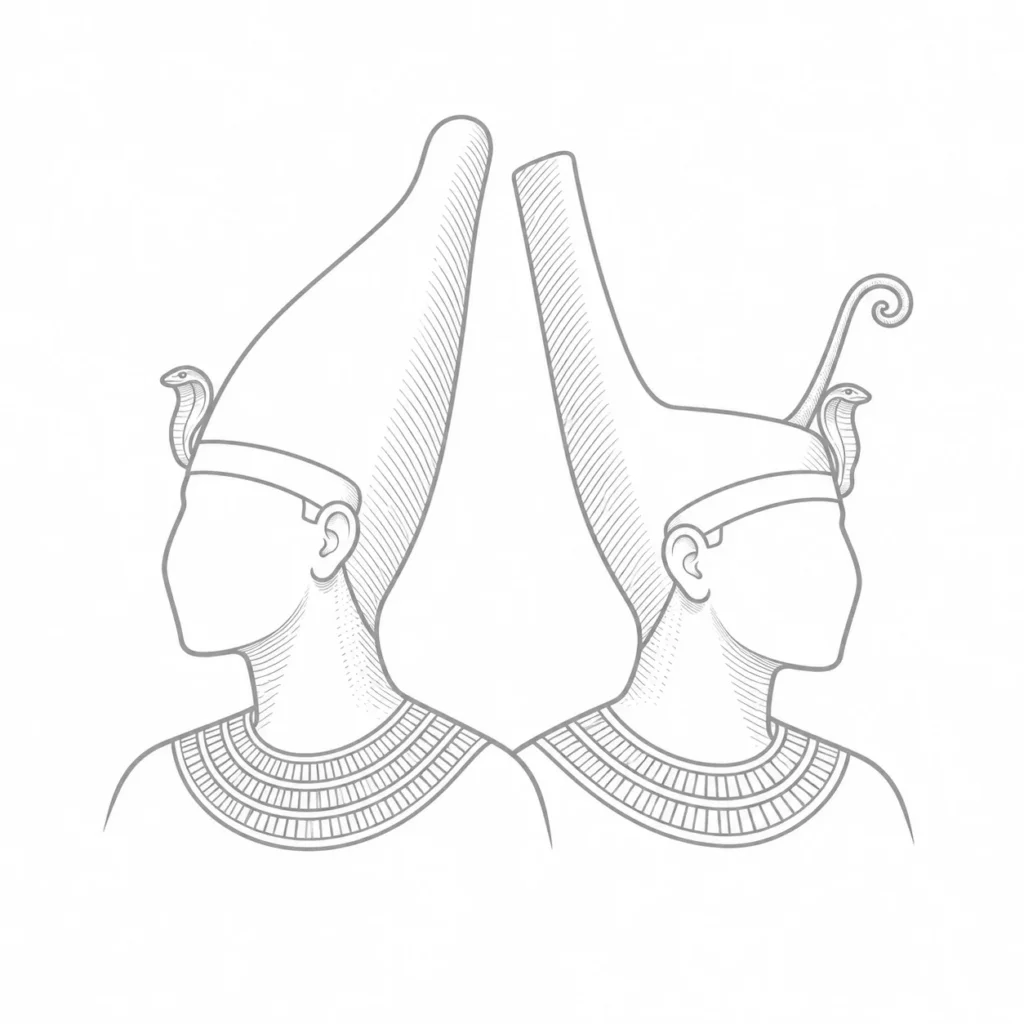
A short reign of the 30th Dynasty
Teos, Djedhor in Egyptian and Irmaatenre as throne name, succeeded Nectanebo I. UCL Digital Egypt places his reign from 362 to 360 BC. Only two years separate his accession from the coming to power of Nectanebo II, which limits the surviving monuments and gives great weight to the Greek accounts of his policy. The kingdom remained independent of the Persian empire, but confronting it required alliances and financial means. Teos prepared a campaign towards the Levant and took measures to fund it. The precise circumstances of his fall must be read with caution, since the classical authors handed down versions that favour military leaders and court intrigue.
The founder’s legacy
Nectanebo I had launched vast building projects in the sanctuaries of the Delta and the valley. Teos inherited a state apparatus able to mobilise resources and a recently established dynasty. His short reign does not allow a building policy comparable to his father’s to be measured. It would therefore be misleading simply to contrast the ‘builder’ with the ‘warrior’. A foreign campaign could itself aim to protect the conditions of Egyptian independence and the wealth needed for the temples. The monuments bearing his name, such as a fragment of a faience cup found at Memphis, show the normal use of his titulary. They do not directly tell of the funding decisions or of relations with the cults.
The project against Persia
The classical sources describe an Egyptian expedition towards the Levant, carried out with the help of Greek commanders and soldiers. The aim was to carry the war outside Egypt and to challenge Achaemenid control of the region. The details of troop numbers and routes vary between accounts. The strategic project, plausible and attested by several traditions, must be distinguished from each scene of council or betrayal reported later. The presence of Greek allies reflects the diplomacy of the 4th century BC: the cities and military leaders sought funding, while Egypt sought additional skills and forces. This cooperation also had its political risks.
The cost of the campaign
Financing an army far from the valley required levies, stocks and payments. Traditions attribute to Teos fiscal measures that are said to have angered the temples and part of the population. Their exact content and scope remain difficult to verify without direct Egyptian archives. A single supposed tax should not be made the automatic cause of his fall. The record nevertheless shows a structural tension: defending independence against Persia required money, while the sanctuaries held resources and a power of legitimation. The story of Teos allows this question to be put concretely. A court could win a campaign abroad while losing the support it needed at home.
Nectanebo II takes power
During the campaign or in its aftermath, Nectanebo II was proclaimed king in Egypt. The family ties and the roles of the military leaders have been reconstructed from varied sources. The event shows that the dynasty was not safe from rivalries despite its massive religious building. Teos lost the throne and, according to the ancient accounts, sought refuge abroad. The destination and the exact circumstances are not certain in every detail. The political outcome, the victory of Nectanebo II, must be separated from the moral explanations that later authors gave for the failure of Teos. The cartouches of the two rulers mark a real transition, even if the personal history of the deposed king remains obscure.
Rare but useful monuments
UCL mentions a fragment of a faience cup bearing the name of Teos and found at Memphis. The scarcity of remains is not surprising for a two-year reign, but it does not mean that the government was without cult activity. Objects may have disappeared, been reused or bear poorly preserved names. The tomb of Teos has not been identified with certainty; Sebennytos has been suggested. These material limits explain the dependence on Greek accounts for the campaign and the fall. The hierarchy of evidence is thus established: the objects attest the kingship, the accounts relate events to be evaluated, and the absence of a tomb leaves the end of his life open.
An experience of fragile independence
The short reign of Teos reveals the tensions between external ambition, funding and internal legitimacy. The campaign against Persia cannot be judged solely by its final political failure: it belongs to a strategy of defending an independent state. The seizure of power by Nectanebo II nevertheless shows that the dynastic and military coalition was unstable. The Egyptian sources are modest, but they guarantee the king and his titulary; the Greek authors provide a livelier history, to be criticised. By distinguishing these levels, the account becomes an examination of the concrete conditions in which the 30th Dynasty attempted to preserve its sovereignty.
Main sources
- UCL Digital Egypt, Teos and his attestations
- UCL Digital Egypt, kings of the 30th Dynasty
- UCL Digital Egypt, Nectanebo I and the dynastic context
- Crowns drawn from the statue of Senusret I and the relief of Ahmose, Metropolitan Museum of Art.
Reference works
- Ian Shaw (ed.), The Oxford History of Ancient Egypt, Oxford, Oxford University Press, 2000, chronology pp. 479–483
- Aidan Dodson and Dyan Hilton, The Complete Royal Families of Ancient Egypt, London, Thames & Hudson, 2004