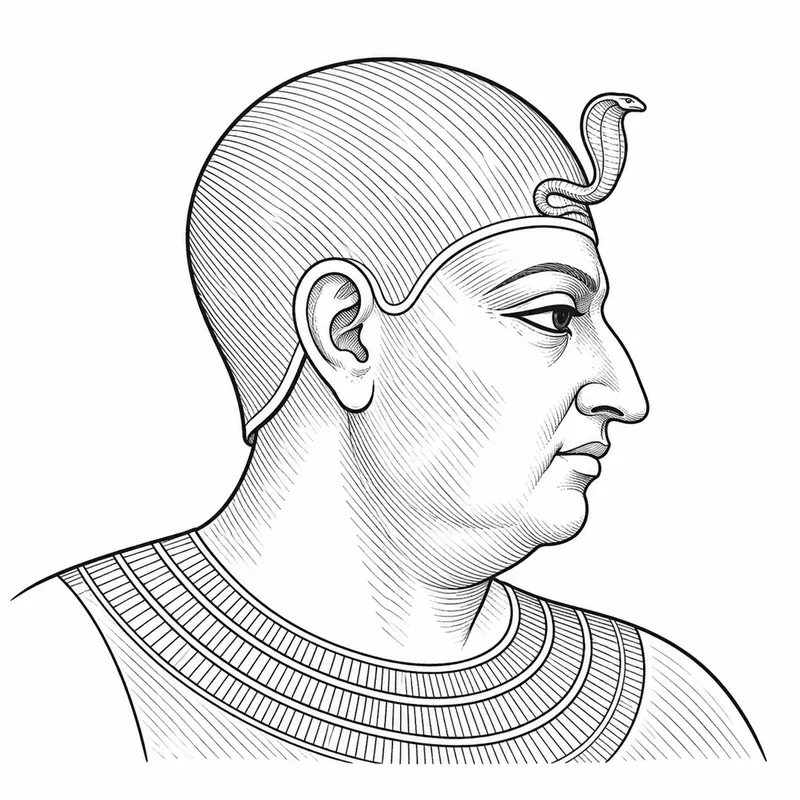
The founder of the 30th Dynasty
Nectanebo I, Nakhtnebef in Egyptian and Kheperkare as throne name, reigned from 380 to 363 BC. He founded the 30th Dynasty, the last great independent line before the Persian reconquest. UCL Digital Egypt stresses the exceptional scale of his building programme: remains bearing his name are known in many sanctuaries of the Delta, the valley and the oases. The reign unfolded in a context of Achaemenid threat that required defences and alliances. Yet the monuments show that the court did not devote all its resources to war. It also sought to inscribe the new dynasty in the local cults and in the long pharaonic tradition.
The Delta, political heart of the dynasty
Works are attested at Sais, Mendes, Tanis, Qantir, Saft el-Hinna, Letopolis and other centres of the Delta. This concentration reflects the economic and political weight of the region. Many buildings have disappeared or their blocks have been moved, which makes the reconstruction of each temple difficult. The surviving naoi, reliefs and inscriptions nevertheless show a significant mobilisation of workshops and materials. Nectanebo I did not content himself with a single monument to proclaim his name. He sought relays in several local cults. Each intervention linked kingship to the personnel of the sanctuary and the surrounding communities, while strengthening the visibility of the new dynasty.
Philae and the cults of the south
Nectanebo I enlarged the sanctuary of Isis (in French) at Philae and left inscriptions on Elephantine (in French). He also worked at El-Kab, at Abydos and in the temples of Thebes. These works show a policy of presence along the whole valley, beyond the Delta centre. At Philae, his buildings belong to the first stages of a sanctuary that would become much larger in the Ptolemaic and Roman periods. Each building must be dated so as not to attribute later enlargements to the king. The monuments of the south show the lasting role of the cults of Isis, Osiris (in French) and Amun (in French) in the legitimation of an independent ruler. They also offered administrative anchors in the provinces.
The desert and the oases
The temple of Hibis in the oasis of Kharga was enlarged under Nectanebo I. This region was important for the desert routes and for the communities that lived there. A royal investment in an oasis shows that the building policy was not confined to the great centres of the Nile. The inscriptions and reliefs of these places had a cult function, but also a territorial one: they asserted the king’s presence on lines of communication. Stone expeditions and transport required an organisation able to link the building sites of the Delta, the valley and the desert. The building programme thus reveals a mobilising state, whose extent can be read better through its sites than through a single capital.
Architecture as policy
Why build so much at a time of external threat? Temples ensured relations with the gods, but they also made it possible to stabilise local elites and to make the continuity of kingship visible. The name of Nectanebo I on a naos or a foundation deposit linked an ancient place to the new dynasty. Artistic forms were often inspired by earlier periods, a choice that asserted the rootedness of power. The scale of the works does not prove the absence of fiscal or military pressure; it shows the priorities displayed by the court. Each project must be studied in its context, since restoration, enlargement and new construction do not involve the same means.
A succession and an unknown tomb
The tomb of Nectanebo I has not been identified with certainty. His son Teos succeeded him, then the dynasty went through a crisis that would bring Nectanebo II to the throne. The founder’s vast programme did not therefore prevent rapid political tensions. It is tempting to explain this succession by the costs of the building works or of war, but the documents do not allow such a simple causality. The monuments show resources mobilised, not the financial balance sheet of the state. Their distribution nevertheless remains evidence of the initial strength of the 30th Dynasty. The continuity of the sanctuaries after the king’s death is a reminder that his building work outlasted the dynastic arrangements.
A last great pharaonic programme
The building works of Nectanebo I cover an exceptional area: the Delta, Memphis, Thebes, Philae, Dendera and Kharga. They show that a dynasty of the 4th century BC could still build on a large scale. Decorative fragments, surviving buildings and uncertain attributions do not have the same degree of certainty. The reign also sheds light on a policy of independence: temples were not only works of art, but networks of religious and regional recognition. This approach does justice to the vigour of the Late Period, often hidden behind the fame of empires and older monuments.
Main sources
- UCL Digital Egypt, Nectanebo I and his many building projects
- UCL Digital Egypt, period of the last independent dynasties
- UCL Digital Egypt, chronology of the 30th Dynasty
- Model for the line portrait: inscribed royal relief of Nectanebo I, British Museum, EA22.
- Reference photograph: Djehouty, CC BY-SA 4.0.
Reference works
- Ian Shaw (ed.), The Oxford History of Ancient Egypt, Oxford, Oxford University Press, 2000, chronology pp. 479–483
- Aidan Dodson and Dyan Hilton, The Complete Royal Families of Ancient Egypt, London, Thames & Hudson, 2004