In brief
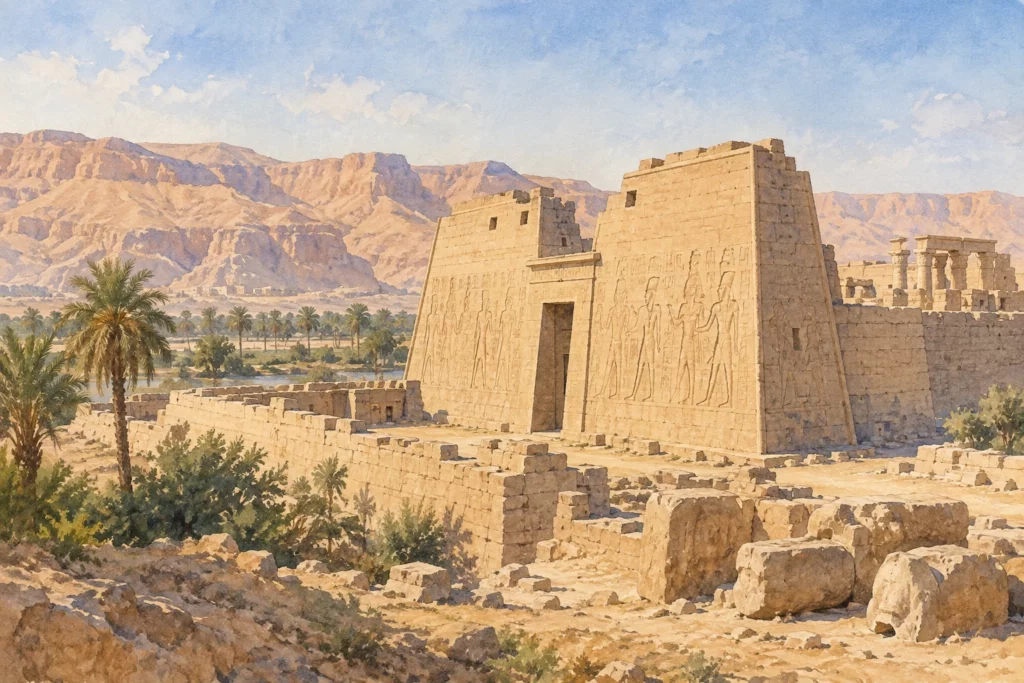
Medinet Habu is the mortuary temple of Ramses III (Ramesses III), a king of the 20th Dynasty who reigned c. 1184–1153 BC,, on the west bank at Thebes. The Egyptian Ministry of Tourism and Antiquities describes it as a temple devoted to the funerary rites of the king and to the cult of Amun, largely inspired by the Ramesseum. The complex goes beyond the temple alone: it also comprises remains of a royal palace, storerooms, administrative buildings and royal stables.
What you discover
Access is through the high gateway, flanked by two terraced towers, on the east side. It opens onto a mudbrick enclosure, punctuated by two guardrooms. A canal linked to the Nile, preceded by a quay, made it possible to arrive by boat. The temple proper follows a clear progression: First Pylon, first court, Second Pylon, second court, three hypostyle halls, chapels, then the holy of holies. Some columns are cylindrical, with papyrus capitals; others show Ramses III in the form of Osiris, an image of the dead king assimilated to the god of the dead. The plan thus combines three functions: the cult of the king and of Amun, the royal residence and the management of property, suggested by the palace, storerooms, administrative buildings and stables. The passage from open courts to columned halls, then to the chapels and the holy of holies, gradually narrows the space and increases its sanctity.
What to look at
The reliefs deserve the closest attention. The walls show campaigns against the Libyans and battles against the Sea Peoples, but also scenes of hunting, expeditions and the adoration of the gods. One detail is often overlooked: a calendar of festivals is carved on the outer wall of the temple. The Epigraphic Survey of the Oriental Institute of Chicago published it in 1934, in volume III of the Medinet Habu series, with the so-called ‘Slaughterhouse’ texts and other minor inscriptions of Ramses III. These texts are a reminder that the temple was a place of daily cult, provided with festivals, offerings and staff, not a mere commemorative monument.
Its history
The site was sacred before Ramses III. Hatshepsut and Thutmose III had built a temple there on the foundations of a 12th Dynasty building, itself built over the tombs of the ancestors of Amun, according to the Egyptian ministry. The great temple of Ramses III was therefore added to an older place of worship, and the two phases should not be confused.
The military scenes do not form a documentary report: they belong to a royal programme in which the king triumphs over Egypt’s enemies before the gods. Their historical interpretation therefore remains cautious, especially for the Sea Peoples. The tomb of Ramses III in the Valley of the Kings is another monument, distinct from the temple.
Sources
Consulted on 30 September 2026: Temple of Medinet Habu, Egyptian Ministry of Tourism and Antiquities; Medinet Habu, Volume III, Institute for the Study of Ancient Cultures, University of Chicago.