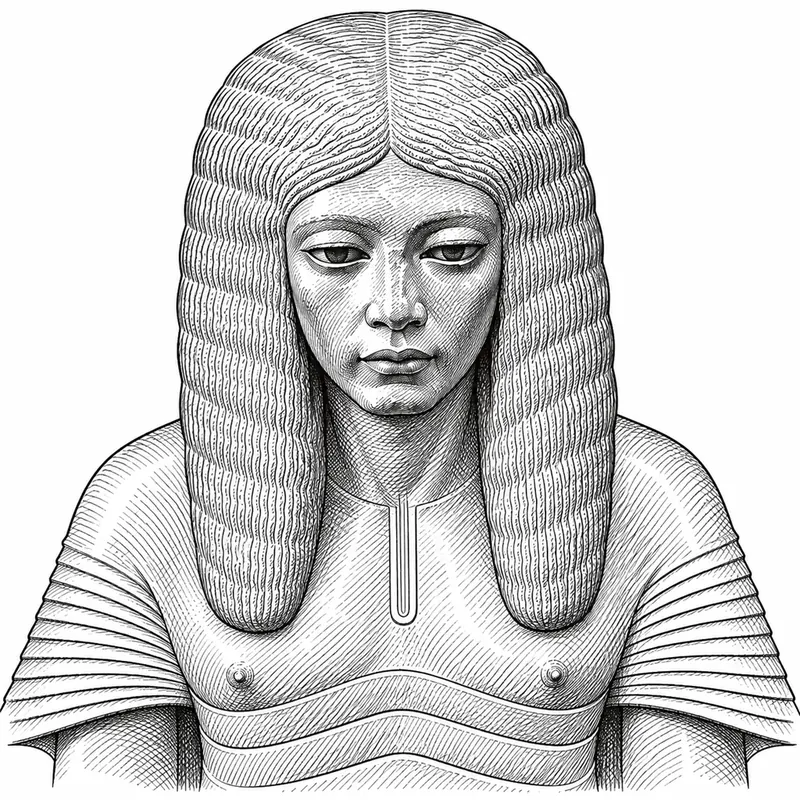
From military command to the throne
Horemheb is attested as a military commander under Tutankhamun. After the short reign of Ay, he became the last king of the 18th Dynasty. UCL Digital Egypt places his rule approximately between 1319 and 1292 BC, while stressing that its exact length is debated. His rise shows that a high court office could open the way to kingship at a time when dynastic succession was fragile. Horemheb presented himself as the restorer of order after the changes of Amarna. This official image must be compared with the facts: he took up some programmes already begun under Tutankhamun and altered the name on several monuments. His reign was therefore also a work of political memory.
The decree and the abuses denounced
A royal decree of Horemheb, known from fragments of which one is kept in the Petrie Museum, lists abuses and announces measures to correct them. It refers to the discipline of officials, exactions and the protection of subjects against certain extortions. This document is a major source for the history of Egyptian law and administration. We should not assume that every measure announced was applied everywhere in the same way. The decree shows first the problems that the court considered worth naming and the solution it wished to make known. Reading it sheds light on how a king legitimised his power through the promise of restored justice.
Karnak and the Aten blocks
At Karnak, Horemheb built using blocks from dismantled temples of the Aten. Archaeologists sometimes find elements of Amarna decoration hidden inside these constructions. This reuse provides material proof of the transformation of the religious landscape. It also had a practical logic: stones already cut could supply new building projects. The fact that the blocks were reused is not enough to know all the king’s motives, but their location shows a building policy set within the sanctuary of Amun (in French). The study of the talatat allows the vanished buildings to be partly reconstructed and shows how one memory was covered by another.
The monuments taken over from his predecessors
Horemheb appropriated several monuments linked to Tutankhamun and the mortuary temple begun by Ay. The reinscribed names could create the impression of an entirely new work, whereas the architecture sometimes belonged to an earlier phase. Egyptologists therefore look for traces of alteration in the sculpture, the epigraphy and the plan of the buildings. The practice reveals a wish to link Horemheb directly with the religious restoration, reducing the visibility of the rulers who had acted before him. It complicates historical reading: a decree or a statue may have several moments of manufacture and alteration. This history of the stone is also a history of legitimacy.
Tomb KV57
Horemheb was buried in tomb KV57 in the Valley of the Kings. Its funerary decoration and religious programme belong to the development of the royal burials of the New Kingdom. The tomb offers a more clearly defined space than the reused monuments of Karnak: it bears witness to a project explicitly linked to the ruler. It has nevertheless suffered the effects of time, plundering and excavation. Comparing KV57 with the tombs of Tutankhamun and Ay sheds light on the choices of a period of transition. The king wished to display complete legitimacy, from public decrees to the rites of the afterlife. The images in the tomb do not provide a biography, but they complete his political portrait.
The end of the 18th Dynasty
Horemheb seems to have left no direct heir to continue his line. Ramses I then opened the 19th Dynasty. Historians must avoid projecting a total break onto this succession: soldiers, sanctuaries and administrations passed through the change of dynastic name. On the other hand, the way reigns were counted and official ancestors selected was modified. Akhenaten, Tutankhamun and Ay could be omitted from lists designed to pass power from the old dynasty to Horemheb and then to the Ramessides. This choice explains some apparent gaps in the ancient chronologies. The contemporary monuments make it possible to restore the rulers that official memory had set aside.
A reign of reconstruction and selection
The reign of Horemheb combines administrative action, architecture, the restoration of the cults and the rewriting of recent history. The decree gives access to the rhetoric of justice; the Karnak blocks show the material transformation of an official religion; the appropriated monuments reveal the mechanisms of royal memory. A distinction must be maintained between his attested decisions and the image of absolute founder that he sometimes wished to convey. His role was considerable, but it belongs to a development begun under Tutankhamun. Following this continuity makes the transition to the 19th Dynasty more intelligible and allows the strength of institutions beyond individuals to be appreciated.
Main sources
- UCL Digital Egypt, Horemheb and his monuments
- UCL Digital Egypt, Tutankhamun and the restoration
- UCL Digital Egypt, Ay and the takeover of the mortuary temple
- Model for the line portrait: statue of Horemheb as a scribe, Metropolitan Museum of Art, 23.10.1.
Reference works
- Ian Shaw (ed.), The Oxford History of Ancient Egypt, Oxford, Oxford University Press, 2000, chronology pp. 479–483
- Aidan Dodson and Dyan Hilton, The Complete Royal Families of Ancient Egypt, London, Thames & Hudson, 2004